Thursday, May 24, 2007

BALL OF FIRE (Samuel Goldwyn 1941) MGM Home Video

Memorably penned by writer, Billy Wilder, and nominated for 4 Oscars, Howard Hawks’ Ball of Fire (1941) is often interpreted as a swing band revamp of Snow White & The Seven Dwarfs. The film – actually a scathing screwball comedy of errors - stars every man Gary Cooper doing his sort of clueless Mr. Deeds-like congenial fop that was Coop’s stock and trade during this part of his Hollywood tenure. Here, Cooper is university professor, Bertram Potts who is in the ninth year of a twelve year encyclopedia writing project.

Potts specialty is language and grammar. Imagine his dismay then, when he discovers that his section on American slang is hopelessly out of date. To rectify the situation, Potts decides to immerse himself in the vernacular of every day jive, landing in one of New York’s hot spot nightclubs where the star attraction is the sultry Sugarpuss O’Shea (Barbara Stanwyck).

Sparks fly as Potts, in an attempt to get to know his craft more carefully, clumsily becomes entangled in a gangster subplot after he learns that Sugarpuss is engaged to crime kingpin, Joe Lilac (Dana Andrews). Warned by Joe’s associate, Duke Pastrami (Dan Duryea) to lay low until the heat is off; Sugarpuss instead decides to hide out at the university where she is gradually befriended by the ensemble faculty. The plot thickens as Potts begins to fall for his covert guest and her for him – resulting in a marriage proposal and memorable gun-shooting showdown between the academics and the mob.

Wilder’s writing is slick and stylish – a warm and fuzzy cornucopia of witty sparking dialogue and sight gags that have remained fresh since their time. Apart from her performance in The Lady Eve (1941) Stanwyck has never been quite so devilishly winsome or adroitly playful. She’s an ideal romantic foil to the clean cut, simple Potts whose initial interest in her is purely scholastic. In the end, Ball of Fire is just that – the low down on a hot story that continues to burn up the celluloid with laughs, laughs and laughs.

Unfortunately, there’s not much to chuckle over in MGM’s rather lackluster DVD incarnation. MGM has long since inherited the Samuel Goldwyn library of classic films from HBO Home Video. Yet only a handful have made the transition to DVD via the MGM label – a travesty that has robbed viewers of virtually all of Danny Kaye’s classic performances for Goldwyn, including Hans Christian Andersen (1952).

The B&W image on this outing is quite soft. Though the gray scale can be nicely represented, often contrast levels appear to have been bumped, with a considerable loss of fine details in the brighter register. Contrast is generally weak. However, the most disappointing aspect of the transfer is its digital anomalies, including shimmering of fine details and edge enhancement. The audio has been rechanneled to stereo. The original mono is also included. There are NO extras.

Honestly, since DVD is no longer in its infancy (and with other studios making quantum leaps and strides to do their best where their classic film libraries are concerned) MGM Home Entertainment has fallen hopeless behind the times in their commitment to quality product. What is required from this studio, other than another corporate acquisition (they are currently part of the Fox Home Video distribution apparatus), is a solid dedication to improving their output on the whole. This DVD is therefore recommended for its content – not its transfer.

FILM RATING (out of 5 - 5 being the best)
4

VIDEO/AUDIO
2.5

EXTRAS
0

CAN-CAN (2oth Century-Fox 1960) Fox Home Video

Not surprisingly, the best thing about Can-Can: the movie is can-can, the dance; a flashy, fleshy and erotic display of France’s enduring contribution to the art of terpsichorean self-expression. With its pre-sold Broadway pedigree, a sparkling Cole Porter score, and, roster of formidable Hollywood headliners (including Frank Sinatra, Maurice Chevalier and Shirley MacLaine), director Walter Lang’s Can-Can (1960) had everything going for it except that elusive spark of musical magic. Alas, it proved to be everything. The resulting film is stagy, static and stultifying, with a convoluted narrative reworked to fit in Chevalier and Louis Jourdan – fresh from their significant contributions in MGM’s Gigi (1958).

The film miscasts Sinatra as loveable Damon Runyon-esque reprobate, François Durnais; an attorney whose patronage to a Bohemian café in Monmatre leads to a flirtation with dancer, Simone Pistache (MacLaine). Durnais has invited his boulevardier buddy and esteemed judge, Paul Barriere (Chevalier) to enjoy the sultry pleasures of the can-can; a notorious dance that has been banned as lewd and lascivious under Parisian law. Unfortunately for all, someone has tipped off the police and a raid is conducted on the establishment. Barriere and Durnais escape with their reputations in tact, but the question of self-expression in the can-can is left to the prudishly watchful eyes of underling magistrate, Philipe Forrestier (Louis Jourdan).

The rest of this lengthy leaden excursion is basically a comedy of errors with Forrestier attempting to entrap the rather simple Pistache into having her nightclub dancers perform the dance and thus, go to jail for breaking the law…and perform it they most certainly do. Dancer extraordinaire, Juliet Prowse is supple, sumptuous and sublime, leading a pack of amiable chorines on to victory over middle class morality with their high-stepping kicks and squeals. Cole Porter’s score – arguably one of his finest – does not fare quite so well.

Sinatra warbles C’est Manifique as though it were a Brooklyn nightclub outtake from Guys and Dolls. Chevalier’s usual ‘talk through’ of a song is an ill fit for It Was Just One of Those Things (best performed by Lena Horne in Panama Hattie (1942). Shirley MacLaine makes mush of the Apache Dance in which she spends a goodly portion of the exercise being tossed about like a rag doll. The film’s other ‘big’ production number, The Garden Of Eden is a garish, gaudy nightmare in which the elements of seduction are overpowered by glitz rather than high gloss. In the end, Can-Can is a film with much ambition but precious little heart.

Fox Home Video’s 2 disc DVD begins with a disclaimer that the film has been restored from the best possible surviving elements. It’s a curious credit, since the film, on the whole looks remarkably pristine and quite vibrant throughout. The DeLuxe color in expansive Todd A-O photography is eye popping. Occasionally, a bit of light bleeding leads to a slight shimmer in color, but this is a minor quibbling.

Much improved over anything the film has looked like for home video in the past, contrast levels are nicely realized. Blacks are deep and solid. Whites are generally clean. The audio is a 5.0 remastering of the original six track stereo – delivering a potent kick and work out to the speakers. Occasionally, dialogue sounds slightly strident. For added benefit, an isolated orchestral score has also been included. On disc two we get 3 featurettes; (1) on the making of the film; (2) Cole Porter’s contribution; (3) Abe Burrow’s writing credits. There’s also a restoration comparison, theatrical trailer and stills gallery to consider.

FILM RATING (out of 5 - 5 being the best)
2.5

VIDEO/AUDIO
3.5

EXTRAS
3.5

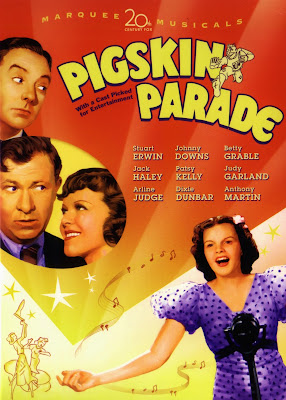
PIGSKIN PARADE (20th Century-Fox 1936) Fox Home Video

David Butler’s Pigskin Parade (1936) is a passable little nothing of ensemble musical comedy that effortlessly passes the time with good cheer and endearing charm. The film stars now forgotten character actor, Stuart Erwin as Amos Dodd – a hillbilly ‘discovery’ by married football coaches, Bessie (Patsy Kelly) and Winston ‘Slug’ Winters (Jack Haley).


Seems Amos knows how to toss around the ol’ watermelon on his farm and that directly translates into a killer forward pass for the fledgling Texas team all set to face off against Yale in the Yale Bowl. Showcasing a veritable who’s who of Fox up and comers and never-would-be’s, including Bette Grable (Laura Watson), Dixie Dunbar (Ginger Jones) and Elisha Cook Jr. (Herbert Terwilliger Van Dyck), today, the film’s focus on Amos’ younger sister, Sairy (Judy Garland) seems far more obvious than it actually was at the time of the film's release.


Garland was a Vaudeville veteran under contract to MGM at the time she was loaned out to Fox for Pigskin Parade. In their shortsightedness, MGM had miscast Garland in several low budget short subjects but had hesitated spending the money to showcase her in a feature film. Instead, they exploited Pigskin Parade as a testing ground for audience interest in Garland's talents. The response was overwhelming. Garland’s renditions of the Texas Tornado and It’s Love I’m After had to be re-shot because they drew spontaneous applause from the cast and crew on the set.


If you’re a fan of musical comedies of this vintage then you already know how this one ends – with merriment, song and laughter; in short – a pretty good way to spend a Sunday evening at home or cozy up with nostalgia on a rainy or snowy day.


Fox Home Video’s DVD is fairly impressive. The B&W image is sharp, solid and nicely contrasted with a fairly solid spectrum of tonality. Occasionally, the image can appear slightly softly focused and fine details do tend to get lost in extreme long shots. Overall, however, the picture will surely not disappoint. 


Age related artifacts are kept to a minimum and the overall quality of the transfer is smooth and appealing. The audio has been rechanneled to stereo. The original mono is also included. Extras include a featurette on all of the talents in the film, a special reminiscence on Garland from her daughter, Lorna Luft, a brief bio on Darryl F. Zanuck, stills galleries and a restoration comparison. Recommended.


FILM RATING (out of 5 - 5 being the best)
3.5

VIDEO/AUDIO
3.5

EXTRAS
3.5

ON THE RIVIERA (20th Century-Fox 1951) Fox Home Video

A remake of a remake, director Walter Lang’s On the Riviera (1951) is third generation sexual farce crudely distilled into second rate musical comedy. The story of a nightclub entertainer whose uncanny likeness to a wealthy businessman leads to all sorts of romantic conflicts when he is asked to sub in for the real McCoy was first tried with the marvelously naughty Maurice Chevalier in Marcel Achard’s Folies-Bergere (1936), then later with the adroit Don Ameche in Irving Cummings’ That Night In Rio (1941). On this outing the hand-me-down goes to the usually superb Danny Kaye.


Kaye is Jack Martin, an American entertainer who bears a striking resemblance to international playboy and pilot, Henri Duran. While Martin is headlining a fashionable hot spot on the Riviera, Duran has just completed a transcontinental journey by air in a prototype plane that is sure to land him lucrative contracts to build other craft for passenger travel. Martin is dating the fiery Colette (Corinne Calvert); Duran is married to – but seemingly disinterested in Lili (the unbelievably stunning Gene Tierney).


Unfortunately for Martin, he is about to be fired by his boss, Gapeux (Sig Ruman) even though his act is drawing patrons by the thousands. In the meantime, Duran is about to lose a billion dollar deal if he doesn’t fly to London for a conference; the problem – his departure will give rival financier Felix Periton (Jean Murat) a heads up as to his intentions. To smooth the wrinkles out, Duran’s associates decide to hire Martin to impersonate him so that the man can be in two places at once. Martin agrees to the fraud only if Lili knows nothing about the switch. Naturally, romantic confusions abound.


The plot – such as it is – is paper thin at best, made even more antiseptic by the production code’s excision of nearly all the double talk that might have otherwise made for a sinfully playful little détente and romantic farce. Kaye is as Kaye does; brilliant in his caricatures and comedy but rather flat elsewhere – particularly in his romantic sparring with both Colette and Lili. Corinne Calvert has assumed the mantel from Carmen Miranda in the 1941 version and is, on the whole, a fresh face with a killer body, but with precious little else to offer.


Calvert makes the least of her appearances, as does Gene Tierney – wholly wasted as the spurned wife. The outstanding performance yet to be mentioned comes from unaccredited dancer Gwen Verdon whose sultry can-can in violet blue ostrich feathers breaks up the monotony of the latter act. Arguably, Folies-Bergere is the best of the three incarnations – but it has yet to make its DVD debut. For now, That Night in Rio is the superior version of this rather contrived and convivial story.


Fox Home Video’s DVD delivers a fairly sparkling transfer. Colors are rich, bold and exotically vibrant. Flesh tones appear a tad pasty and overly pink. Contrast levels are solidly represented. Whites are clean and bright; blacks, deep and velvety. Occasionally a minor hint of edge enhancement crops up, but nothing that will distract. 


The audio has been rechanneled to stereo. The original mono is also included. Extras are nicely put together; broken into all new featurettes; (1) on the making of the film; (2) Danny Kaye’s contributions to film; (3) Jack Cole’s contributions to musicals. There’s also a restoration comparison, theatrical trailer, stills gallery, a printed program and four lobby card reproductions.


FILM RATING (out of 5 - 5 being the best)
3


VIDEO/AUDIO
3.5


EXTRAS
3.5

Saturday, May 5, 2007

SON OF FURY (20th Century-Fox 1942) Fox Home Video

Director John Cromwell’s Son of Fury: The Story of Benjamin Blake (1942) is a magnificent South Seas island adventure yarn based on the novel by Edison Marshall. It stars Fox’s resident heartthrob, Tyrone Power as Ben Blake – the bastard son of an English lord whose uncle, Sir Arthur (George Sanders) commands the wealth, power and prestige of the family name and lavish estate. 


Sir Arthur’s daughter, Isabel (Frances Farmer) is in love with the roguishly handsome Ben, whom Arthur has bonded in servitude to the house as his stable boy. At a lavish costume ball, Ben attempts to seduce Isabel – a move that incurs his uncle’s wrath. He is whipped and beaten unconscious, restored to health by Arthur’s compassionate wife, Helena (Kay Johnson), and hidden from view by the lowly bar wench, Bristol Isabel (Elsa Lanchester) after Ben’s uncle has sworn out a warrant for his arrest. 


Escaping to the South Sea as a stowaway, Ben is discovered and put to work on the vessel. There, he befriends Caleb Green (John Carradine), a man whose intent it is to jump ship and mine the island for its pearls. However, somewhere along the way, Green gets other ideas. He decides that the simple life of the native population suits him best and retires to that palmed pastoral oasis, leaving Ben to return to England and avenge his good name. 


In this course of action, Ben is greatly aided by barrister, Bartholomew Pratt (Dudley Digges – in a superb bit of character acting).The matter of Ben’s rightful place in England however, is further complicated by the fact that he has fallen in love with island innocent, Eve (the impossibly gorgeous, Gene Tierney – in her first film).


Sumptuously photographed by Arthur C. Miller in glorious B&W, with a magnificent and haunting score and stellar performances throughout, Son of Fury: The Story of Benjamin Blake is a potent adventure film that continues to hold up remarkably well by today’s standards.  It is a huge story, built on an impossible lavish scale with superb art direction by James Basevi and Richard Day, and with an emotionally uplifting score composed by Fox's resident, Alfred Newman.


Tyrone Power is at the height of his matinee idol good looks and virile charisma that made him such an enduring heartthrob among adoring female fans. George Sanders is a treat as the brutish villain who delights in the malicious torture of his nephew. Also, notable in the cast is a young Roddy McDowell, playing Ben as a willful child, briefly glimpsed during the opening scenes.


Fox Home Video’s DVD transfer is quite stunning, though not without its flaws. The B&W elements are in reasonably good shape. The gray scale is nicely contrasted. Blacks are deep, velvety and solid. Whites are, on the whole, quite clean. However, occasionally contrast levels appear a bit low. There’s also a considerable amount of film grain in certain shots, age related artifacts riddled throughout, and a slight patina of digital grit that tends to make the image appear less than entirely smooth. On the whole, the picture elements will satisfy – but they are not pristine.


The audio has been rechanneled to stereo. The original mono is also included. The revelation on this disc is in the isolated score track – which features a true stereo mix of the original recordings; remarkably crisp and spatially superior in their fidelity. There’s also a brief featurette, billed as ‘behind the scenes’ that is actually a wasted opportunity; generalizing and glossing over every film in the Tyrone Power Collection without saying much about any of the films specifically. Highly recommended!


FILM RATING (out of 5 - 5 being the best)
4

VIDEO/AUDIO
3.5

EXTRAS
3

CAPTAIN FROM CASTILE (20th Century-Fox 1947) Fox Home Video

Director Henry King’s Captain from Castile (1947) is a sumptuously photographed but woefully mismanaged would-be epic. Lamar Trotti's lumbering screenplay makes a valiant – if misguided - effort to present Spanish conqueror, Hernando Cortez (Cesar Romero) as a benevolent and heroic figure.


Originally budgeted and planned for a lavish ‘road show’, complete with intermission and fanfare, production chief, Darryl F. Zanuck eventually scrapped these ideas and curtailed his spending when road shows suddenly fell out of favor with the public. The result; a lengthy and laborious 141 minute excursion, based on Samuel Shellabarger’s novel, first serialized in Cosmopolitan Magazine.


The film stars resident Fox heartthrob, Tyrone Power as Pedro De Vargas, a courtier accused of heresy by Diego De Silva (John Sutton) after Pedro helps one of De Silva’s tortured slaves escape to the ‘new world’. Murdering Pedro’s younger sister and imprisoning his father and mother under laws of the Spanish inquisition, De Silva is challenged to a duel by Pedro, at the end of which Pedro mis-perceives that he has mortally wounded his arch enemy.


Forced to flee Spain with the aid of the lusty Juan Garcia (Lee J. Cobb) and peasant girl, Catana Perez (Jean Peters), Pedro journeys to Mexico where he becomes embroiled in Cortez’s plans to conquer Montezuma’s Mexican Empire and bring back the wealth and riches of its untapped lands.


The film, a magnificent spectacle photographed in lurid Technicolor, is nevertheless full of loose ends that are never entirely resolved. For example; after rescuing his mother and father from prison, Pedro and Catana and DeLora (John Burton); a man who has bartered to help save the De Vargas family in trade for being allowed to take Catana as his slave girl are pursued on horseback by a regiment of Spanish soldiers dispatched from the prison.


DeLora, Pedro and Catana head off in one direction to misdirect the soldiers while Pedro’s mother and father go off in another – presumably to safety in Italy. It is the last time we see Pedro’s mother or father, though Pedro is constantly referring to them as though he knows they have made it to Italy. Also, after plummeting from a cliff on horseback, only Pedro and Catana survive – though, we are never quite told what became of DeLora’s corpse.


Furthermore, the entire focus of the narrative seems to shift from Pedro’s personal plight – to avenge his family’s honor – to the quest for jewels under Cortez’s expedition. Pedro, who is love struck with Luisa De Carvajal (Barbara Lawrence) in the first act, never sees her again after that, and by the middle of the story has instead made a child with Catana who has loved him ever since he rescued her from the fate of two of De Silva’s henchmen. 


In the end, director Henry King becomes engrossed - or perhaps, overwhelmed, with his cast of thousands, providing endless footage of warriors and tribesmen trekking across the Mexican countryside – even capturing the natural phenomenon of a volcanic eruption, which has absolutely nothing to do with the story.


Fox Home Video has provided a rather inconsistently rendered DVD transfer. Colors on the whole are richly saturated, perhaps at times overpowering. There are, however, brief inserts which appear quite faded. Flesh tones are garishly orange throughout. Night scenes suffer from a considerable loss of fine detail. Digital anomalies are not an issue, but age related artifacts are present throughout. The audio has been rechanneled to 2-channel stereo. The original mono is also provided.


Extras include a thorough and informative audio commentary by Rudy Behlmer, Jon Burlingame and Nick Redman; an isolated score, magnificently presented in full stereophonic splendor and with cue notes from composer Alfred Newman heard before and after each track; a very brief set of stills divided into two separate galleries and the film’s original theatrical trailer.


FILM RATING (out of 5 - 5 being the best)
3

VIDEO/AUDIO
3

EXTRAS
3.5

Thursday, May 3, 2007

BLOOD AND SAND (20th Century- Fox 1941) Fox Home Video

A remake of Rudolph Valentino’s silent classic, Rouben Mamoulian’s Blood and Sand (1941) is a slightly absurd melodrama about the destructive forces that jealousy and a woman can have on the manly Spanish sport of bullfighting. Juan Gallardo (Rex Downing) is a strapping, though impoverished boy of the streets who fears nothing - not even certain death in the bull ring. Each night, after his mother and sister have gone off to bed, Juan sneaks over to the fashionable hacienda of Pedro Espinosa (Fortunio Bonanova) to stare down a prized bull and hone his craft. He also fosters an undying love for Pedro’s daughter, Carmen (Ann Todd).


Eventually, Juan leaves his family behind with the aid of friends, Nacional (John Carradine) and Manola de Palma (Anthony Quinn) to become a great bullfighter. However, Juan (now played by Fox’s heartthrob, Tyrone Power) is scoffed at by critic, Natalio Curro (Laird Cregar) who equates his ‘skill’ in the ring to that of an arrogant and uncouth fool. But Juan is determined.


Season after season he faces down the beasts of the ring until his dream of becoming a great matador is realized. Unfortunately, Juan’s new followers – including Natalio - are not men of faith, friendship or loyalty, but rather bent on exploiting his new found popularity and greatness for their own sycophantic ends. Only Carmen (now played by Linda Darnell) remains everlasting and real.


Regrettably, Carmen’s dedication does not cure Juan of his roving eye – one that eventually comes to rest on the incurable devil-may-care man trap, Dona Sol des Muire (Rita Hayworth). Forsaking his wife for Dona, Juan is eventually betrayed by her wayward lust. His career spirals out of control, his fair weather flock desert him and even his own mother turns her back in shame. Determined as ever to prove himself worthy of those who love him best, Juan plots a comeback in the ring…but at what price?


Working from Vicente Blasco Ibanez’s novel, adroitly adapted by Jo Swerling, director Mamoulian delivers a fiery melodrama with visuals based on the great Spanish painters, El Greco and Velasquez. Ever the adventurer in real life, Tyrone Power originally proposed to perform the bull fighting stunts himself – a request that neither production chief Darryl F. Zanuck or the insurance company backing the film would agree to. In the end, the bull fights are secondary to the incendiary lover’s triangle between Juan, Carmen and Dona.


From a purely visual perspective, Fox Home Video’s DVD is stunning. The Technicolor positively glows off the screen. The benefactor of 200 hours of restoration, the film’s palette of color is rich, fully saturated and consistently balanced. Flesh tones are realistically realized. Blacks are velvety and deep. Whites adopt a slightly pinkish tone but are otherwise quite nicely realized. Fine details are evident even during the darkest scenes.


There is no hint age related or digital anomalies for an image quality that is virtually smooth and almost reference quality. Only occasionally and all too briefly does the image appear slightly thick or chalky. For the rest, this is a fine a transfer of any film of this vintage this reviewer has seen. The audio has been rechanneled to stereo. The original mono is also included, as is a thorough and fascinating audio commentary by Richard Crudo. Recommended!


FILM RATING (out of 5 - 5 being the best)
4

VIDEO/AUDIO
4.5

EXTRAS
3

PRINCE OF FOXES (20th Century-Fox 1949) Fox Home Video

Shot on location in Italy, Henry King’s Prince of Foxes (1949) is a lavish, visually resplendent ‘would-be epic’ that tragically only comes to life in fits and sparks. Based on the novel by Samuel Shellabarger, the film tells the story of greedily ambitious Cesare Borgia (Orson Welles); a 1500 AD conqueror who is set to devour the whole of Italy, one province at a time. Cesare has been exploiting his sister, Angela’s (Marina Berti) beauty to rack up husbands who are shortly thereafter poisoned, seceding all lands and titles to the Borgia family.


Also to his purpose, Cesare sends his most trusted co-conspirator, Andrea Orsini (Tyrone Power) to conquer Citte del Monte; the rich and fertile lands and kingdom belonging to Count Marc Antonio Verano (Felix Aylmer) and his much younger wife, Camilla (Wanda Hendrix).


Andrea’s self-appointed importance as a lady’s man, presupposes that Camilla will be just as easily swayed by his charm and good looks and thereafter betray her husband. Andrea’s mother (Katina Paxinou) is horrified when she learns of Andrea’s latest quest. She rightfully perceives her son as a dupe, dependent on Cesare’s every whim and command for his livelihood. But Andrea also holds a deeper dark secret – he has not been born to noble blood as Cesare supposes.


However, what Andrea discovers upon his arrival in Citte del Monte is a Count who desires nothing but peace, and a woman who is as loyal to her husband as he remains to his country. The experience is humbling, and Andrea turns coat to rise up against Cesare in a fight to the death. But will Andrea’s fair weather confidant, Mario Belli (Everett Sloane) – a man who began by plotting to assassinate Andrea, feel the same way about Andrea’s new found loyalty?


Sumptuously photographed by Leon Shamroy, with confounding and gargantuan sets designed by Thomas Little, and with a lush orchestral score by Alfred Newman, Prince of Foxes has everything going for it except narrative cohesion to keep the action and dialogue portions in perfect harmony. As Cesare, Orson Welles is obviously in his element and having a good time being master of all he surveys. But the narrative, jettisons his involvement with the story about midway through to focus on Orsini’s growing affection for the Count.


Alright, I’ll say it – the allure of Ty’ Power in period garb escapes this critic. He is ill served by breast plates, capes and spandex – appearing effeminate and not terribly engaged with his material as the lady’s man, in a way that Errol Flynn seemed all too readily and easily to assimilate into while retaining an air of devilish handsome and manly grace in similar fare over at Warner Bros. The appearance of Everett Sloane in similar attire is woefully laughable to say the least. Prince of Foxes is regarded as one of the best of this sort of cloak and dagger faux history epics. It is – but that isn’t saying much for the genre on the whole.


Fox Home Video’s DVD is impressively mastered. The B&W image is, for the most part, solid and nicely contrasted. The gray scale is well delineated, sharp without appearing digitally enhanced. Occasionally, age related artifacts are thicker than expected. There is also a hint of edge enhancement and pixelization, but neither will terribly distract. The audio has been rechanneled to stereo. The original mono is also available.


Extras include an isolated score (actually a score and effects track that rather defeats the purpose, since you hear everything from chains being dragged across a floor to swords clashing over the musical score, wholly ruining one’s appreciation for just the score). There’s also a stills and advertising gallery and a brief Movietones newsreel covering Power’s wedding to Linda Christian in Rome. The original theatrical trailer is actually the Italian trailer for the film, minus any narration.


FILM RATING (out of 5 - 5 being the best)
3

VIDEO/AUDIO
3.5

EXTRAS
3

THE BLACK ROSE (20th Century-Fox 1950) Fox Home Video

Based on Thomas B. Costain’s novel, Henry Hathaway’s The Black Rose (1950) is an absurd and wholly unconvincing epic. It starts in England where Saxon bastard, Walter of Gurnie (Tyrone Power) has returned to his father’s house for the reading of his will, only to discover that he has been left nothing but his father’s boots and a last request to join the alliance of the new Normand king of England, Edward (Michael Rennie). At least, that’s how things appear on the surface. Bitter, Walter vows to leave England forever with fellow social outcast and superb archer, Tristram Griffin (Jack Hawkins).


Together, the men journey all the way to the Far East where they encounter the ruthless marauding desert pirates overseen by the Bayan (Orson Welles). Impressed with Walter’s gallantry – though nevertheless not understanding it – the Bayan employs Walter as his scholarly guide to aid in his crusade of conquering China after Tristram wins an archery contest in the Bayan’s camp.


If you think the story is already weird, it gets positively ridiculous with the introduction of Maryam (Cecile Aubry); a white girl who speaks broken English and is imprisoned by the Bayan; known only to others in the camp as ‘the black rose.’ Impersonating a servant boy, Maryam escapes the Bayan and hides in Walter and Tristram’s tent; a move that will spell certain death for all if she is discovered. But who has time to go searching for an errant girl when there is the whole of China to conquer?


Tristram and Walter quarrel and part company, the former leaving with Maryam while Walter pursues the Bayan’s campaign of slaughter across the Chinese countryside. Eventually, the Bayan sends Walter on a mission to enter the Forbidden City. But Walter is apprehended by the Chinese and imprisoned along with Tristram and Maryam in the palace by the Empress, who believes that their white skin is an omen of sacred protection for her people against the Bayan’s forces.


The narrative, such as it is, is condensed so that no time is allotted for explanation of any of its individual threads. Instead, the audience is moved through a rapid succession of vignettes that are episodic at best and really do not make much sense when strung together.


As the Englishman who renounces his country, then miraculously comes to his senses and rejoins his people and his king back home, Power looks quite silly and unconvincing in his Arab garb. Orson Welles is barely recognizable as the Bayan, overplaying his hand with charismatic, though overwhelming aplomb. Cecile Aubry is not a very compelling heroine. There is virtually no sex appeal to the scenes she shares with Power and their on-screen chemistry is practically nonexistent. Quite frankly, there’s more of an emotional attachment between Walter and Tristram than there is between Walter and Maryam.


Fox Home Video’s DVD is a tad disappointing. Little has been done to restore or preserve the film’s original lush Technicolor palette. Colors are inconsistently rendered and can appear quite blocky and thick at times. Flesh tones are either garishly pink or overly orange. The image fluctuates from reasonably sharp and nicely contrasted, to darkly rendered with clotted up colors and an inherent loss of fine detail. The audio has been rechanneled to stereo. The original mono is also represented. A brief featurette with the surviving members of Tyrone Power’s immediate family, a stills gallery and theatrical trailer are the only extras.


FILM RATING (out of 5 - 5 being the best)
2.5

VIDEO/AUDIO
3

EXTRAS
2.5