Monday, March 23, 2009

HOW THE WEST WAS WON - Blu-Ray (MGM 1962) Warner Home Video

In the wake of television cannibalizing theater attendance, maverick movie producer Merian C. Cooper pioneered a ‘revolutionary’, although not quite 'new' form of motion picture presentation he called Cinerama. This cumbersome experiment employed three synchronized 35mm projectors angled at 146 degrees on a perforated screen to create a one of a kind ‘you are there’ moving going experience for the audience.

So successful was the fledgling company’s first feature ‘This Is Cinerama’ (a plot-less travelogue released in 1952) that Cooper believed all major movie studios would be clamoring to license Cinerama for standard film making. It never happened. Within a year, 20th Century-Fox’s single strip anamorphic process – Cinemascope - became the norm. The age of Cinerama had ended even before it had officially begun.

Hence, 1962’s How The West Was Won emerges as an even greater anomaly to the footnote that was Cinerama – coming, as it did, a decade after the initial hype of Cinerama. Described as an ‘epic western’ by MGM’s marketing department, and employing no less than four of Hollywood’s alumni directorial talents (John Ford, Henry Hathaway, George Marshall and Richard Thorpe), the resulting project is only one of two narrative films shot in Cinerama.

And although How The West Was Won became the highest grossing movie of its year, in retrospect it is hardly a landmark screen achievement.The story – part fact/mostly fiction – from screenwriter James R. Webb is trite, predictable and rather turgid in spots. The ensemble cast – featuring some of the finest actors of their generation – is under employed in an ever-changing cavalcade of brief cameos to tell a generational story of struggle and setback against the faux old west.Ironically, what made How The West Was Won so monumental (it’s Cinerama photography) is what dates the film today.

No conventional television monitors can reproduce the ‘you are there’ experience of Cinerama’s curved theater screen. Hence, as a home video viewer we are treated to some very skewed ‘fisheye’ perspectives, while the vertical lines that separate the three camera images create some rather interesting, unintentional effects – particularly during pans and zooms. As example: watch the buffalo stampede, where the animals appear to be running into one another on the left and right sides of the screen.

Perhaps most regrettable of all is Cinerama’s lack of close-ups on the actors. Everyone appears either in full or three quarter medium shot all the time; thus the distance between the characters on the screen and the audience is greater.

Our story begins in earnest with Zebulon (Karl Malden) and Rebecca (Agnes Moorehead) Prescott and their two daughters; Lilith (Debbie Reynolds) and Eve (Carroll Baker). Zeb is hell bent on settling as a farmer out west. Along the way, the clan is introduced to lone trapper, Linus Rawling (James Stewart), whose confrontation with a murderous band of cutthroats fronted by Jeb Hawkins (Walter Brennan) almost leads to his death. Eve has her head stuck in a book of romantic fairytales. She daydreams of Linus as a rugged backwoodsman and is immediately smitten. Lilith, however, has other ideas about returning back east where culture and refinement are the order of the day.

Tragedy strikes without warning. Zeb and Rebecca perish in a white water rafting accident, leaving their daughters alone and divided. Eve marries Linus, has two sons by him and sets up house on the land where her parents are buried and Linus goes off to fight in the American Civil War.

Lilith becomes a saloon entertainer in St. Louis. She is told by her barrister (Clinton Sunburg) of a gold mine inheritance that beckons her to California. Along the route, Lilith meets Roger Morgan (Robert Preston); a wagon train foreman who falls madly in love with her. Unhappy chance for Roger that Lilith’s heart has already been swayed by no account gambler, Cleve Van Valen (Gregory Peck). After some initial apprehensions, Cleve reforms and proposes marriage.

Following the film’s intermission, our story jumps forward by several decades. Eve’s eldest son, Zeb (George Peppard) enlisting in the Army to carry on the fight that his father began. Eve laments Zeb’s decision but allows him to go to war because his idealistic visions of a soldier’s glory cannot be swayed. However, Zeb soon learns how unglamorous war actually is. Linus is killed in action and, upon returning home at war’s end, Zeb learns that Eve has also died – presumably, of a broken heart.

With nothing left for him, Zeb leaves the farm and continues his commission, becoming the law in a lawless country. Railroad foreman, Mike King (Richard Widmark) exploits Zeb’s alliance with the Indians to assure that the Union Pacific railroad goes through. The Indians retaliate by creating a buffalo stampede through settler country and many lives are lost.

Finally, Zeb – now a married man – is united with his aged Aunt Lilith who represents the staunch, undying will and determination that, presumably, cultivated the west and made it great.What is particularly distressing about James R. Webb’s screenplay is how devil-may-care it is with each of these narrative threads; discarding character interaction by simply cutting from one plot point to the next.

For example; after Lilith and Cleve’s initially tempestuous relationship, Lilith’s free spirit is inexplicably tamed to accept his proposal of marriage just before the film's intermission. After the intermission Cleve’s character is discarded. We never see him again. We only learn that Cleve has died some forty years later as Lilith observes with bitter regret the auction of all her late husband’s assets to pay for their mounting debts.

Worse, a slew of genuinely gifted performers have been reduced to mere sound bytes in the film. John Wayne and Henry Morgan (as Generals Sherman and Ulysses Grant respectively) have four lines of dialogue in two very brief scenes. Raymond Massey is barely glimpsed in profile as President Abraham Lincoln without so much of one word to recite.

Finally, there is Spencer Tracy as our narrator; providing intrusive external bridges to the action when plot lags behind.There are many such artistic misfires in the film. But this reviewer suspects that most of these were probably overlooked by an anesthetized audience gaping in awe at the enveloping process of Cinerama. After all, who cares about narrative structure when the Rockies are towering in on all sides or the roar and hiss of locomotive steam seems to explode from all the stereo channels in the theater?

Hence, How The West Was Won is a Cinerama experience rather than a movie – its gimmicky ‘you are there’ feel compensating and/or overriding all other shortcomings. Removed from the ‘Cinerama experience’ on a flat television monitor these oversights become insurmountable and glaring - a bizarre and incongruent revisionist myth of the old west.

Predictable for the Cinerama experience, How The West Was Won concludes its lengthy overhead pan across the various landscapes of the U.S.; a dizzying array of overhead shots that challenge our equilibrium. We sail over skyscraper, dive through canyons and trace the contours of the Golden Gate Bridge. But the spectacle is diffused because our home viewing screens cannot - and do not - match the grandiose curved screens in a darkened theater properly calibrated for maximum effect.


For years, all home video versions of How The West Was Won were glaring example of Cinerama’s more prominent shortcomings. Mis-registration of the three camera negatives and obvious fading between the various film stocks exaggerated the separation between left, middle and right images. But in 1997 the Library of Congress declared How The West Was Won a culturally, historically and aesthetically significant film worthy of preservation.

And now, after two previous lack luster incarnations on DVD, Warner Home Video seems to concur with that assessment. They have resurrected How The West Was Won in an approximation of how it must have appeared to audiences in 1962. Released simultaneously as a Blu-Ray and standard DVD, the Blu-Ray bests its standard counterpart considerably, providing a more refined visual palette with sharper colors, deeper contrast levels and a tighter image with incredible fine details.

Flesh tones appear more natural on the Blu-Ray than they do on the DVD by direct comparison. But best of all, the Blu-Ray has included a ‘smile box’ version of the film – essentially making the image concave on a flat screen to suggest what the actual Cinerama presentation must have felt like.


On smaller monitors, this ‘warping’ of the image may be distracting. On a larger monitor or projection screen the effect is rather startling, particularly during action sequences and aerial shots. With regards to the new alignment of the three panel image: apart from a few very brief moments, the vertical separation lines have been seamlessly laced together to give the illusion of a single strip of film.

The audio is DTS from the original 7-track stereo masters – delivering a startlingly aggressive spread across all channels. The biggest benefactor here is the film’s score. It soars. Dialogue continues to sound a tad strident and generally lacks in bass. Extras include a thorough audio commentary stitched together from new and vintage interviews and a comprehensive documentary on the Cinerama process – Cinerama Adventure; a fond look at those early heady days of this widescreen wonderment that is worth the price of the disc all by itself.

*Please note that How The West Was Won has also been repackaged as a ‘Deluxe Edition’ Oddly enough, no Blu-Ray SE has been released. Extras on the discs are virtually identical with only a collectible brochure and stills offered in the box set at double the price!

FILM RATING (out of 5 - 5 being the best)
3.5

VIDEO/AUDIO
Blu-Ray - 5+
DVD - 4

EXTRAS
3

QUO VADIS - Blu-Ray (MGM 1951) Warner Home Video

Mervyn LeRoy’s Quo Vadis (1951) is gargantuan spectacle. Partly to stem the tide of waning theater attendance caused by the advent of television, but more importantly, to continue to exercise its supremacy as a world leader in movie entertainment, Louis B. Mayer’s dream factory – MGM – acquired the rights to Henryk Sienkiewicz’s sprawling novel of Roman bloodshed and Christian conquest.

At the turn of the century Sienkiewicz’s book had sparked a public fervor for ancient civilizations. Indeed, Sienkiewicz – who studied abroad to soak up the Roman Empire’s richly dark heritage – infused his novel with meticulous attention to detail, producing one of the most comprehensive contemporary reflections on Roman antiquity.

And 'large' is precisely the way a Roman film company envisioned their 1913 silent masterpiece of the same name. The movie was so wildly popular that it ran over a year. It was followed by an even more ambitious American version in 1917 that, although popular, did not make back its initial costs.

With the coming of the second World War and Hitler’s fascination with Roman artifacts, the public’s general fascination with this particular part of the historical record fell out of favor; an unhappy circumstance for MGM. They had acquired the rights in 1943.

Quo Vadis was original conceived as a film for Robert Taylor and Elizabeth Taylor. Ultimately, only the former Taylor would weather the various mutations in casting and script that proceeded throughout the 1940s until Mervyn LeRoy assumed the reigns from director John Huston in 1949. However, the post-war period in Hollywood had been particularly unkind to more intimate dramas that had been a primary staple during the first half of the decade.

Hence, Quo Vadis would not only have to be grand in the reigning style of super productions that had once been popular in the 1930s; it needed to be colossal beyond all living expectations. L.B. Mayer, who was battling company politics in a desperate bid to maintain his control over the studio, saw Quo Vadis as one last chance to exercise his vast and highly skilled studio on a project that would be the gold standard bearer for the rest of Hollywood.

The film begins in earnest with the arrival of soldier, Marcus Vinicius (Robert Taylor) to the gates of Rome after a successful campaign against British forces. Marcus is a crude male animal, whose rough edges begin to smooth out after his first sight of Lygia (Deborah Kerr) – a freed slave and a Christian living in the house of a retired Roman general. From the start, Lygia is physically attracted to Marcus even though she cannot abide the pleasure he derives from recanting his bloodthirsty conquests.

The state is under tyrannical rule from the mentally unstable Nero (Peter Ustinov); whose bastardization of the arts is but one discomfort endured by his council, Petronius (Leo Genn) who also happens to be Marcus’ uncle. Nero has recently murdered his wife and mother to marry Poppaea (Patricia Laffan) – a woman of ill repute and even more ill temper. The film makes much of Poppaea’s destructive influence over men in general and the empire of Rome in particular.

At Petronius’ home, Marcus is introduced to Eunice (Marina Berti); an exotic slave intended as a gift for his sexual pleasure. But Marcus’ heart has already been drawn to Lygia, leaving Eunice to confess her genuine and undying affection for Petronius instead. After exercising a rule of law to take Lygia by force, Marcus is utterly perplexed when Lygia recoils from him in despair.


Lygia is taken to Nero's court and made a concubine. Outwardly remote, Lygia’s assigned lady in waiting, Acte (Rosalie Crutchley) confesses that she too is a Christian in exile. Together with Lygia’s former bodyguard, the towering mountain of flesh – Ursus (Buddy Baer), Acte helps Lygia escape into the night.

The exile is bittersweet; for Lygia cannot return home, but must live obscurely within the hidden community of Christians at the home of philosopher, Paul (Abraham Sofaer). At the palace Nero embarks on a lethal campaign of self destruction. With delusions for a gleaming white city, he orders the Praetorian Guard to torch the old to make way for the new, forcing Rome’s populace to flee into the streets.

The flames draw Lygia out and she is reunited with Marcus. Unfortunately for these lovers, Poppaea has become jealously enamored with Marcus herself. After she convinces Nero to spread the lie that it was the Christians who torched Rome, Poppaea decides that if she cannot possess Marcus for her own she will destroy him. Nero devises a sport out of throwing Christians to the lions. Marcus is imprisoned along with the rest. But having experienced an epiphany he rescues Lygia from the arena. Rome turns against Nero, forcing him to commit suicide.

The action in Quo Vadis plays like grand soap opera; albeit with a religious slant. The screenplay by S.N. Behrman, Sonya Levien and John Lee Mahin suffers from the same mild turgidity that plagued many sword and sandal spectacles from this vintage; apparently incapable of deciding whether to approach the exercise as a human drama or a Biblical melodrama the screenplay attempts to do both, but only occasionally succeeds.

Robert Taylor is long in the tooth as the romantic heartthrob but manages to make the most of his role. Deborah Kerr is quite extraordinary – balancing Lygia’s naiveté with a more profound spirituality. Regrettably, there is NO on screen chemistry between these two celebrated stars - rendering their romance moot and occasionally, even unattractive. Taylor is too boorish, too 'Roman' in his man handling of this delicate flower. Kerr shrinks too much and spends too many close ups casting telling glances in every direction but toward her lover.


The standout performance belongs to Peter Ustinov as Nero; a maniacal and bizarrely tragic historical figure never more skillfully displayed in the movies. Despite Nero’s insatiably monstrous behavior, Ustinov manages to create an underpinning of sympathy for the character. No small feat given that Nero was a demigod of mythic proportions. Leo Genn is the other memorable actor in the movie; devilishly congenial as the arbitrator of good taste. His Patroneus is most readily missed after he is forced to commit suicide or die at Nero's hand.

Ultimately, audiences do not flock to see such a colossal entertainment for its historical accuracies, but for the mind-boggling fun of witnessing gargantuan sets and spectacular costuming. Quo Vadis masterfully delivers on both fronts. Matte artist Peter Ellenshaw takes the film’s already lavish production values and expands them through exceptional use of paintings on glass, achieving a scope and depth that is daunting.

Warner Home Video’s 1080p Blu-Ray of Quo Vadis is the beneficiary of the studio’s patented ‘Ultra-Resolution’ restoration. The usually stellar results however, are not flawless.

The DVD (issued simultaneously as the Blu-ray) exhibited several glaring examples of misaligned Technicolor, producing a jumpy transition between cuts. Whole portions of the orgy at Nero’s palace were out of focus with the color appearing blurry and at times overly contrasted. These oversights all seem to have been corrected on the Blu-ray. But age related artifacts are still present. Nicks, chips and scratches all make their presence known. On the standard DVD, these imperfections are less obvious than on the Blu-Ray.

The standard DVD is spread across two discs. The Blu-Ray compresses the entire 3 hr. plus feature on one disc. Image quality is more refined on the Blu-ray to be sure. Without a doubt, the image is sharper and tighter on Blu-ray. The DTS audio exhibits all the shortcomings of an original mono track remixed to pseudo-stereo using original sound stems. That said, this is an impressive repurposing with interesting spread across all five channels. It won't win any awards for fidelity, but it provides for a unique listening experience never before heard on home video.


Both the Blu-Ray and the DVD come with a comprehensive documentary on the making of the film. There's also a very comprehensive audio commentary that is worth your time and consideration and the original theatrical trailer. Bottom line: Highly recommended!

FILM RATING (out of 5 - 5 being the best)
4

VIDEO/AUDIO
Blu-Ray 4
DVD 3.5

EXTRAS
2

Sunday, March 22, 2009

FROM HELL - Blu-Ray (20th Century-Fox 2001) Fox Home Video

Inspired by the Alan Moore/Eddie Campbell graphic novel about Jack the Ripper, directors Albert and Allen Hughes’ From Hell (2001) is a harrowing, bloodthirsty journey into the heart of a madman, akin in spectacle and thrills to having the unnerving experience of careening through the darkened recesses of an amusement park funhouse.

Stylishly executed and with a great sense of cinematic space provided by Peter Deming’s lush cinematography, the film grips its audience almost from the beginning, thanks to a very clever screenplay by Terry Hayes and Rafael Yglesius. The screenplay is an intriguing tapestry of possible suspects who may or may not have been Jack the Ripper; putting forth a multitude of conspiracy theories that may involve Scotland Yard and even Queen Victoria.

The story opens with a troop of ‘unfortunates’ working the sex trade in the seedy White Chapel district. Though embittered, Mary Kelly (Heather Graham) encourages her fellow prostitutes to stick together and resist becoming pawns of the ruthless Nichols boys – a pair of pimps.

One of the prostitutes, Ann Crook (Joanna Page) seems to have already escaped this threat by marrying Albert Sickert (Mark Dexter); a man she believes to be a successful businessman. Having placed their young daughter in the care of Mary Kelly for the afternoon, Ann goes off for a romantic rendezvous with her husband. What she cannot know is that Albert is really Queen Victoria’s nephew – Prince Albert, who is stricken with an incurable case of syphilis.

Victoria’s (Liz Moscrop) Scotland Yard spy, Ben Kidney (Terence Harvey) learns of Ann and Albert’s rendezvous and seizes them while they are in the act of making love. Kidney packs Albert off to the palace and exiles Ann to a mental institution where she is lobotomized to procure her continued silence. Meanwhile, the Ripper begins to work his carnage on the streets of White Chapel, slowly eradicating all of Ann Crook’s friends.

Enter Inspector Frederick Abberline (Johnny Depp); a brilliant detective who experiences moments of clairvoyance while attempting to blot out his own inner demons by taking opium. Abberline and Mary Kelly form a bond, she providing him with pieces of the puzzle that don’t quite fit as nightly more and more of Ann Crook’s friends die gruesomely on the streets at the hands of the Ripper.

Taking a clue that the Ripper is a man of surgical expertise Abberline engages Sir William Gull (Ian Holm); physician to the Royal family. Through Gull, Abberline discovers the secret society of the Masons and begins to suspect that one of their own, Dr. Ferrel (Paul Rhys) may be the Ripper. Abberline furthers his bait for the prospect of apprehending Dr. Ferrel by sending Mary Kelly and Ann Crook’s baby away to the relative safety of the country and furthermore, setting a trap for the Ripper. Unfortunately, Abberline has critiqued the situation all wrong. It is Gull, not Ferrel who is responsible for the killings.

From Hell is gripping entertainment from start to finish – sublimely haunted by the specter of genuine evil and fleshed out by stellar performances from all its principle cast. Johnny Depp, one of the finest actors of his or any other generation, assimilates into the role of a man so brilliantly tormented by his visions that they eventually drive him to the brink of self destruction.

Heather Graham is superb as the careworn, weather beaten prostitute whose faith in humanity is restored by her flawed romantic association with Abberline. Trevor Jones’ musical score provides the finishing touches on this period drama/thriller with consummate tension and paralyzing grace constantly peppered throughout his music. In the final analysis, From Hell is superb entertainment!

Fox Home Video’s Blu-Ray release is both welcomed and a let down. First, the good news: great care has been taken to preserve the visual splendor of the original filmic elements. Colors are rich, fully saturated and vibrant. Contrast levels are bang on. Fine details are evident throughout for a thoroughly beguiling video presentation from start to finish. Truly, this is a reference quality disc with absolutely nothing to complain about. The audio is represented as 5.1 lossless audio and is compelling from start to finish.

Now for the bad news: Fox continues to neglect the special features on its Blu-Ray releases – extras that have been made available on their standard edition DVDs. On the Blu-Ray we get the previously available audio commentary, alternate ending and 20 deleted scenes – none presented in anything but abysmally poor video quality. We also get the film’s original theatrical trailer.

What is missing from the Blu-Ray is the brilliant picture in picture ‘explore the feature’ device from the standard DVD that basically gave the viewer an inside comparison between the graphic novel, history and the film. Also absent is the brilliant BBC documentary on Jack the Ripper that was also a supplement on Fox’s Collector’s Edition. For shame.

Why Fox continues to reduce its special features previously made available on standard DVD in abundance on the titles they are currently releasing on Blu-Ray is beyond the scope of understanding for this critic. Suffice it to say, if the studio is planning to re-release the same titles currently available on Blu-Ray in the next few years with all of those extras we already own elsewhere, this is one collector who will not be running out to buy yet another copy of any film he already currently owns!

FILM RATING (out of 5 - 5 being the best)
4.5

VIDEO/AUDIO
5

EXTRAS
2

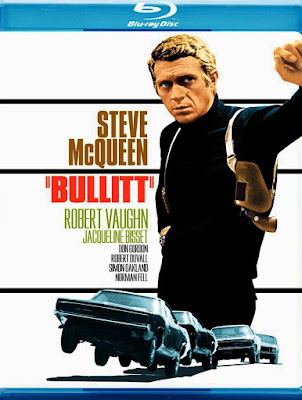
BULLITT - Blu-Ray (WB 1968) Warner Home Video

The plot of director Peter Yates’ taut political/action/thriller Bullitt (1968) is slightly perplexing, but here goes: Johnny Ross (Pat Renella) is a front man for brother, Chicago mobster Peter. Escaping death twice, Johnny is placed in protective custody by politician Walter Chalmers (Robert Vaughn) whose interest in Ross is superficial and politically motivated.

Johnny has agreed to testify at a trial. Problem: one of the names that could get called before the grand jury is Chalmers’.Now, Chalmers asks Detective Lieutenant Frank Bullitt (Steve McQueen) and Sergeant Delgetti (Don Gordon) to guard Ross at a flophouse.

But the assignment goes horribly awry with yet another assassination attempt on Ross’s life that leaves him in a coma at the local hospital. Feeling he has been set up – and he has, by Chalmers - Frank bleeds information from his leeches and, after Johnny dies, keeps the death a secret from Chalmers, whom he already suspects as being responsible for setting up the assassination.

Nervous, but without recourse, Chalmers is determined to keep everything hush-hush or dismantle Bullitt’s career. After pursuing Ross’s would-be assassin - making attempt number two on his life inside the hospital - Bullitt gets down and dirty with a high-speed pursuit of the suspects that are now attempting to put a period to his investigative research and his life.

The car chase through San Francisco that immediately follows has since entered the annals of all time great chase sequences. What is remarkable about this sequence is that none of it is faked. For the most part, McQueen did his own driving or was at least in the car with a stunt double, careening off insanely steep Frisco slopes and coming perilously close to danger at every hairpin curve.

Critics who initially doubted McQueen’s staying power at the box office prior to this film’s debut were quick to turn coat and suddenly declare the actor ‘the king of cool.’As for Frank - after contributing to the fiery crash of his assassins at a highway gas station, fingerprints lifted from the scene reveal Chalmers complicit in the crimes. What is best remembered today about the film is undoubtedly its car chase – perhaps not the most esthetically sound reason to recommend a film as an all time great – but in Bullitt’s case, the moniker is arguably well deserved.

McQueen plays his hand with equal portions of compassion and ‘harder than nails’ raw determination. He’s an anti-hero’s hero but one who struggles to find his own niche justified against the backdrop of his profession. Bullitt is really McQueen’s movie.

The rest of the performances pale by direct comparison, while the Alan Trustman/Harry Kleiner screenplay never attains the sort of slick and stylish thriller packaging afforded its source material – a novel by Robert L. Fish. William A. Fraker’s cinematography and Frank P. Keller’s editing should also get the nod, particularly for their work on creating the frenetic and relentless pace of the car chase.

Warner Home Video’s Blu-Ray is nothing to write home about. Warner’s previously issued remastered 2-disc standard DVD exhibited a dated image with intense film grain during dark scenes. The latter deficiency was an inherent shortcoming of slower speed film stock. But the Blu-Ray seems to exaggerate the grain even more, making it so sharp that at times it tends to overpower the visuals in the actual image. We see the grain first and the image itself as an afterthought.

Colors continue to exhibit a slightly faded characteristic with pasty flesh tones. The audio on the Blu-Ray is Dolby Digital 2.0 Surround, with inherent sonic limitations. What is impressive herein are the extras: two exemplary documentaries; one on McQueen, the other, a feature length critique of film editing presented in 1080p – The Cutting Edge.

FILM RATING (out of 5 - 5 being the best)
3.5

VIDEO/AUDIO
3.5

EXTRAS
4.5

SPEED - Blu-Ray (20th Century-Fox 1994) Fox Home Video

Jan De Bont’s Speed (1994) is a high octane action/thriller with a one hit premise screenplay written by Graham Yost. In a nutshell, a Los Angeles city bus has been rigged with a bomb that will explode if the bus’ speed drops below 50mph. That this threadbare plotline could sustain a nearly two hour movie seems initially improbable, particularly as the leading man of the piece is Keanu Reeves: a stilted performer whose very declaration of “There’s a bomb on the bus!” seems to have been misinterpreted from being read off delayed text on a malfunctioning teleprompter.

Nevertheless, a despite what seems to be insurmountable shortcomings, Speed clings to life and valiantly so throughout its 116 min. running time, garnering our interest, respect and sustained disbelief in the improbability of the exercise along the way.

The story begins inside a high rise where a group of businessmen and women are trapped in an elevator rigged to explode by blackmailer/madman Howard Payne (Denis Hopper). Enter the L.A.P.D’s SWAT team fronted by Jack Trevan (Keanu Reeves) and Harry Temple (Jeff Daniels). Attempting to barter with Howard by telephone for the lives of the hostages, Jack instead departs from the scripted negotiations and, together with Harry, rescues all of the men and women seconds before Howard detonates the elevator. Though Howard escapes capture, Jack and Harry are made public heroes and receive citations for valor from their precinct.

Jack assumes he has seen the last of Howard, a naïve assessment brought into refocus after Howard detonates another bomb that kills one of Jack’s friends. From here, Howard seizes the opportunity to play a game of cat and mouse with Jack, informing him that another bus – this one loaded with passengers – is set to explode unless Jack can devise a clever way to rescue them.

Aboard this second bus is Annie Porter (Sandra Bullock), a good natured woman who will quickly discover herself the heroine of the troop after bus driver, Sam (Hawthorne James) is accidentally struck by a wayward bullet. Jack makes chase in a commandeered Jaguar, boarding the bus and successfully steering it through the crowded streets, byways and highways of greater Los Angeles.

Eventually, Jack discovers that Howard has rigged a hidden camera on board to keep track of the passengers. Jack has Harry patch into the video feed, record back, then loop in a few minutes of the video signal to fool Howard into believing that no one has left the bus, meanwhile evacuating everyone on board except for Jack and Annie, who eventually make a successful escape by sliding under the wheels on a plate of metal as the bus endlessly circles an abandoned airport terminal.

Outraged and more insane than ever, Howard takes Annie hostage aboard a moving subway car, strapping her with a belt of explosives and forcing a direct showdown between him and Jack – one that predictably ends with Howard’s death, a mass of destruction below street level, and finally, with Jack and Annie falling in love.

Andrzej Bartkowiak’s cinematography, Jon Wright’s film editing and Mark Mancina’s gripping score combine to develop an engaging patina of thrills, chills and narrow escapes - even when Yost’s screenplay struggles for something to say. This, however, doesn’t happen very often, though the moment when Annie accidentally plows into a baby carriage with the bus – only moments later revealing that the carriage was actually full of tin cans pushed by a bag lady and not an infant, as Annie originally presumes – is a direct rip off inspired by Gene Hackman’s car chase in William Friedkin’s The French Connection.

In the final analysis and as a film, Speed is exonerated, from what otherwise might be misconstrued as simplistic bad taste, by its clever and slick packaging. It’s an action/thriller with few contemporary equals, moving with a great sense of cinematic timing.

Fox Home Video’s Blu-Ray bests the studio’s previously released Five Star Edition on practically every level – delivering a crisp, clean image with fully saturated colors, nice contrast and an excellent smattering of fine details throughout. The only flaw, as this critic can see, comes in the Blu-Ray’s 25GB encoding – not utilizing all of the disc space available, while limiting extra features to two separate audio commentaries, a trivia track, a ‘game’ feature and theatrical trailer.

Why Fox continues to reduce its special features previously made available on standard DVD in abundance on the titles they are currently releasing on Blu-Ray is beyond the scope of understanding for this critic. Suffice it to say, if the studio is planning to re-release the same titles currently available on Blu-Ray in the next few years with all of those extras we already own elsewhere, this is one collector who will not be running out to buy yet another copy of any film he already currently owns!

FILM RATING (out of 5 - 5 being the best)
3.5

VIDEO/AUDIO
4

EXTRAS
2

THE FRENCH CONNECTION (20th Century-Fox 1971) Fox Home Video

Director William Friedkin reinvented and invigorated the gritty police action/drama with The French Connection (1971); a taut and dynamic film about a real life international heroin smuggling cartel. Based on case files of New York City police detectives Eddie Egan and Sonny Grosso and a book by Robin Moore, the screenplay by Ernest Tidyman is a gripping revision of the truth. In the film, Bud Russo (Roy Scheider) and Jimmy ‘Popeye’ Doyle (Gene Hackman) set out to apprehend French businessman, Alan Charnier (Fernando Rey) whom they suspect is a front man for international narcotics trafficking.

Charnier has smuggled his latest drug shipment into the U.S. via the snazzy automobile of a legitimate French film star in America to do a movie. Charnier’s American contact is a two bit hustler from the Bronx, Sal Boca (Tony Lo Bianco) who first catches Doyle’s attention at an ‘after hours’ watering hole, spending far too much money for the proprietor of a greasy spoon that he pretends to be by day. Doyle becomes obsessed with nabbing Boca and Charnier; an obsession that frequently lands him in hot water with his superior officer, Simonson (actually, the real Eddie Egan).

Director Friedkin cast Fernando Rey on the assumption that he was the actor he had earlier seen in the foreign film, Belle de Jour (1967). Unfortunately, Friedkin had the wrong man. However, with shooting about to commence and the studio pressing the production forward it was too late to do anything but accept Rey in the role.

Throughout the production, accidental verisimilitude remained the order of the day. From the crash and bang-up that takes place during the penultimate car chase (not originally intended but left in the film for its heightened realism), to having actual motor men and conductors operate the subway trains (city authorities would not give the crew permission to use an actor), the movie leaps across the screen with a genuine grit for excitement.

A stickler for realism, Friedkin reportedly did not rehearse Hackman’s car chase with a double. Nor did he get permission from the proper city authorities to clear several blocks of pedestrian traffic before he yelled ‘action!’ Instead, with a hand held camera in the backseat, Friedkin instructed his star to drive at top speeds under an elevated train.

The resulting footage is so viscerally alarming that one can almost feel the hairs begin to stand up on the back of Hackman’s neck. On Oscar night, Friedkin, Hackman and the film were all honored with statuettes, if for nothing else, their insane blind courage exercised during this trend-setting action sequence.

Fox Home Video’s previously issued Five Star Collector’s Edition provided us with a fairly impressive DVD transfer of this Oscar winner. The new Blu-Ray minting is therefore something of a mystery. Film grain that was moderate on the standard DVD has been bumped via Blu-Ray’s bit rate to such an extent that it all but obliterates fine detail during night scenes. More perplexing is Friedkin’s choice to manipulate the original filmic elements with digital color filtering that renders the resulting Blu-Ray image a lot cooler and with a more desaturated color palette than has ever before been seen – even in theaters at the time of the film’s general release.

As if to justify the reason for his alterations, one of the Blu-Ray’s extra features is an extensive featurette on color timing. Friedkin claims that the Blu-Ray’s image is the way he ‘always’ intended the film to be seen. Perhaps – but that isn’t the way audiences saw the film in 1971, nor is it a particularly flattering viewing experience to contemporary eyes. Instead of appearing vitally sharp with desaturated colors, The French Connection now looks faded and more worn than ever before.

The audio has been remixed to 5.1 lossless audio but exhibits a dated characteristic. Featurettes on the making of the film, reminiscences from the stars and cast, the original BBC documentary and Don Ellis’ score round out the extensive extra features. An isolated score track containing the complete musical tracks (not how they appear edited into the film’s final cut) are also a welcome edition.

FILM RATING (out of 5 - 5 being the best)
4

VIDEO/AUDIO
3

EXTRAS
4.5

PRETTY WOMAN - Blu-Ray (Touchstone 1990) Buena Vista Home Video

Gary Marshall’s Pretty Woman (1990) is a fable that could only have been made palpable to film audiences at the end of the 1980s; a decade revered for its improbable comedies (The Breakfast Club, The Secret of My Success, Mannequin, Weird Science, Bachelor Party, Big etc).

Transforming then relative unknown Julia Roberts into a megastar, Pretty Woman became one of the most celebrated romantic comedies of its time and a colossal money maker for Disney’s Touchstone apparatus – a Cinderella story set in modern day Beverly Hills, between a Hollywood Blvd. prostitute and a romantically frigid corporate raider in desperate need of a lover’s makeover.

Yet, viewed from the vantage of over 20 years removed from that decade of featherweight pulp, and in particular, with the ominous socially mobile framework of dark and more brooding social critiques that currently occupy our filmic landscape, Pretty Woman seems a little worse for the wear; its premise pure soap and treacle, its characterizations mindless and from another planet, rather than another time.

Even given that the company's penchant for producing ‘family entertainment’, Vivian Ward (Roberts); a Hollywood hooker minus the vices of many a working girl (drug addiction, bastard children, STDs, etc.) seems strange bedfellows (pun intended!). Make no mistake, Pretty Woman is still a fairytale with the princess distilled into a nice girl with a heart of gold who just happens to also be a real whore in bed.


The screenplay by J.F. Lawton opens with Edward Lewis (Richard Gere), an emotionless shell of a man who lives, eats and breathes corporate raiding. Unable to pry his limousine from the juggernaut of party guest’s cars at the home of his attorney Philip Stuckey (Jason Alexander), Edward borrows Stuckey’s Lotus Esprit, instead. But his attempt to make it back to the Beverly Wilshire prove a disaster. Edward can neither successfully drive a stick shift nor navigate the streets of Los Angeles. Instead, he quickly finding himself on Hollywood Blvd. after hours where he meets Vivian working her corner with fellow hooker, Kit De Luca (Laura San Giacomo).

Asking for directions, Edward gets more than he bargains for when Vivian offers to drive him back to the Beverly Wilshire. As Edward has just broken up with his current girlfriend, Jessica, he invites Vivian upstairs to his penthouse suite – entirely uncertain what his next move with her will be. Slowly, an unlikely romantic bond begins to develop between these two. Edward decides to have Vivian stay the week with him at the Wilshire. He needs a girl on his arm to close an attractive deal, but one without romantic illusions.

The hotel's manager, Barney Thompson (Hector Elizondo) confronts Vivian about the reasons for her staying in the penthouse. "Things that happen at other hotels don't happen at the Beverly Wilshire," he reminds her. Nevertheless, Barney has a heart. After Vivian breaks down in his office he decides to help her achieve her goals for the week; to dress and behave like a lady of culture.

Vivian works her magic on the new men in her life, easily winning Edward and Barney’s respect along the way. Barney trains Vivian in the social etiquette of fine dining for her first big night out with Edward and rival businessmen, James (Ralph Bellamy) and David Morse (Alex Hyde-White). But the meeting turns sour after Edward makes it clear that he hopes to acquire and then dismantle James’ company through a hostile corporate takeover.

Meanwhile, Philip begins to sense that Edward’s infatuation with Vivian is growing into a love that may have softened his partner’s usual ruthless business savvy. All this needless worrying is, of course, mere window dressing. The fairytale prevails, with Edward conquering his fear of heights to scale Vivian’s fire escape and ask her to be his wife by the final reel.

What is particularly naïve about the narrative in retrospect is how all the elements of living dangerously have been excised from the subtext. A hooker’s life is presented as good natured, and curiously sexless, romantic fun with more than a hint of glamour associated to the art of the trade.

In the extended cut of Pretty Woman – not seen in theaters but previously released by Buena Vista Home Video for the ‘Anniversary Edition’ – the character of Carlos (Billy Gallo) the pimp was modestly fleshed out in a key sequence to present at least something of a serious threat to Vivian and Kit’s welfare and safety. He threatens Edward in the alley behind ‘The Blue Banana’ – a club frequented by Vivian and Kit. *This scene does not appear on the Blu-ray.

Even the death of ‘Skinny Marie’ a fellow prostitute addicted to crack at the beginning of the film is dolled up for sheer comic relief The body is never shown. Instead, a man and woman are seen taking pictures of the alley cornered off by police. Asked by the presiding detective (Hank Azaria) if they are from the media, the woman casually replies,
“No, we’re from Orlando.”

Pretty Woman is a showcase for Julia Roberts and she works it like a pro. Her performance sustains the film with sincerity, heart and a frank understanding. Richard Gere’s stoic and near expressionless corporate raider is another matter. As an actor, Gere has two expressions to draw from; mediocre and mediocre plus. Ironically, the mileage he gets from this limited range is rather impressive – perhaps because the character of Edward Lewis demands little else.

Hector Elizondo is the most charming edition to the cast; a sort of 'fairy Godmother' who finds something unique and enchanting in the girl from the wrong side of the tracks and thereafter does all he can to sprinkle a little pixie dust over the film's inevitable ‘hearts and flowers’ conclusion.

In the final analysis, Pretty Woman represents Touchstone Pictures at its most slickly packaged. Throughout the 1980s, the company produced many less than perfect entertainments that nevertheless caught the public fancy and box office dollars; Adventures in Babysitting, Can’t Buy Me Love – both in 1987, Beaches 1988 among them. Pretty Woman represents the last of this breed, today belonging more in a time capsule than definitive history of American movie making.

Buena Vista Home Video’s Blu-Ray release of Pretty Woman is sure to infuriate fans of the film on several levels. First, after providing the consumer with the extended cut on DVD, Buena Vista has decided to limit its Blu-Ray release to only the theatrical cut. The limited ‘special features’ that were included on the extended cut – including Natalie Cole’s ‘Wild Women Do’ music video and a meandering audio commentary by Garry Marshall – are the only extra features regurgitated on this outing and presented in 480i – not 1080p. But perhaps the biggest oversight on this release is the studio’s failure to go back to original source masters for the film's 1080p upgrade.

The image is virtually identical to the previously issued ‘Anniversary Edition’ on standard DVD – its only marginal improvements coming from Blu-Ray’s superior bit rate that results in a tighter image with ever so slightly more vibrant colors. The differences between the DVD and the Blu-Ray are negligible at best and frankly, a let down.

Several scenes appear softly focused with a considerable loss of fine detail. The audio is uncompressed DTS – thank heaven. Other extras include a blooper reel and vintage production featurette from 1990. Big deal!

FILM RATING (out of 5 - 5 being the best)
3.5

VIDEO/AUDIO
3

EXTRAS
2.5

THE PINK PANTHER - Blu-Ray (The Mirisch Co. 1963) MGM/Fox Home Video

Blake Edward’s The Pink Panther (1963) is perhaps the most delightfully obtuse sleuth/comedy ever conceived for the movies. Certainly, it is one of the most visually elegant. The film not only provides comedian Peter Sellers with one of his most enduring and iconic performances – that of French Inspector Jacques Clouseau – it also launched a cartoon phenomenon franchise for the effeminate feline featured in the film’s main title sequence.

True, the screenplay by Maurice Richlin and Edwards is a bit episodic, but its juxtaposition of three separate narratives gradually melds into one seamless and very hilarious caper. It is pointless to wallow in a critique of specific errors in narrative construction. For example, there really is no reason why Simone Clouseau (Capucine) ought to have married a police inspector when her heart is obviously drawn to the devices and seductions of Sir Charles Lytton (David Niven). The point is that the narrative is more than adequate to sustain all of the claptrap and calamity brought on by a frantic race to possess the most fabulous diamond in the world.

The film opens in an undisclosed province in the Far East where the reigning monarch bestows the fabulous ‘pink panther’ gem to his daughter, Princess Dala (Claudia Cardinale). After a cartoon main title sequence that introduces the panther, as well as Henry Mancini’s instantly recognizable theme music, the narrative fast tracks some twenty years into the future.

A mysterious phantom cat burglar makes off with some priceless jewels in Rome. In Hollywood, con artist George Lytton (Robert Wagner)fakes his own college graduation photo to present to the uncle who has paid for his formal education – such as it is or, in fact, isn’t.

The plot thickens as the action migrates to Cortina, where George’s uncle, Sir Charles is keeping tabs on Princess Dala. Next, we’re off to France, where a mysterious woman is seen fleeing the police after exchanging a package with her contact on the banks of the Seine. The woman, who manages a stunning escape by performing a quick change in an elevator, is none other than Simone Clouseau – Jacques’ wife!

Jacques bumbling ineptitude in practically all things makes him a figure of fun, though his slightly savvier cohort, Tucker (Colin Gordon) is particularly faithful as a sidekick. Unable to recognize that his wife is an accomplice in the latest series of jewel robberies, Jacques focuses his attentions on Sir Charles – never realizing how close to the truth he is. Meanwhile, Princess Dala attends several fashionable parties given in her honor by nattering socialite Angela Dunning (Brenda De Banzie), while all the while playing a cagy romantic game of cat and mouse with the very flirtatious Sir Charles.

What is perhaps most intriguing about the narrative is how many loose ends and secondary characters there are that don’t amount to much or seem to matter. Angela Dunning is a dead end character, as is her nameless Greek cousin played by Fran Jeffries – who is given a plum musical highlight; Mancini’s Meglior Stasera to sultrily slink through as all the principles look on.

In suspending the plot for this musical interlude director Edwards respects his audience just enough to forget them; a directorial move that requires fortitude, self-confidence and plain old guts to masterfully pull off. A resounding success upon its initial release, The Pink Panther spawned a film franchise that arguably, was not quite up to snuff. Nowhere else in the series, except perhaps A Shot In The Dark (1964), do all of these elements - zany characters, cornball sleuthing, clever innuendo and unabashedly screwball comedy - unify to produce such an inspired featherweight, feel good entertainment.

MGM/Fox's The Pink Panther on Blu-Ray easily bests its SE DVD incarnation. The image is undoubtedly crisper and tighter – given Blu-Ray’s superior bit rate. But colour fidelity doesn't quite take that quantum leap into the future. Yes, colours are brighter and more refined on the Blu-ray than on the DVD. But flesh tones seems just as pale. Fine details improve as does contrast and grain looks more film like than before. Age related artefacts aren't an issue either. Overall, the image is smooth and satisfying.


The DTS remix of original mono exhibits obvious shortcomings. Although Henry Mancini’s Pink Panther theme gets the full stereo treatment, much of the rest of the music, effects and dialogue are bound by rather limited source material – the biggest regret being Meglior Stasera sung by Fran Jeffries; a track that apparently does not survive in any sort of pristine recording - either stereo or mono. It is interesting to note that Jeffries unique rendering of the song also does not appear on the 2002 CD release of The Ultimate Pink Panther compilation that features the rest of Henry Mancini’s musical cues from the entire series remastered in true stereo.

Extras are all direct imports from the SE DVD and include an audio commentary from Blake Edwards and three featurettes: The Pink Panther Story, The Coolest Cat In Cortina, and The Tip-Toe Life Of A Cat Burglar.

FILM RATING (out of 5 - 5 being the best)
4.5

VIDEO/AUDIO
3.5

EXTRAS
3

THE SEARCHERS - Blu-Ray (WB 1956) Warner Home Video

John Ford’s The Searchers (1956) is a dark western saga into one soulless man’s driving ambition to avenge the death of his entire family. The film stars Ford favorite, John Wayne as tired loner Ethan Edward. Ethan is a rover who returns to his brother, Aaron’s (Walter Coy) ranch house somewhere in Death Valley. Upon his arrival, Ethan is welcomed by Aaron’s wife, Martha (Dorothy Jordan), son Ben (Robert Lyden), and daughters Lucy (Pippa Scott) and Debbie (Lana Wood). The bliss of this reunion is short lived.

When Ethan is called to investigate the ravages of Comanche Indians on a nearby cattle ranch, he returns home later to discover that his own homestead has been burnt to the ground and his entire kin massacred. The loss turns rancid when half breed Martin Pawley (Jeffrey Hunter), who was taken in by the family and reared as one of their own, decides to accompany Ethan on his quest for revenge.

Martin’s Indian heritage is despised by Ethan, whose soul cannot rest until he learns what has become of the only family member not among the raped and dead – Debbie. The rest of the film is basically Ethan’s journey; overriding and all-consuming with a frustrated, avenging passion to murder the murderers.

John Wayne, long perceived in films to be everyone’s favorite cowboy, inverts audience expectations with his blistering performance of a racist so utterly consumed by hatred that, in discovering Debbie the adopted daughter of her captors decides she too must be put to death for betraying her white heritage. Viscerally photographed against the desolate and towering beauty of Monument Valley, The Searchers remains one of John Ford’s most prolific and engaging westerns; not to be missed.

Warner Home Video’s Blu-Ray release of The Searchers gives us yet another visual interpretation of what the original VistaVision image might have looked like. The original DVD release from 1997 was a mess of age related artifacts and faded colors that in no way lived up to VistaVision’s claim of ‘motion picture high fidelity’. Then, in 2002 Warner’s restoration experts revisited this title with a beautifully restore hi-resolution print master.

The Blu-Ray’s image is considerably different from that latter restored print, with slightly truer blues and reds and ruddier flesh tones. The earth tones that appeared more orange in the restored edition are now more yellow. Blu-Ray’s higher bit rate in data compression results in a sharper image with zero film grain. But is this really how the film looked to theater audiences over 60 years ago?

Extra features on the Blu-Ray are direct imports from Warner’s lavish box set, including ‘an appreciation’ featurette on the film, the 1990 documentary about Wayne and Ford’s collaborative efforts and personal relationship, a commentary track from Peter Bogdanovich and vintage ‘behind the scenes’ segments from Warner Bros. Presents television show. Recommended!

FILM RATING (out of 5 - 5 being the best)
5+

VIDEO/AUDIO
5

EXTRAS
4

PATTON - Blu-Ray (2oth Century-Fox 1970) Fox Home Video

Franklin J. Schaffner’s Patton (1970) is the Academy Award-winning biography of larger-than-life WWII general, George S. Patton (George C. Scott); a walking contradiction of brilliant military strategies and the only American war hero to be openly revered and simultaneously feared by the Nazis.

Patton’s defeat of German Gen. Rommel’s (Karl Michael Vogler) forces in North Africa wins him initial praise and honors on both sides of the war front.To be certain, Patton is a genius. Time and again, where others fail, Patton breaks with tradition and makes inroads into the Axis advancing forces.

If he carries his heart on his sleeve, Patton also isn’t shy about advertising his victories. That self appointed bravado lands him in hot water on more than one occasion. But his special gifts for decimating the enemy do not go unnoticed. Unfortunately, neither does his unconventional and arguably harsh discipline of his own troops.

To soften the blow and keep the peace, Eisenhower appoints Gen. Omar Bradley (Karl Malden) as Patton’s second in command. The two men have a tempestuous relationship, but one ultimately built on a solid foundation of trust and mutual respect. However, when Patton denounces a shell-shocked solider as a yellow coward and orders him back to the front lines, the resulting censure from Patton's superiors is both demoralizing and a bitter pill to take. Patton is demoted in rank, and this impacts his self-appointed stature as well.

Director Franklin J. Schaffner constructs a tragic tableau; that of a 17th century man trapped in a contemporary setting that will ultimately be the death of him. In essence, the expectations of the classical Hollywood narrative are played in reverse. The film begins on a high note. We see Patton at the peak of his powers – a man of feisty intelligence, who is unable to control his own mythology until it slowly unravels to the hour when his military zeitgeist is reduced to just another forgotten cog in the great wheel.

As Patton, George C. Scott is enigmatic, inspiring; a force to be reckoned with. Scott does not merely inhabit the part; he assimilates into it. In retrospect, the film and the actor’s life seem to be mirror images. After Patton, and George C. Scott's snub at AMPAS for refusing his Best Actor Oscar, the actor never again scaled such heights in his career. The last act of Scott's life, like that of his alter ego, became mired in public failures and personal regrets. As Patton's reign as the man of war had no place in peace time, Scott's warring self gradually fell out of favour in the movies.


No less than 3 standard DVD versions of Patton are available from Fox Home Video; all with identically flawed image quality. The curiosity for Patton on Blu-Ray is that although the image has been greatly improved, the results remain critically assessed as far from providing definitive quality.

Immediately following the release of this Blu-Ray, internet forums were abuzz with complaints that the Dimension 150 image had been made too pristine. The removal of film grain had resulted in a perceivable loss of minute details.

So what's the truth? Well, now that I have had the opportunity to view Patton on a projected wall size image I can honestly say the pundits are right. Patton on a screen larger than 65 inches has its obvious shortcomings. The image is slightly waxen with a 'scrubbed' look that seems out of character with what the film must have looked like before excessive DNR was applied.

Okay, now here's the good news. I don't know of too many people (yours truly included) who will have the capability to view Patton on anything larger than a 65 inch TV monitor. Here, the aforementioned shortcomings all but vanish and I was left with a wholly satisfactory viewing experience. In motion it was impossible for my eyes to notice the DNR except if I really stared at stationary background information.

While I am not reporting to say that I am pleased with Fox's Blu-ray, I can't entirely say I'm angry with the results either. I loved the solid, razor sharp image with its lush greens, vibrant reds and superbly rendered flesh tones. Fine detail didn't seem to suffer as much on my 65inch TV monitor as it did on the wall size projection.

The new widescreen image captures much of the glory of Patton’s original Dimension-150 camera negative. The audio is a 5.1 Dolby lossless audio – near pristine and quite remarkable if dated. Overall, dialogue sounds crisp. Jerry Goldsmith’s rousing patriotic theme is the benefactor here.

Extras are identical to those on Fox’s Cinema Classics Edition standard DVD: a thorough ‘making of’ documentary and biography special on the real George S. Patton, stills galleries and the film’s original theatrical trailer. Recommended.

FILM RATING (out of 5 - 5 being the best)
4.5

VIDEO/AUDIO
4.5

EXTRAS
3.5

INDEPENDENCE DAY - Blu-Ray (20th Century-Fox 1996) Fox Home Video

The first hour of Roland Emmerich’s Independence Day (1996), a revisionist take on 1950s paranoia-infused sci-fi thrillers, comes as close to attaining cinematic perfection in that genre as is humanly or otherworldly possible. The first half of the screenplay by Dean Devlin and Emmerich is clever enough to avoid most of the conventions and clichés of a sci-fi movie; investing in some solid character development leading up to July 3rd, the day of world infamy.

That the rest of the narrative immediately following the colossal destruction of New York, L.A. and Washington D.C. rapidly digresses into atypical ‘aliens vs. humans’ conflict most certainly reduces both the potency and imagination of the film as a whole, eventually bogging it down in the over schmaltz of rank patriotism by the final reel. Perhaps, it’s just bad planning, bordering on cliché, but the middle and third act to the piece simply do not add up to the impressive scale of the opening scenes. Even so, this story clings heroically together, primarily because the cast continue to sell their silly wares as complete truth.

The story begins with an Area 51 sighting of a large circular object moving toward the earth from outer space. Foppish U.S. President Thomas Whitmore (Bill Pullman) is immediately informed of a possible other worldly invasion by his military advisers. Tragically, he does not recognize the immediacy of their concern, at least in time to evacuate the populace from the initial three major city centers that have been targeted by the alien mother ship for extinction.

Meanwhile, hotshot cable programmer, David Levinson (Jeff Goldblum) has managed to decode a countdown in the alien ships’ broadcast signals. Driving to Washington with his father Julius (Judd Hirsch), David convinces his ex-wife, Constance Spano (Margaret Colin) to inform the President. The White House is evacuated and all military installations are placed on high alert. The mother ship strikes and Washington, Los Angeles and New York are wiped off the face of the map.

In another part of the country pilot Steve Hiller (Will Smith) is pressed into military service to combat and eliminate the encroaching invaders. Prior to his enlistment, Hiller had planned to marry his stripper/girlfriend, Jasmine Dubrow (Vivica A. Fox). With L.A. a distant memory, Hiller believes that Jasmine is lost to him.

In a remote desert town, crop duster Russell Case (Randy Quaid) is exonerated of the stigma in claiming for years to have been one of many alien abductees when the mother ship bursts forth in a cloud of atmospheric haze to cast its gigantic shadow over all residing beneath her.

These four male lives and the resurrection of their romantic relationships via acts of valor done in the name of human salvation are the film’s focus for the next two hours. The melodrama isn’t bad. It’s just that following the spectacular deluge of New York, Washington and Los Angeles, it never contributes anything more than serviceable filler to Emmerich’s otherwise impeccable overriding vision.

Employing detailed miniatures of famous U.S. landmarks, a litany of pyrotechnic special effects and several small, but very ‘real’ explosions shot at high film speeds and then played back at normal speed, the overwhelming sense of mass catastrophe is as awe inspiring impressive as it is utterly terrifying to behold.

In the days following the real life terrorist tragedies of Sept. 11th 2001, 20th Century-Fox contemplated re-editing these city destruction sequences, particularly the apocalyptic long shot of the World Trade Center seen with its upper floors decapitated and burning. Thankfully, cooler heads have prevailed and the shot, however ominously it now appears to foreshadow that terrible act, remain intact. This reviewer is a firm believer that art should never be revised to reflect life. Whatever its shortcomings, all film art before Sept. 11, 2001 is an artifact of a simpler, more carefree time when such gross acts of violence seemed not only fanciful, but all together improbable.

In 1998, Independence Day became one of Fox Home Video’s first 2-disc Five Star DVD Editions, later repackaged as a Deluxe Edition. The new Blu-Ray from Fox bests all previous standard editions in image quality, but only marginally – a testament to the care that went into mastering the film for DVD in the first place.

The anamorphic widescreen elements on the Blu-Ray are a tad sharper and more refined. Also, the minute hints of edge enhancement evident on the DVD are absent on the Blu-Ray. Otherwise, colors appear fairly the same as before: bold and vibrant. Flesh tones are accurately rendered. Blacks are deep and solid. Whites are pristine. This is a reference quality disc.The audio is 5.1 Dolby Digital lossless and subtly more refined than its predecessor.

Regrettably, Fox has limited its extra features two audio commentaries, a trivia track and an ‘game’ feature. Regrettably, the extensive documentaries illustrating how the film was made that were a part of both the Five Star and Deluxe Editions are no where to be found on this offering. For shame!

FILM RATING (out of 5 - 5 being the best)
3.5

VIDEO/AUDIO
4.5

EXTRAS
3

Friday, March 20, 2009

THE ROBE - Blu-Ray & DVD (20th Century-Fox) Fox Home Video


In the late 1930s French film pioneer Henri Chretien tried valiantly to convince American film makers that his anamorphic widescreen process was a revolutionary invention in screen projection that they simply could not do without. Hollywood studios thought otherwise and the standard 1:33:1 aspect ratio remained the norm until 1953 when television suddenly sent the entire film making community into an economic tailspin.

Progressive by most mogul standards, 20th Century-Fox’s production chief, Darryl F. Zanuck remembered Chretien and his device, putting both to work for Fox with the debut of The Robe (1953), the first Cinemascope widescreen motion picture with stereophonic sound. How much The Robe’s initial impact and critical/financial success was predicated on Chretien’s ‘evolutionary’ film process, as opposed to the film’s subject matter or acting performances, remains open for debate. What is for certain is that The Robe revitalized the sub-genre of Bible/fiction epics first made fashionable two decades before by Cecil B. DeMille.

Based on Lloyd C. Douglas’ novel of spiritual conversion, director Henry Koster’s The Robe is a sweeping spectacle employing all of the tried and true Hollywood clichés about ancient Rome. Originally, screenwriter Albert Maltz collaborated on the adaptation with Philip Dunne. Unfortunately for Maltz, his indictment by HUAC in the Red Scare resulted in an obliteration of his screen credit – an oversight that the new DVD incarnation has corrected.

The Robe opens with a grand master shot of a Roman coliseum ripped from the film’s sequel: Demetrius and the Gladiators (simultaneously shot but released one year after The Robe’s triumphant debut). From this magnificent master shot we are treated to a montage of images depicting Rome’s decadence and its impervious disregard for humanity in the slave markets.

Enter tribune Marcellus Gallio (Richard Burton); a playful but vane and self centered man of wayward charm. Perusing the local trade, Marcellus has his heart set on bidding for a pair of Macedonian twin sisters. Unfortunately for Marcellus, the Emperor Caligula (Jay Robinson) also has his eye on the pair.

Before the bidding, Marcellus is also reunited with childhood sweetheart, Diana (Jean Simmons) who is currently Caligula’s ward. Caligula is a demigod; drunk with power and emotionally unstable to assume the reigns of governing the most powerful empire on earth. He rules by tyranny; a manipulation that Marcellus ironically fails to see will have an impact on his own station in life. After Caligula outbids Marcellus on the twins, Marcellus deliberately outbids the emperor on a Greek slave, Demetrius (Victor Mature), thereby incurring Caligula’s wrath.

Caligula exiles Marcellus to Jerusalem where he encounters Christ’s arrival on Palm Sunday. Marcellus is unmoved by the experience, but Demetrius has an on the spot conversion that transforms him into one of Christ’s disciples. Demetrius learns that Governor Pontius Pilate (Richard Boone) intends to sentence Christ to death for crimes against the state, but he is too late to prevent the crucifixion. Instead, he arrives at the foot of the cross that bears Christ’s body to collect ‘the robe’ Christ wore.

The robe is seized in a card game at the foot of the cross and won by Marcellus who has been put in charge of the crucifixion. However, as Christ takes his last breath, the spirit of his suffering bewitches the robe and thereby Marcellus who attempts to clothe himself in it during the violent thunderstorm that immediately follows. Haunted by an invisible mental sickness that renders him a shivering wreck, Marcellus returns to Rome where he and Diana rekindle their love.

Marcellus embarks on a journey to discover Christ’s past and thereby rid himself of the ‘curse’ of the robe. In the process, however, he crosses paths with a loyal merchant, Justus (Dean Jagger), Christ’s disciple, Peter (Michael Rennie) and Miriam (Betta St. John). Together with their faith, compassion, love and understanding, Marcellus’ health is restored. But more important, Marcellus has now become a true believer of the kingdom of heaven which ironically makes him an enemy of the state.

Forced to choose between Caligula and God, Marcellus picks the latter, providing Caligula with the opportunity to sentence both Marcellus and Diana to death. The film ends, not with another crucifixion, but with Marcellus and Diana escorted from Caligula’s palace, the backdrop transformed into a heavenly spire of clouds married to composer Alfred Newman’s lush and evocative choral and orchestral underscoring that concludes the narrative on an inspirational note of hope and promise.

In point of fact, Newman should get most of the credit for elevating what is otherwise a largely pedestrian tale to heights of celestial bliss. Comparatively speaking the Maltz/Dunne screenplay is not up to snuff, periodically faltering for something meaningful to say. The growing pains of adapting conventional filmmaking techniques to the more expansive 2:35:1 aspect ratio also seems to have hampered Leon Shamroy’s ability to create engaging cinematography. The film replies heavily on process matte shots and paintings that are less than seamlessly blended into the live action.

Nevertheless, the story clings together, primarily because the performances from Richard Burton, Jean Simmons, Victor Mature and Dean Jagger in particular are so very good. Interestingly, Burton – primarily a stage actor up to this point in his career - thought he was terrible in the role. In point of fact, he does seem mildly stiff in his actions, but his ability to communicate volumes of self loathing through vocal ability alone makes his performance quite a standout. The same can be said of Victor Mature who, given limited dialogue, majestically conveys the eloquence of a tortured soul released to its higher calling through Christ’s invisible message.

The Robe has been simultaneously released on DVD and Blu-Ray with varying degrees of success. The original filmic elements, that for years have registered the glaring ravages of time, underwent a monumental restoration effort and the results are an image that is far more textured, smooth and detailed than ever before seen on home video.

Though transitions between scenes (fades, dissolves) continue to suffer from momentarily clumpy color and an obvious amount of film grain, the rest of the picture element exhibit a refined texture. Flesh tones are particularly improved, more pink than the garish and putty-like orange we’ve become too used to in previous incarnations.

Comparatively speaking, the Blu-Ray disc outranks the standard DVD with a tighter image, more boldly saturated colors and with improved sharpness and clarity throughout. Still, in either format, this new Special Edition of The Robe will surely not disappoint.

The audio has been restored to provide a bombastic and thrilling sonic experience that really gives all channels of the home theater a considerable workout. Extras on the DVD include an introduction by Martin Scorsese, commentary from David Newman, Jon Burlingame, Julie Kirgo and Nick Redman, an isolated score track and two featurettes – one on the making of the movie, the other on the Cinemascope process. There’s also a stills gallery and interactive press book to consider.

The Blu-Ray imports all of these features and adds another featurette on Hollywood’s 50s obsession with The Bible, as well as an audio interview by Philip Dunne and a ‘picture in picture’ comparison of The Robe in widescreen and full frame. Highly recommended!

FILM RATING (out of 5 - 5 being the best)
3.5

VIDEO/AUDIO
Blu-Ray 4
Standard DVD 3.5

EXTRAS
Blu-Ray 4
Standard DVD 3

THE THREE STOOGES: VOL. 5 (Columbia 1946-48) Sony Home Entertainment

Curly Howard will likely forever remain everyone’s favorite stooge – his bald pate and bulbous face contorted into innumerable expressions of severe stupidity that elevate ‘dumb comedy’ into a refined art. Such was the case when Curly began as one of The Three Stooges together with brother Moe and cohort Larry Fine in Vaudeville. Together, these three cinematic nitwits reigned over just about every comedy act of their day, though they appeared in nothing more than their highly successful series of two reel short subjects for Columbia Studios between 1932 and 1950.

Now, Sony Home Entertainment rolls out the latest installment of their franchise series celebrating Columbia’s most enduring funny men, Larry, Moe and Curly with The Three Stooges Collection: Volume 5. Spanning the years 1946 to 1948, this latest edition to the series is perhaps the most bittersweet. Midway through shooting 1947’s Half-Wits Holiday, Curly Howard suffered a debilitating stroke that forced him to withdraw from the trio.

However, even before this tragic event occurred, there seems to be – at least in retrospect - a sense of tired restraint lingering throughout the shorts featuring Curly in this box set. Not only Curly, but Moe and Larry look more careworn, or perhaps merely less carefree than we’ve come to expect them to be. Though Uncivil Warbirds – the short that casts the stooges as a trio of confederate soldiers during the war between the states – is a bright spot of clever comedy, shorts like Beer Barrel Polecats and Monkey Businessmen tend to linger as waning reminders of the stooges at the height of their popularity, strangely juxtaposed against their then currency of simply going through the motions.

As Half-Wits Holiday was a less than stellar remake of the stooges own, Hoi Poloi (1934), for all intensive purposes the act might have dissolved after Curly was forced to retire. Instead, Moe suggested to Columbia’s president Harry Cohn that the stooges be given a second chance to make good; this time with Moe’s other brother – Shemp Howard, who had begun as part of the act on Vaudeville, but departed the stooges before they made the successful transition from stage to film.

The shorts featuring Shemp in this collection are perhaps the real reason to stand up and cheer; for they represent not only a renewed willingness from Moe and Larry to resurrect and slightly reinvent the act for a new generation, but also a commitment on the part of their alma mater to reinvigorate the franchise with as much pomp and circumstance as the act received at the height of Curly’s popularity.

Shemp’s inaugural as a stooge, 1947’s Fright Night is a tour de force in slapstick comedy for the stooges as they exploit a prize fighter by feeding him creampuffs. Hold That Lion (1947) is an exuberant mishmash of hilarity as Curly makes his final cameo in a stooge short while Moe, Larry and Shemp hunt down a swindler for revenge. Shivering Sherlocks (1948) is another delightful romp as the new trio comes face to face with a bloodthirsty robber and his diabolical henchman, while The Hot Scots (1948) is a whacky tale of three detectives guarding a haunted highland castle.

In all then, Volume 5 of The Three Stooges is a celebratory note for the ‘fourth’ chuckle-head in the equation – Shemp. Part of Shemp Howard’s appeal is that he attempts in no way to resurrect the memory of his brother’s tenure with the act through his own performance. Whereas Curly was bombastically irreverent with grandiose gestures of physical comedy, Shemp is a more refined raconteur, carrying the act of a ‘mama’s boy’ to new heights of whiny perfection. Though Curly will always be in our hearts, Shemp occasionally gets inside our heads. Thus, when we think of Curly we remember his energy and laugh out loud. When we think of Shemp we simply have to smile.

Sony Home Entertainment’s commitment to ‘restoring’ the stooge classics on DVD seems to have slightly waned with this latest compilation. Although these shorts come from a later period in the stooges’ career and are therefore younger than all the shorts offered in previous collections, a good many shorts in this collection tend to exhibit more grain and a less smooth B&W image.

A Bird In The Head (1946) as example appears to have several dupe shots inserted from second generation source material that is slightly out of focus and considerably more grainy than the rest of the short. Three Loan Wolves (1946) exhibits some minor edge enhancement. The characteristic of the visuals is therefore inconsistently rendered at best. The audio portion of this presentation is mono and adequately represented. As is the case with all other Three Stooges Collections currently put forth by Sony, there are NO extras.

FILM RATING (out of 5 - 5 being the best)
3.5

VIDEO/AUDIO
3

EXTRAS
0

PINOCCHIO 70th Anniversary - Blu-Ray (Walt Disney 1940) Walt Disney Home Video

Walt Disney’s initial flush of success with Snow White and The Seven Dwarfs (1937) was to be put to the test on his next animated project, the ambitiously mounted Pinocchio (1940). With its very adult and sophisticated themes, in many ways Pinocchio is a close cousin to James Whale’s Frankenstein; the tale by Carlo Collodi, much more a harrowing nightmare about the harshness of humanity pitted against an innocent creature not of this world.

Like Frankenstein, all the antagonists in Pinocchio are adult male authority figures – each devious, threatening and running amuck in their own social depravity – determined even - to ensure that the oddity in their midst is not allowed to assimilate into the human world.

The narrative eventually ironed out by Ted Sears, Otto Englander, Webb Smith, William Cottrell, Joseph Sabo, Erdman Penner and Aurelius Battaglia consolidates the Collodi tale into three separate vignettes: the first, charting Pinocchio’s (voiced by Dickie Jones) abduction by Honest John (Walter Catlett) and Gideon (Mel Blanc) and his brief career as an actor in Stromboli’s (Charles Judel) traveling menagerie of puppets. However, apart from a few brief moments where the full wrath of Stromboli is revealed, this opening vignette is the most light-hearted of all three represented in the film.

The second sequence is terrifying to say the least. Pinocchio’s naïveté is ruthlessly exploited by the delinquent, Lampwick (Frankie Darro). The two boys are taken by The Coachman (Charles Judel also) to Pleasure Island – a veritable paradise of adolescent decadence. After a night of vapid debaucheries, Lampwick is transformed into a physical manifestation of the jackass he has been behaving, right before Pinocchio’s eyes.

The transformation is largely done in silhouette but is nevertheless frightening even to an adult audience. Pinocchio escapes his own complete transformation by diving off a cliff and swimming to safety – retaining a set of mule’s ears and a tail as his comeuppance. In the final sequence, Pinocchio returns home to discover that Geppetto (Christian Rub), his wood carver/father, has been swallowed by Monstro, the giant whale. To offset the darkness of these adventures, Disney artisans developed and expanded the role of Jiminy Cricket.

In Collodi’s original he is rather unceremoniously squashed by Pinocchio before the real story even begins. In the film, Jiminy (Cliff Edwards) not only survives, he assumes the function of being Pinocchio’s conscience – a gift from The Blue Fairy (Evelyn Venable) who entrusts Jiminy with Pinocchio’s very soul. However, Jiminy is far from an innocent. At varying intervals in the narrative he is worldly, satirical and quite a scamp with the ladies – in short, a Chaplinesque creation representing man, woman and child.

At a cost of $2 million, Pinocchio was more technically and artistically proficient than Snow White; its Oscar-winning ballad ‘When You Wish Upon A Star’ by Leigh Harline and Ned Washington married to stunning usage of Disney’s multiplane camera. Yet, the film only managed to recoup $3 million dollars at the box office; a colossal disappointment.

At long last, one of the finest animated films ever conceived has been masterfully restored by The Walt Disney Company. Painstaking restoration efforts have yielded a masterpiece so complexly executed and multi-textured in its visual presentation that in either its standard DVD or Blu-Ray incarnation this should be a reference disc for many years to come.

Where the previously issued bare bones ‘limited edition’ yielded a very orange color palette, this latest transfer captures all the spooky blue/gray tones of the original artwork. Pleasure Island’s ominously garish tones positively pop with fright. The Blue Fairy is a vibrant, ethereal blue. Jiminy Cricket is a warm and subtly textured green. In all, the visual splendor of this American classic shines with a sustained and meticulous focus to fine detail in each and every frame.

Grain and age related artifacts have been removed for a crystal clear video presentation. Walt Disney Home Video has made the prospect of owning the Blu-Ray 2 disc 70th Anniversary Edition even more appealing by providing consumers with both the Blu-Ray and standard DVD in one package – something this critic hopes will become the norm and trend for subsequent releases.

The restoration of the audio is a revelation too – expanding the sonic palette, not merely to provide re-channeled stereo, but a genuine stereo mix from the original mono stems. This is Pinocchio like you’ve never heard or seen it before and so gratifying to see it at long last on DVD.

Walt Disney Home Video has also outdone themselves on the extra features. Apart from the prerequisite music videos and junket materials that have since become standard on all Disney DVDs (games, trivia tracks, stills galleries) this 2 disc set also includes a comprehensive ‘making of’ documentary and an appealing sidetrack charting contemporary toymakers and puppeteers journey to develop tomorrows toys. Pinocchio in any edition is a must have. In its’ current restored state it is an essential to any home video library! Highly recommended!

FILM RATING (out of 5 - 5 being the best)
5+

VIDEO/AUDIO
Blu-Ray 5+
Standard DVD 5

EXTRAS
4.5