Thursday, April 28, 2011

MOGULS & MOVIE STARS: A HISTORY OF HOLLYWOOD (Ostar Enterprises 2010) Warner Home Video


The rise and fall of Hollywood's golden age is the stuff that dreams and legends are made of. That era of innovation and ingenuity, modernization and mechanization that transformed mere 'dumb show' into celluloid art was as epic and memorable for its tumultuous back lot backstabbing as it became internationally revered for its surface sheen glitz and glamour. To understand and truly appreciate all that the movies achieved in a relatively short period of time it is important to recognize how the industry itself was conceived.


This latter ambition is at the crux of TCM's seven part documentary Moguls & Movie Stars: A History of Hollywood (2010); an elaborate deconstruction of the studio system and the often maniacal men who made everything possible.


Divided into seven one hour episodes, this series attempts to explain away the myth and mystique of Hollywood's greatest period in critical and financial growth and evolution; without a doubt, a daunting task. The humble birth and mounting aspirations for movies as both an art form and viable mode of commerce are well documented in the series first two episodes (contained on Disc One): Peepshow Pioneers 1889-1907 and The Birth of Hollywood 1907-1920.


Here we see the men before they became studio moguls; immigrant dreamers with stardust in their eyes and sawdust in their veins; part showmen, part hustlers. They migrated from New York to Los Angeles in search of riches and became some of the most acclaimed storytellers of the 20th century besides. These 2 episodes chart the rise to prominence of independent creators, both in the fields of technology (Thomas Edison) and the burgeoning art of storytelling on celluloid (D.W. Griffith).


Disc Two features 3 episodes (The Dream Merchants 1920-28, Brother, Can You Spare A Dream? 1929-41, Warriors and Peacemakers 1941-50) that celebrate the acclaim and prestige of the studio system, its glittering assemblage of star power and the overwhelming monopolistic supremacy of its star makers as undisputed monarchs in the realm of entertainment.


It's here that the likes of Louis B. Mayer, Jack Warner, Harry Cohn and Sam Goldwyn, among others, are given their due; their determined ruthlessness to outdo each other at the crux of achieving a personalized quality and level of sophistication that belied their 'cookie cutter' dream factory assembly lines. Through sheer effort and occasional blind faith profits soared throughout the terrible years of WWII.


The last disc in this set features the final two episodes from the series (The Attack of the Small Screen 1950-60, Fade Out, Fade In 1960-69). Here, we witness the last gasp of the establishment. As the old moguls are bought out, die off or are forced into ceremonial posts and retirement, the system they fostered begins its slow sad decline into oblivion.


Television captures the public's fascination and with it, forty percent of the dream merchant's potential audiences. The government's involvement, first with HUAC's communist 'Red Scare' and later its monopoly-dismantling 'Consent Decrees' cripple a once vibrant industry and reduce its legendary status to mere auction house rubble. Free agents and changing audience morays and cinematic tastes bring down the curtain on an age of glamour that once seemed impervious to even the most daunting of outside influences (WWII, The Great Depression, censorship).


Moguls and Movie Stars fittingly concludes at the end of Hollywood's golden age that regrettably has not given birth to anything more promising or nearly as lasting in the industry during the last 40 years. The documentary is ambitious, but rather curiously short on indulging us with vintage clips from some of this period's best loved movies. Realizing, of course, that the documentary's tag line is "A History of Hollywood" not "...of the movies" it still seems rather incongruous to make a biography about the industry without jam packing it full of priceless and memorable nostalgia that, after all, was Hollywood's stock and trade.


Yet, except for the briefest of clips from Snow White and the Seven Dwarfs and His Girl Friday, there are virtually NO film clips from any movie that does not already belong in the Warner library (presumably due to exorbitant licensing fees from other studios). This, in itself is a shame and a considerable oversight for a documentary that reports to be about all of Hollywood.


Even when the producers of this documentary turn to the vast Warner library for inspiration the results are less than satisfactory. We get mere sound bytes from The Wizard of Oz and Singin' in the Rain. Bette Davis is briefly glimpsed unloading her gun from the opening scene of The Letter. Cagney is seen dodging a bullet from The Public Enemy (but no grapefruit scene). Busby Berkeley gets a momentary reprieve with a blurry shot of his kaleidoscopic efforts in Wonder Bar - one of his lesser artistic efforts. There are no epic shots of the burning of Atlanta from Gone With The Wind, no 'frankly my dear...' either. Such filmic colossuses as Quo Vadis and Ben-Hur (1959) are not even mentioned!


Cecil B. DeMille gets scant play time with no clips from any of his films - not even The Ten Commandments! Alfred Hitchcock's legacy is distilled into a 10 second snippet of Cary Grant being hunted down by the crop duster from North By Northwest. No reference to Hitch' and Selznick, or Hitch's tenure at WB, Paramount or Universal. The Marx Brothers are the only comedy team briefly afforded a place in this history. How anyone could do an overview of Hollywood in general and not at least provide footnotes on the other brilliant comedic teams of Abbott & Costello, Laurel & Hardy and The Three Stooges is beyond me!


Marilyn Monroe's death and funeral get more coverage than her work in films - not a single clip from a Monroe movie included herein. We get one clip from John Wayne's The Fighting Seabees - a minor programmer - yet, no clips from The Searchers or The Alamo, arguably his two most enduring masterworks. The 1950s widescreen revolution, beginning with Cinerama is glossed over in a sentence or two in episode six.


Even more curious are the incongruities that do appear. For example, one black and white still image from The Sound of Music is followed by colour film footage of Rex Harrison as he prepares to shoot Fox's disastrous Doctor Doolittle. Yet which musical has more historical significance? Liz Taylor's Cleopatra, the film that arguably 'changed Hollywood' and damn near ruined 20th Century-Fox is glimpsed from an out of focus B&W home movie rather than inserts from the film itself. The rise of youth culture in the early fifties is reduced to a 10 second clip of James Dean arguing with his parents in Rebel Without A Cause and another clip of Glenn Ford attempting to diffuse a harrowing knife fight in The Blackboard Jungle.


If anything, that comprehensive quality essential and so evident in other documentaries about Hollywood, like MGM: When The Lion Roars, and, Cleopatra: The Film That Changed Hollywood is wholly absent herein. At 419 minutes Moguls and Movie Stars can hardly cover all of the ground that it needs to, making it a monumental mouse rather than an all encompassing saga about Hollywood and the film industry.


The film historians (Leonard Maltin, Jeanine Basinger, Molly Haskell, Robert Osborne, among them) gathered together to provide filler commentary all have something valuable to contribute, yet rarely do their comments seems to dig deeper than the surface narration by Christopher Plummer. In the final analysis, Moguls & Movie Stars is a superficial look at Hollywood's first 60 years.


Warner Home Video's 3 disc DVD set is a modest offering at best. First of all, image quality is well below par. Vintage clips are inconsistently framed in either their proper full frame 1:33:1 aspect ratio or reformatted for 1:75:1 widescreen. As example, a clip of Gene Kelly singin' in the rain is cropped from its full frame aspect ratio to conform to the 1:75:1 video screen while a clip from The Sweet Smell of Success, originally shot in 1:66:1 is presented non-anamorphic and centered with very thick black bars on both sides and thin ones at the top and bottom of the screen.


There's also a rather disturbing amount of video noise present throughout this presentation, particularly - and oddly - on disc two, perhaps because, unlike discs one and three, it houses 3 episodes rather than 2. The final snub comes when viewing the 'panel discussions' that have been shot in widescreen as an extra feature to augment the series and provide additional information from some of the documentary's historians. These extras, one per episode and hosted by Robert Osborne have NOT been anamorphically enhanced either. Stretching the image, via changing the aspect ratio on one's DVD/Blu-ray player only serves to cut off part of the image. The audio is 2.0 Dolby and adequate for this presentation.


Parting thoughts: Moguls & Movie Stars left me wanting more. It plays like a preview for something else; a 'coming attractions' trailer for a finished product that will never come!


FILM RATING (out of 5 - 5 being the best)


3


VIDEO/AUDIO


2.5


EXTRAS


1

Tuesday, April 26, 2011

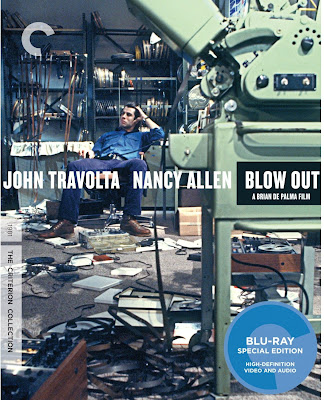
BLOW OUT: Blu-ray (Orion 1981) Criterion Home Video


In retrospect, Brian DePalma's Blow Out (1981) is a curious hybrid. It's a political thriller...well, sort of, yet far removed from the bland prestige that usual accompanies that subgenre. It's a love story...uh...in a way, since its leading man, sound editor Jack Terry (John Travolta) is hopelessly obsessed with the screams of a reformed 'working girl', Sally (Nancy Allen). It's a crime story...perhaps, but particularly in its climax; a traumatic race against time that uncharacteristically ends with the psychotic assassin, Burke (John Lithgow) as its victor. The most interesting aspect about Blow Out is that it manages to sustain all of these threads in perfect balance, its departure with our conventional expectations becoming more ambitious with each plot twist.


Perhaps the best assessment of DePalma's film was written by the late film critic Pauline Kael who suggested that Blow Out represents that seemingly irreconcilable crossroads between 'art', 'trash' and 'dreams'. If used as a sort of divining rod to examine DePalma's work as a whole, then Blow Out most definitely illustrates the director at his zenith.


DePalma is particularly engaged herein. His pacing of the action is so taut that from the very first frame to its last he strains the audience into a nail-biting frenzy. Exploiting his tricks of the trade, DePalma brings forth a seamlessly blended, exhilarating roller coaster ride that effortlessly bridges those deep chasms between art, trash and dreams.


The screenplay by DePalma and Bill Mesce Jr. opens on a generic disco-inspired B-slasher sex-capade, set in an all girl's college dorm no less. For a moment, our disillusionment is overwhelming. How could the man who gave us Carrie (1976) have degenerated into such low brow pop camp? The answer is glibly revealed to us as the intended victim of a paunchy middle aged mama's boy toting a knife, screams in terror at the sight of his weapon. Only what emerges from the naked blonde in the shower is hardly a scream.


We cut to the relative safety of an editing room inside Liberty Studios, a fly by night hole in the wall where sound technician, Jack Terry (Travolta) has been assigned the task of locating an actress on a budget who can provide him with that shriek of terror he will use to overdub this scene from a typical exploitation film. There's just one problem...none of the women he auditions are any good.


This is the first thread in DePalma's melange - 'trash' that Jack is ordered to turn into 'art'. But can he do it? Jack's quest for new sound effects to add to his library lead him to a catwalk beneath a bridge in Philadelphia where his calibrated equipment records various natural sounds on reel to reel tape. After a few false starts, Jack's microphone picks up the sound of a gunshot...or is it a blow out? A car comes into view, loses control and careens over the embankment, plunging into the river with Governor McRyan (John Hoffmeister) and his call girl, Sally (Allen) inside.


Jack dives into the frigid waters, discovers McRyan dead and Sally about to drown. Saving Sally from her fate, Jack is given the third degree by the governor's aid, Lawrence Henry (John McMartin) at the hospital. Henry suggests to Jack that Sally be kept out of the tabloids, a request Jack reluctantly agrees to. Still, there is something more sinister and troubling about this harmless cover up, presumably to spare the Governor's grieving widow and his family their dignity.


Meanwhile, amateur photographer, Manny Karp (Dennis Franz) announces to the press that he has film footage of the governor's 'accident'. Unbeknownst to Jack, Manny and Sally were part of a scheme to blackmail the governor, thus preventing him from running for the office of President. What is as yet unclear to Sally, is that the man who fired the fatal gunshot that killed McRyan, the assassin Burke (Lithgow), had been hired by Henry, not to scandalize the governor but to eliminate him from the race altogether.


To cover this trail of conspiracy, Burke kills several prostitutes around Philadelphia, all of them bearing a striking resemblance to Sally. He is dubbed 'The Liberty Bell Stalker' by the police and the press's interest in Governor McRyan's death goes away. The sophistication with which DePalma slowly dispatches these seemingly obvious threads of a cover up is what elevates Blow Out's premise from simple entertainment to pure 'art' - his second thread.


Regrettably, Jack refuses to accept the official cause of McRyan's demise as 'accidental'. Jack begins a flawed romance with Sally, one predicated on learning her complicity in what she believed was a crime of blackmail. Realizing that Sally is a relative innocent to the bigger crime of murder, Jack convinces her to wear a wire to help him draw Burke out of hiding.


It's a flawed premise, as Jack himself proves to be a very flawed hero- neither as romantic nor as heroic as Sally or the audience would want him to be. Yet, Sally's innocent devotion to Jack is both touching and tragic. She represents DePalma's final thread - the 'dream'. Without reason or logic, she has placed her life in Jack's hands, believing in the old adages that 'crime must pay' and 'good will triumph over evil'. Regrettably, the film's harrowing climax proves everyone wrong. Sally has overestimated Jack's sense of heroism as well as his love for her, just as Jack has underestimated Burke's cunning to outwit his technology. Jack loses Sally as a result of his own obsession.


Left with only Sally's recorded final screams of terror before she is murdered by Burke, Jack inserts Sally's death cries as the overdub for the B-movie he has been working on; an ill-fated homage that will continue to haunt him from her grave.


Blow Out is heartbreakingly poignant during these final moments, uncharacteristic for a movie that began with the stock premise of a 'who done it?' Yet, even with the discovery of the killer's identity made known to the audience long before the final showdown, Blow Out loses none of its tormenting dread. In fact, the penultimate cat and mouse chase through the crowded streets of a city, itself on the verge of its own urban renewal, sets the stage for Jack's eerie purgatory that follows.


Sally, the embodiment of that 'dreams' thread is destroyed, only to be reborn as 'an effect' for a trashy B-movie, and this from the man who ought to have been her protector. The real crime - the 'art' in that conspiracy to kill McRyan, goes unpunished. In the final analysis, Blow Out leaves these threads of art, trash and dreams as a mobile forever dangling overhead and just a little out of reach for our imperfect hero, our own collective consciousness also caught in that proverbial 'might have been' ending.


Criterion Home Video brings Blow Out to Blu-ray. But the results are not as universally appealing as one might expect. For starters, this is a 2K hi-def scan made at a time when 4K has already been established as 'the norm' in Blu-ray mastering and 6K is increasingly becoming the preferred resolution to achieve even greater clarity in the processed image. While film stock of this period is flawed to begin with, Blow Out's resultant image has adopted a rather severe 'red' palette as a result of this current remastering effort. Flesh tones are frequently garish orange rather than flesh like.


Grain structure, that has always been apparent and is a part of the viewing experience of this film, still retains a moderately harsh edge to it; more digitized that film like. The overall presentation is considerably darker than on the previously issued DVD from MGM. The DVD, it should be noted, had its contrast levels severely bumped up. But while the DVD looked too bright, the Blu-ray appears just a tad too dim with a definite loss of fine detail, particularly during night scenes.


This rendering of Blow Out has been given the thumbs up by DePalma, but it doesn't quite measure up to my level of expectation. I still believe Vilmos Zsigmond's cinematography is being given short shrift. Overall, what we see here is only marginally sharper than what was apparent on the DVD. There's also a few fleeting glimpses of edge enhancement on the Blu-ray that, ironically, were not found on the inferior DVD rendering. Check out the rather obvious edge enhancement on the grills and chrome of parked cars in the scene where Jack and Sally pull up to the train station near the end of the film to hunt for Burke.


Criterion sticks to its guns and maintains a faithful 2.0 stereo track that, although dated, is rather appropriate for the film. Extras are the real plum in this pudding: an hour long interview with DePalma, new interviews with Nancy Allen, DePalma's 1967 feature Murder a la Mod (that exhibits mere traces of the magic touch the director would later exhibit), plus a new interview with Steadicam inventor, Garrett Brown and the film's original theatrical trailer.


The feature film's moderate bit rate is also a sticking point with this reviewer. If extras are to be included, then let them be featured on a second disc so that the overall Blu-ray bit rate for the feature itself is not compromised. Criterion is not the first or only studio to attempt cramming everything they can onto one disc simply because they can, but this seems as good a time as any to point out that the practise ought to be stopped! Overall, Blow Out on Blu-ray is recommended, although with slight misgivings.


FILM RATING (out of 5 - 5 being the best)


4


VIDEO/AUDIO


3


EXTRAS


3.5

Friday, April 22, 2011

VANITY FAIR: Bluray (Focus Features 2004) Alliance Home Video


Based on William Thackeray's panoramic social critique of English society, director Mira Nair's Vanity Fair (2004) is a lushly exotic, occasionally erotic and always flamboyant celebration of period costume. That the central performances sometimes become secondary to Declann Quinn's gorgeous cinematography is a misgiving I have no doubt Thackeray himself would have approved of, particularly when the story focuses on the absurdities of the aristocracy.


Made in 1935 as Becky Sharp starring Miriam Hopkins, this remake also proved to be an expensive dud at the box office. Yet, this is indeed a shame, because unlike the 1935 version, Nair's remake is both clever and concise, no small feat given the expansiveness of Thackeray's novel.


It should be pointed out that Thackeray's central character, Becky Sharp is hardly a stock Hollywood heroine and this is perhaps the difficulty many have when viewing any film derived from the book, because their level of expectation for a winsome gal in a bodice and corset is at odds with the complexities of the character that Thackeray wrote into immortal literature. Becky Sharp is a shrewd, conniving and manipulative social climber. Her thirst for riches is unquenchable and will cease at nothing to be satisfied.


In Nair's version, Becky is played with exceptional reverence by Reese Witherspoon, who was pregnant at the time of filming no less! In the Matthew Faulk, Julian Fellowes, Mark Skeet screenplay we are first introduced to Becky as a child inside her father's impoverished artist's studio, determined to barter with the exceptionally wealthy Marguess of Steyne (Gabriel Byrne) for a price to be paid on her father's latest portrait.


The Marguess acquiesces to the child's demand and, after the death of her father, Becky is sent to Miss Pinkerton's (Ruth Sheen) Academy for Young Ladies where she is generally abused and overworked. At the end of her tenure at this finishing school, Becky is sent to the dilapidated country estate of Sir Pitt Crawley (Bob Hoskins) to manage the education of his two young daughters.


Becky's one true friend, Amelia Sedley (Romala Garai) continues to write to her at Sir Pitts regularly. Amelia's rather oafish, though kindly brother, Joseph (Tony Maudsley), who is an officer in the army, is entranced by Becky from the start but heartily discouraged from pursuing a romance with her by his fellow officer George Osbourne (Jonathan Rhys-Meyers).


Sir Pitt is most impressed by Becky's tutelage and the way that she has whipped his unkempt house into shape for the arrival of his wealthy sister, Matilda (Eileen Atkins) whom he depends on for his own inheritance. Matilda is a shrewd woman and recognizes Becky's intensity to be of this upper class rather than simply a slave to them.


To this end, and even moreover because it will frustrate the family, Matilda brings Becky back with her to London where she eventually falls in love with Matilda's favourite nephew, Rawdon (James Purefoy) who is a Captain in the Royal Army. Meanwhile, Amelia fancies herself engaged to George. But he is selfish prig who considers Amelia an unfit match after her father's estate is ruined by his father (Jim Broadbent). To defy his father's edict that he should marry a wealthy woman rather than out of true love, George marries Amelia instead and is promptly ostracized from the family. The same fate befalls Rawdon after he sweeps Becky off her feet and is disowned by Matilda. This forces Rawdon and Becky to survive on his soldier's salary, which is meagre at best, and by her wits, which are amply endowed.


Amelia, George, Rawdon and Becky take their holiday in Brussels. However, after the outbreak of war with Napoleon, George and Rawdon are called into service while Becky and Amelia are driven into seclusion to wait out the duration of the Battle of Waterloo. George is killed during this skirmish, leaving Amelia with child. Mr. Osbourne refuses to acknowledge Amelia as his late son's wife, but takes a definite interest in his grandson, whom he will eventually steal away from Amelia.


In the meantime, Becky enters into an arrangement with the Marguess. This 'trade' secures Becky and Rawdon the necessary monies to live off but also destroys their marriage after it is revealed that Becky is expected to come to the Marguess whenever she is called to satisfy his sexual favours. Distraught, Rawdon leaves Becky for good and is forced to abandon their son with his brother, Pitt (Douglas Hodge) before accepting a commission on Coventry Island where he succumbs to Yellow Fever and eventually dies.


Revealing to Amelia that George once attempted to seduce her while still married, Becky pursues Joseph in India where he has become quite a wealthy land owner. Realizing that she has been a fool in love, Amelia surrenders her memory of George and their child to marry Major William Dobbin (Rhys Ifans), the only man who ever loved and cherished her from afar.


Vanity Fair is sumptuous and extraordinarily engrossing at times. The screenplay is adept at keeping all of the characters at play. Yes, the show belongs to Becky Sharp, but we're also introduced to a miraculous ensemble of witty, adroit and deceptively handsome characters, all entertaining fascinating back stories that only serve to enrich our experience as a whole. If there is a criticism to be made about the film, it is that Nair's direction at times seems to momentarily depart from the true period in which the tale is set into a suspended neo-classic realism that remains slightly at odds with the rest of the story.


As example, the sequence in which a discarded Becky performs a rather erotic India ballet could almost take its cue from a vintage MTV music video. While staged with finesse and beautifully photographed, the sequence does tend to stand apart from the scenes that bookend it and this can be quite jarring. Nevertheless, Vanity Fair proves itself a riveting melodrama. It is a must see/must own visual cream sundae with solid performances that will live on long after the elegant Ms. Sharp has departed for greener pastures.


Alliance Home Video's Blu-ray is quite beautiful. Mastered in full 1080p, the image exhibits some very breathtaking colours, gorgeously rendered fine details, and an all around stunning image that will surely not disappoint. Flesh tones are bang on as are contrast levels. Blacks are solid and velvety deep. Whites are crisp and clean. Film grain is represented as grain not digital grit. There are no digital anomalies to speak of. The audio is 5.1 DTS and very hearty indeed. Mychael Danna's sultry score is the real benefactor. Dialogue is natural sounding.


Extras are scant but well placed, included three brief featurettes that cover similar ground on the making of the film, plus an audio commentary by Nair that is comprehensive to say the least. Aside: I could have done without Alliance Home Video's interminable litany of trailers that precede the feature, but overall I have to say that in this case, their handling of the Blu-ray format is most satisfying.


FILM RATING (out of 5 - 5 being the best)


3.5


VIDEO/AUDIO


4.5


EXTRAS


2

THE KING'S SPEECH: Blu-ray (Weinstein 2010) Alliance Home Video


Some movies are revered for their exceptional advancements in the art of motion picture making. Others are clearly a throwback to that simpler time when movies were required to entertain us without breaking all the rules or simply flooding the screen with a mind-boggling assortment of special effects.


Tom Hooper's The King's Speech (2010) is of this latter ilk; a poignant 'talking picture' whose strength, oddly enough, is derived from its dialogue. I say, oddly, because one of the principle performances in the film requires our patience to suffer through a stutter that is as psychologically crippling to its character as it proves to be a genuine chore to listen to throughout the movie.


Ah, but how well The King's Speech wears this mantel of frozen respectability and how easily it wins our hearts with its re-envisioning of the proverbial 'underdog makes good' narrative that fundamentally we're all suckers for.


Colin Firth magnificently stars as Prince Albert, Duke of York who is the younger brother to David (Guy Pearce) the future King of England. Albert suffers from a near paralytic stutter that is exaggerated whenever he becomes nervous. His shortcomings as a great orator are made painfully clear at the start of David Seidler's screenplay, as Albert attempts to address a crowd of several thousand at Britain's 1925 Empire Exposition inside Wembley Stadium (no, pressure there!).


The address is a disaster and an embarrassment to King George (Michael Gambon). Still, the King can take some comfort in knowing that Albert will not be the one to succeed him on the throne. That honour belongs to first born, David - that is, until he decides to forsake his country for the woman that he loves, divorcee Wallis Simpson (Eve Best).


As George falls ill, and eventually dies, all eyes turn hopeful and desperately for inspiration to Albert and his dutiful, doting wife, Elizabeth (Helena Bonham-Carter). After Albert attempts with no avail to rid himself of his stutter through conventional methods, Elizabeth decides to secure Australian speech therapist, Lionel Logue (Geoffrey Rush) for the cause. At first, Lionel does not recognize Her Royal Majesty and turns the offer down.


Lionel's unorthodox methods for treating the cause of Albert's stuttering create initial friction between the two men. Lionel insists on calling the future King 'Bertie' to his face and thereafter breaks almost every rule of monarchical etiquette in order to challenge and defeat the emotional ties that have made Albert so insecure. After Lionel tells the king that he should abandon smoking to soften his acoustic nerves, Albert informs Lionel that smoking has been soundly conferred on him as a means to manage his stutter by the King's physicians.


"They're idiots," Lionel exclaims.


"They've all been knighted," Albert suggests.


"Makes it official then," concludes Lionel.


As Adolph Hitler amasses his armies in readiness for the invasion of Europe, Albert prepares for what will eventually go down in the annals of history as his finest hour; the King's speech delivered with such sustained poise and grace that it rallies his nation to war.


In the ye good ol' days of Merchant-Ivory, The King's Speech would have been a lavishly appointed Edwardian spectacle with a visual sumptuousness to rival its subject matter. Tom Hooper does not have that luxury, however. In fact, the film was almost not made because no one holding the purse strings could envision a hit from a movie about two men talking to one another.


As such, The King's Speech is very much a throwback to the 'drawing room' talkies made some sixty years before by the Archers at Pinewood Studios in England. There's very little outside of the relationship between Albert and Lionel worth mentioning and yet it proves to be everything!


Danny Cohen's cinematography captures the dark dinginess of coal fogged London. Jenny Beavan's Costume Design resurrects the classicist system with superb attention to every last detail. With the limited means afforded them, Production Designer Eve Stewart and Art Director Netty Chapman work a minor miracle.


Still, the effortless repartee between Rush and Firth is what sustains this movie. Both are skilful thespians, classically trained masters in the art of acting and it shows in every enriching frame that they appear in together. Helena Bonham-Carter is a very capable Queen Elizabeth. Derek Jacobi provides a very solid cameo as Archbishop of Canterbury.


In the final analysis, The King's Speech is most deserving of its Best Picture Academy Award, and now those who missed it in theatres can finally deduce for themselves the reason why. Alliance Home Video's Blu-ray is visually stunning, which is saying much for a film whose cinematography is just average.


The transfer is a feast for the eye with very solid colours that are bold and rich. The film's general colour scheme adopts a blue-gray patina but the Blu-ray's handling of this subtly nuanced palette is perfection!


Fine detail is evident in every scene. Blacks are deep and solid. Whites are somewhat subdued, but again, this is in keeping with the film's original visual presentation. The audio is DTS 5.1 and although hardly as aggressive as your run of the mill action flick, is nevertheless hearty and robust. Dialogue is very natural sounding. Alexandre Desplat's score is given its moment to shine.


Extras are rather limited. We get a featurette on the inspirational back story and a Q&A session with director and cast as well as speeches from the real King George (the name Albert took after becoming king). There's also an informative audio commentary from Hooper.


The King's Speech comes highly recommended. It's 'old fashion' in the very best tradition of movie making and it really reminded this critic why he used to love going to the movies so often as a child.


FILM RATING (out of 5 - 5 being the best)


4


VIDEO/AUDIO


5


EXTRAS


3

LOGAN'S RUN: Blu-ray (MGM 1976) Warner Home Video


At least in literature, the 1970s were a particularly prolific period for science fiction morality tales; most foreboding, forewarning and, occasionally, foreshadowing visions of an apocalyptic future where some facet of mankind's own stupidity brings about the end of his civilization only to give rise to another even more terrifying than the one left behind.


Based on William F. Nolan and George Clayton Johnson novel of the same name, director Michael Anderson's Logan's Run (1976) is supposed to be a movie about a dystopian 23rd century megacity where population control is achieved by killing everyone over the age of thirty. That the resultant motion picture emerges as a colourful claptrap rather than lush metaphor for this moral decline and societal evolution is indeed a shame as well as a gross bastardization of the source material.


Cheap jack sets and ultra tacky special effects (that won an Academy Award!) are painfully obvious in all their 70s chic moderne design. This isn't the future. It is, in fact, the then immediate present, gussied up with a few flashy/trashy pieces of modern art that have severely dated over the last 30 plus years.


Of course, as a time capsule of 70s cinema all this oversight in Robert De Vestel's Production Design would be largely forgivable if the screenplay by David Zelag Goodman did not degenerate into a pointless chase spectacular, shot mostly in and around Fort Worth and on the old MGM back lot (in a deplorable state of decay and about to become a housing project).


The film stars gooney-looking '70s pop star Michael York as Logan 5, a bounty hunter working the policed state circa 2274. On the surface, the future is an idyllic paradise populated by half naked sex kittens wearing no bras or panties beneath their paper thin diaphanous gowns and buff young surfer dudes who can barely hide what God gave them under their Nylon/spandex ensembles. All these ludicrous outfits are colour coded to reflect the age of the person who wears them.


At birth, infants have a chip imbedded in the palm of their hands that changes colour as they grow up. Red proves to be the most lethal hue in the spectrum. For once the chip turns red and begins to blink it signifies the end of an imposed life expectancy. These inhabitants are collected together, trade in their colour coded robes for white hooded garments (that look like cast offs from the KKK) and demonic looking black and white hockey masks and are sent to 'carousel'; a new fangled take on the old Roman arena.


With the rest of the city's gentry cheering them on, these expired individuals are hurled toward a spinning vortex that vaporizes them in much the way a garden bug zapper dispatches unwanted mosquitoes and flies.


Logan 5 and his best friend, Francis 7 (Richard Jordan) are Sandmen - assigned to capture a wayward expiree - known in the film as 'runners' - who has escaped the most recent carousel. After some silly running around all over the multileveled interior of the Dallas/Fort Worth Metroplex, the runner is quickly dispatched by Logan and Francis using their childish 'flare guns' that are about as excitingly executed on the screen as watching lead paint dry.


All hot and bothered from the chase, Logan returns to his apartment to search for recreational sex on 'the circuit' - a pay as you go service that teleports companionship right into your room. Logan's desires come to rest on Jessica (Jenny Agutter); a Twiggy-esque blonde airhead.


But after Jessica and Logan engage in a conversation about why it is wrong to run, Jessica opts to leave Logan to his own devices. Before she leaves his apartment, however, Logan takes notice of an ankh pendent around her neck. Back at Sandman headquarters, the computer reveals to Logan that the runner he and Francis killed also wore a similar pendent belonging to a secret organization that helps runners escape their fate by showing them the way to 'sanctuary'. Logan is given the assignment to locate sanctuary and destroy it. To convince the organization that he is also in jeopardy of being called to carousel, the computer advances Logan's palm crystal time clock so that it begins to flash red.


Remembering Jessica's ankh pendent, Logan reunites with her and helps another runner escape. Francis, who is unaware of Logan's assignment takes Logan's actions as treason against the state and sets out to destroy him.


Logan and Jessica's first port of call is a medical clinic overseen by Doc (Michael Anderson Jr.) and his sultry assistant, Holly (Farrah Fawcett-Majors). Here, life altering plastic surgery is achieved through instant laser procedures in a matter of seconds. Jessica assures Doc that Logan is their friend, but Doc is unconvinced. He places Logan in the operating chamber then attempts to cause the machine to malfunction so that the lasers will burn Logan to death.


Too bad for Doc that Logan is a better fighter than the machine. After escaping the operating table, Logan manages to toss Doc inside the chamber where he is seared to death by laser beams. Holly follows Logan and Jessica to an abandoned part of the city where members of the organization who save runners are waiting. After some initial convincing, one of the members instructs Logan and Jessica to make their way beneath the city, using the ankh pendent as a key to open various vapour locks along the way.


Unfortunately, Francis and an army of Sandmen arrive at that moment. They blow open the first gate barring their entry and this explosion kills Holly. Logan and Jessica escape into the bowels of an underground 'fish farm'. Francis floods the chamber with sea water but Logan and Jessica manage an escape and find themselves in a brightly lit frozen cave overseen by the robot keeper, Box (Roscoe Lee Browne).


After some initial exploration of the cavern, Logan and Jessica come upon the tombs of all the previous runners whom Box has frozen. Box now informs Logan and Jessica that they too must be frozen as a possible future food source (shades of Soylent Green). Logan fights back, destroying Box and much of the cavern to reveal a porthole to the outside world...but is this sanctuary?


Decidedly not. In fact, after walking some distance through swampy marshes and densely overgrown forests, Logan and Jessica come upon the tattered remains of Washington D.C., a city they have never known but whose landmarks are distinct and easily recognizable to the audience. In the Capital Building, Logan and Jessica discover 'Old Man' (Peter Ustinov); a rather hapless, cat loving curmudgeon whom they promise to bring back to their world as proof that one can grow old. Unhappy circumstance that Francis has found his way to the Capital Building and, after a struggle, he is killed by Logan in the vine encrusted hallows of the former U.S. Senate.


Logan and Jessica take Old Man back to the city, though why either of them should desire to ever return there is beyond the scope and understanding of this critic. Leaving Old Man just beyond the city limits, Logan and Jessica are captured and taken to Sandman headquarters where the computer attempts to extrapolate the true origins of sanctuary from Logan's thoughts.


The revelation that sanctuary does not exist is too much for the computer to bear. It overloads and short circuits. Logan and Jessica escape, killing more Sandmen in the process. The city's authoritarian command centre self destructs and the inhabitants are released into the outside world where they discover Old Man eagerly waiting to meet them.


Logan's Run is utterly mindless in both its narrative and execution. The acting is universally terrible, except for Peter Ustinov who seems to be having a ball hamming it up and, as such, delivers a most amusing cameo.


I must admit that the matte work and cinematography by Ernest Laszlo is first rate, particularly when melding the MGM back lot to paintings of the corroded and overgrown Lincoln Memorial and Capital Hill. But Dale Hennesy's Art Direction is a disaster. Glen Robinson and Wayne Rose ought to be ashamed of their SFX work that singularly fails to fire the imagination.


The long shot miniatures of the domed city have all the believability of a cartoon model of the 1960s New York World's Fair. If this is a vision of the future, it is one of the most lugubrious and uninspired yet to make it down the Hollywood pipeline.


Warner Home Video brings Logan's Run to Blu-ray in a rather middle of the road transfer. When the transfer kicks into high gear, the 70mm elements are bright, registering good colour fidelity and contrast levels with a considerable amount of fine detail evident throughout. Unfortunately, optical process shots are extremely grainy and even more obvious to the naked eye. The audio is unexceptional, with Jerry Goldsmith's score given solid representation. Dialogue is never natural sounding and sound effects are often strident.


Extras are restricted to a rather meandering and self congratulatory audio commentary from Michael York and director Michael Anderson who gush and coo about the film as though it were the futuristic equivalent to Gone With The Wind. There's also a vintage featurette, badly faded and full frame, where star and director once again extol the virtues of their efforts in the film.


If there's nothing like a great sci-fi movie to kick off the summer season of blockbusters than Logan's Run is indeed nothing like a great sci-fi movie! It's not even second tier vintage camp. It's just plain awful, two hours of one's life that can never be taken back, and should be avoided at all costs. This is, quite easily, one of the worst motion pictures to ever be financed by a major Hollywood studio!


FILM RATING (out of 5 - 5 being the best)


0


VIDEO/AUDIO


3.5


EXTRAS


1


Wednesday, April 13, 2011

TRACY & HEPBURN: THE DEFINITIVE COLLECTION (Warner,Fox Sony, Universal 1942-1967) Warner Home Video


Hollywood's dream merchants of the golden age were savvy businessmen to be sure. But they were also blessed with an intuitive creativity, a necessary commodity in the film industry then and one almost entirely, and regrettably, lacking from movie making today. One of the most enduring ghost flowers from that nearly mythical age was the creation of magnificent pairings; bringing together individual gifted talents to yield an even more fruitful alliance that audiences could relate to and fall in love with.


Over the years there have been many such alliances exclusively created for the movies; Greer Garson and Walter Pigeon, William Powell and Myrna Loy, Clark Gable and Joan Crawford, Gable and Lana Turner, and, Judy Garland and Mickey Rooney. But if you had to pick just one team that exemplified this legacy of screen pairings, I have a feeling the vote would be unanimously cast for Katharine Hepburn and Spencer Tracy.


By the time they made their screen debut as a couple in 1942, each had already been working steadily - if unevenly - in the industry for more than 10 years. Their respective bodies of work apart from each other had made their faces easily identifiable. Each had cache at the box office, although Tracy's was more secure in his than Hepburn by 1942. If, apart, they held their own, then together they were the quintessence of martial perfection in 9 movies between 1942 and 1967, the year of Tracy's death.


The truth, of course, was far removed from this idyllic on screen portrait. Tracy, a devote Catholic, was already married to Louise with two children of his own while Hepburn had managed a string of highly publicized affairs that, like her movie career seemed to have their critical ups and downs.


Once labelled 'box office poison', Hepburn had managed to claw her way back to stardom after appearing in both the stage and screen versions of The Philadelphia Story (1940). The clout Hepburn acquired from this film earned her the right to choose her next screen property, Woman of the Year (1942) and with it her choice of leading man. Hepburn chose Tracy. It was the beginning of a memorable partnership.


In retrospect, George Steven's Woman of the Year (1942) seems the ideal vehicle to debut Tracy and Hepburn as two relentless go-getters who desire one another but have to choose between their respective careers and true love. In real life, there was never any question as to what came first. But in the screenplay by Ring Lardner Jr. and Michael Kanin, newspaper political analyst, Tess Harding (Hepburn) is not at all certain that she prefers the company of crass sports columnist, Sam Craig (Tracy) to her work on the newspaper.


On the surface, Tess fits quite nicely into Sam's world, though he remains an affront to her cultured set, particularly Tess's ever present male private secretary, Gerald Howe (Dan Tobin). Despite their obvious differences, Tess and Sam are married and adopt a refugee child, Chris (George Kezas) whom Sam takes to with a genuine affinity, but whom Tess regards merely as another appendage to her already overwhelmingly busy social life. Realizing how unfair this is to Chris, Sam returns him to the orphanage while Tess is out on one of her political rallies. Infuriated, Tess is told by Sam that their marriage is over.


Next, Tess receives a phone call from Ellen Whitcomb (Fay Bainter), the aunt who raised her. After years of sacrificing her own happiness in the service of causes, Ellen has decided to marry Tess's father (Minor Watson). As a result, Tess also comes to realize that a woman of influence must eventually make her choice between love or having a career.


To prove her love for Sam, Tess sneaks into his apartment the next morning, determined to remake herself into a good wife by cooking him breakfast. But this menial task becomes a hilarious disaster. However, her genuineness at attempting domesticity strikes a chord with Sam and they are reconciled.


Although no one probably knew it at the time, Woman of the Year was to become the template for most Tracy/Hepburn films that followed. With few exceptions, the two would play variations on this sparing couple formula for the rest of their careers. The first exception to this rule however is their next film together, George Cukor's Keeper of the Flame (1942); a dark and brooding mystery/thriller with political undertones, based on Donald Ogden Stewart's best-selling novel.


In retrospect, the film is an ill fit for Tracy and Hepburn, though it did moderately well at the box office at the time of its release. She plays Christine Forrest, the youthful wife of a nationally revered elderly political statesman, Robert Forrest who drives his car over a bridge to his own death one stormy evening. Was it suicide or murder?


The rest of the I.A.R. Wylie screenplay plays fast and loose with a stack of red herrings. These include the possibility that Christine killed her husband after he learned she was having an affair with her cousin, Geoff Midford (Forrest Tucker), or perhaps was toying with Robert's social secretary, Clive Kerndon (Richard Whorf).


After surveying the outpouring of public grief at Robert's funeral, Reporter Steven O'Malley (Spencer Tracy) begins to suspect Christine of all sorts of wickedness, particularly after he has a brief tete a tete with Robert's insane mother (Margaret Wycherly) who suggests that her son's marriage to Christine was a destructive union doomed to fatalism. Eventually, the real truth emerges, that Robert was a fascist working from his time honoured political connections within the government to secretly destroy the United States.


In retrospect, Keeper of the Flame is a nonsensical espionage thriller. Hepburn doesn't do the haunted femme fatale thing well at all and Tracy seems more lugubrious than laconic as the investigative reporter. That spark of Tracy/Hepburn chemistry and magic so potent in Woman of the Year is entirely absent herein. Perhaps because of this, Hepburn and Tracy would not make another film together until 1945's Without Love, a charming minor programmer based on Philip Barry's smash stage hit. This film returns Tracy and Hepburn to their romantic comedy roots.


Tracy is Patrick Jamieson, a brilliant scientist who takes a room in the mansion of a young spinster, Jamie Rowan (Hepburn) to conduct his vital experiments for government research in her basement. After an initial misunderstanding, a gradual friendship blossoms between these two and Jamie suggests that they marry 'without love' to conceal the true reason for his staying at her home. Patrick is reluctant on the subject, having had nothing but bad luck with relationships. Nevertheless, the two are married and agree to a platonic understanding that eventually gives way to genuine feelings of romance.


The next film, Elia Kazan's Sea of Grass (1947) is a rather breath-taking melodrama set against the vast expanses of the western frontier. Based on Conrad Richter's novel, the screenplay by Marguerite Roberts and Vincent Lawrence is a battle of wills.


Hepburn is Lutie Cameron, a prim St. Louis bride who marries New Mexico rancher, Colonel Jim Brewton; a man who uses intimidation and force to keep settlers off the unspoiled plains. Jim's arch enemy in town is Brice Chamberlain (Melvyn Douglas), who eventually becomes an elected judge and thereafter launches a full scale attack on Jim's interests in the name of the law.


After Jim's stake in preserving the plains leads to a near fatal bludgeoning of homesteader, Sam Hall (James Bell) and the miscarriage of his wife, Selina's (Ruth Nelson) child, who just happens to be Lutie's good friend, Lutie realizes that her husband is the aggressor, not the hero of the west that she has imagined for herself.


This revelation begins a rift in their marriage, one that leads Lutie into an affair with Brice in Denver. The result of this fleeting moment of passion is a son, Brock (Jimmy Hawkings as a child, Robert Walker as an adult) that Lutie reveals is not Jim's while she is in labour.


Loyal friend, Doc J. Reid (Harry Carey) vows to keep Lutie's secret, but eventually the town's folk begin to suspect the affair and Jim's marriage to Lutie crumbles. Lutie leaves her children in Jim's care but eventually returns to his side, the years having mellowed the differences that once divided them.


I didn't expect to enjoy Sea of Grass as much as I did, especially when I read that director Kazan hated the finished film so much that he encouraged his friends not to see it. Yet, the final product is a considerable masterwork with a sweep and grandeur that only a studio like MGM could pull together during its heyday.


True enough, this isn't the Tracy/Hepburn chemistry that fondly, or even immediately, comes to mind but the two deliver competent performances that are faithful to the source material. The Roberts/Lawrence screenplay manages to bring believable concision to the expansive novel and, as a result, we get a generational narrative that only occasionally seems mildly rushed.


The next film in the Tracy/Hepburn cannon remains one of their very best; Frank Capra's State of the Union (1948), produced independently for Capra's Liberty Films production company and distributed by MGM. Once again, Tracy and Hepburn are cast as an established married couple; Grant and Mary Matthews. Grant is a U.S. Senator whose pureness of heart in the political arena is about to be corrupted by wily publicist Jim Conover (Adolph Menjou) and newspaper maven, Kay Thorndyke (Angela Lansbury).


In fact, Kay and Grant have been having an affair for sometime in Washington D.C. while Mary has remained back home. Convinced by Conover that Grant has a real spot at becoming President, Grant is also informed by Kay that to have a real shot at the office he must patch things up with Mary before embarking on the campaign trail as a viable 'family oriented' candidate.


After some reluctance, Mary returns to Grant's side, partly because she truly believes in him as a strong and honest man who is right for the job. Cynical press agent, Spike McManus (Van Johnson) starts out on Grant's side with his own misgivings but gradually comes to respect Grant as Mary does. All the more reason for Mary and Spike to suddenly find themselves bitterly disillusioned when Grant starts to take his cues from Conover and Kay, who suggest that the only way to win the party's nomination is to lie, steal and cheat.


State of the Union is Capra's most inspired, politically themed film since Mr. Smith Goes To Washington (1939). Hepburn and Tracy are superb together as a married couple torn apart by external forces that threaten not only their marriage but also the very essence of who they are as people. Anthony Veiller and Myles Connelly's screenplay, based on the stellar stage play from Howard Lindsey and Russell Crouse is as fast moving as the political machinery that threatens to destroy an honest man. This is a great film!


Tracy and Hepburn move on to what is today probably their most fondly remembered sparring, in George Cukor's Adam's Rib (1949); a fascinating battle of the sexes made fashionably funny long before the 60s feminist revolution. They play Adam and Amanda Bonner, two halves of the legal system. He is a prosecuting attorney. She is a defence lawyer. Both find themselves on opposite ends of the same case when a woman named Doris Attinger (Judy Holliday) is charged with attempting to murder her philandering husband, Warren (Tom Ewell).


To prove her point in the courtroom, that women are judged inferior to men by a patriarchal society, Amanda is willing to place her relationship with Adam on the line, even encouraging the flirtatiousness of song writing playboy, Kip Lurie (David Wayne). Once seen, few can forget the iconic moment when Adam, who is giving Amanda her rubdown in their apartment midway through their case, decides to slap her behind instead to silence her from singing Kip's song. When challenged by Amanda, who suggests to Adam that his reaction is 'typical masculine brutality', Adam replies "What do you have back there? Radar equipment?"


Adam's Rib is delightfully astute in its critique of the unique qualities that separate male from female and masculinity from femininity. Ruth Gordon and Garson Kanin's screenplay is as poignant as it is hilarious, taking an exceptionally rare and deft excursion that rings more than a few 'true to life' bells along the way. Tracy and Hepburn chew up the scenery with galvanized performances that are as relevant as ever.


After a hiatus of nearly 3 years, George Cukor's Pat and Mike (1952) proved - as though proof were required - that the Tracy/Hepburn chemistry was as vital as ever. Once again Ruth Gordon and Garson Kanin provide a stellar screenplay, this one casting Hepburn as Patricia Pemberton, a superior all around lady athlete who can withstand any adversary except the condescending stare of her stuffy academic fiancée, Collier Weld (William Ching). To ease her anxieties, Patricia enlists the help of Mike Conovan (Tracy) who is currently involved in training brain dead pugilist, Davie Hucko (Aldo Ray) for the heavyweight championships.


Unable to quantify that elusive quality that makes Pat so proficient an athlete, Mike knows too well what her downfall is. To the purpose of securing Pat's own successes for the newspapers and provide himself with a perennial meal ticket, Mike becomes Pat's full time trainer, keeping Collier at bay. Narrowly rescued by Pat from having his legs broken after a bet goes sour, Mike decides that Pat is the only gal for him.


In retrospect, Pat and Mike is the last truly great Tracy/Hepburn film. It also happens to be the final movie they made for alma mater, MGM. Their next endeavour, Walter Lang's Desk Set (1957 at 20th Century-Fox) is an atypical retread of themes already explored elsewhere. Leon Shamroy's cinematography is much more concerned with celebrating the expansive rectangular layouts of Cinemascope (that I must confess, are grand), than it is in re-interpreting the old Tracy/Hepburn intimacy for the widescreen.


The screenplay by Phoebe and Henry Ephron isn't bad, per say, but it does tend to meander somewhat, losing focus on the increasingly romantic friendship between efficiency expert, Richard Sumner (Tracy) and research analyst Bunny Watson (Hepburn). To a large extent, the old Tracy/Hepburn chemistry is blunted by the intrusion of Gig Young as Mike Cutler, Bunny's soon to be ex-fiancée and, strangely enough, by Hepburn's performance that attempts to balance the strong savvy archetype she helped to create in films like Adam's Rib with a more giddy school-girlish fascination for Mike that seems grossly out of character.


The final film to star Tracy and Hepburn also proved to be the last for Tracy, who died at the age of 67 a scant two weeks after filming Stanley Kramer's Guess Who's Coming to Dinner (1967). Viewed today, the film's 'love is color blind' social critique, then timely in a country struggling with the civil rights movement, seems moderately clichéd today. Nevertheless, the screenplay by William Rose makes the attempt to take an honest - if gentile - look at the subject of racism from both sides.


Tracy and Hepburn are Matt and Christina Drayton, a forthright older married couple whose liberalism is put to the test when daughter, Joey (Katharine Houghton, who is actually Hepburn's niece) announces she is engaged to be married to Dr. John Wade Prentice (Sidney Poitier) - a man whose skin colour obviously does not match their own. Christina is at first shocked, but then accepting of their union. Matt, however, is challenged by a spectre of emotions and feelings he probably never realized he even had until this very moment.


The family's close friend, Monsignor Ryan (Cecil Kellaway) is dismayed at Matt's inability to overcome his prejudices. Yet, even these pale to the intolerances exhibited by John's own father (Roy E. Glenn) who is discouraged with his son's decision to marry a white girl. Meanwhile, Christina attempts to win over Mrs. Prentice (Beah Richards).


The film is most fondly remembered today for its brilliant summation delivered by Tracy during the final moments, where he equates John and Joey's love for each other with the depth of mutual admiration, respect and sincerity that he and Christina have shared throughout their years together. Yet, in this abridgement of love's great story there also seems to be a blurring of the lines between reality and fiction; the very public relationship Tracy and Hepburn shared for so many year together just as meaningfully embodied and on display in this film's penultimate poignant declaration.


Warner Home Video has at long last collected the works of these two formidable icons of the screen into one deluxe box set, aptly titled 'Tracy & Hepburn: The Definitive Collection'. And although 'definitive' it most certainly is, at least in the essence that every movie from their tenure is represented herein, the quality of these transfers hardly lives up to that moniker.


In fact, with the exception of Keeper of the Flame and Sea of Grass, the rest of the transfers included in this box set are identical to those previously released from their respective studio catalogues. This is a regrettable oversight, since Woman of the Year, Pat & Mike and Adam's Rib (arguably the most iconic Tracy/Hepburn movies in this set) sport problematic digital transfers that date all the way back to 1997 and the infancy of DVD mastering.


None of the transfer are terrible, but Woman of the Year, Pat & Mike and Adam's Rib contain a considerable amount of edge enhancement and shimmering of fine details that this critic had hoped would be eradicated for this new 'definitive' release. Overall, the gray scale has been exceptionally preserved on all of the B&W movies in this set. Keeper of the Flame seems to suffer from contrast levels that are just a tad lower than expected. The transfer on Sea of Grass occasionally suffers from more prevalent grain than one might anticipate.


On the whole, however, the image quality is adequate and will surely not disappoint. The best looking B&W transfer of the lot unquestionably belongs to State of the Union - released by Universal Home Video. It's the same transfer as released in 2002, but remarkably smooth, sharp and full of fine detail throughout.


Only Desk Set (from Fox) and Guess Who's Coming to Dinner? (from Sony Home Entertainment) are in color and widescreen. These are also the same digital transfers as before, Desk Set from 2004 and Guess Who's Coming to Dinner? from its reissue in 2006. Both contain beautiful looking transfers, the Cinemascope offering on Desk Set supporting slightly more refined and richer colours, though ironically a little less fine detail than is evident on Guess Who's Coming to Dinner?


Extras are limited to a few short subjects included on Sea of Grass and Keeper of the Flame. There's also audio commentaries on Desk Set and Guess Who's Coming to Dinner? The last extra worth mentioning is Kate Hepburn's personal tribute documentary to Spencer Tracy, housed on a separate disc. The quality of this transfer is, frankly, terrible. The film clips included are often blurry, grainy and out of focus. For a definitive collection like this, it would have been nice to have new masters on all of the titles, but particularly on Woman of the Year and Adam's Rib, plus audio commentaries on each film and, at least chapter stops included on State of the Union, Sea of Grass and Keeper of the Flame!


For the price point of $49.99, I suppose I can recommend this collection to someone who has yet to have purchased any of these titles as they originally appeared one separate discs. But if you already own all but Sea of Grass and Keeper of the Flame, my advice is to simply buy these two titles as they are sold separately and add them to your collection. You get nothing new in this set that would warrant a repurchase.


FILM RATING (out of 5 - 5 being the best)


Woman of the Year 4


Keeper of the Flame 2.5


Without Love 3


Sea of Grass 3.5


State of the Union 5+


Adam's Rib 5+


Pat and Mike 5


Desk Set 3.5


Guess Who's Coming to Dinner? 3.5


VIDEO/AUDIO


Woman of the Year 2.5


Keeper of the Flame 3.5


Without Love 3.5


Sea of Grass 3.5


State of the Union 4


Adam's Rib 3


Pat and Mike 3


Desk Set 3.5


Guess Who's Coming to Dinner? 3.5


EXTRAS


2.5