Saturday, March 31, 2012

THIS HAPPY BREED (Eagle-Lion/Two Cities 1944) Criterion Home Video


David Lean's This Happy Breed (1944) is a little gem of a family saga, sublime and poignant; a beautifully crafted snapshot of a Britain already lulling into a state of social decline. Based on Noel Coward's 1939 play, the screenplay by Lean, Anthony Havelock-Allen and Ronald Neame manages to effortlessly span the years between 1919 and 1939 in just 111minutes, yet without ever seeming rushed or out to prove a point.


Then again, that was the genius of Noel Coward; unabashed sentimentality and comedic, while feathering the real joys and struggles of a typical English family into the play's subtext. Whereas Coward's earlier Cavalcade presented a reflection of an eternal England, the proud and unflinching empire, This Happy Breed takes a more subtle, and arguably, more honest view of this careworn kingdom as its globe-encompassing supremacy slowly fades into obscurity.


The Gibbons family are all representatives of this sad prolonged farewell to the Victorian age. Yet to Coward's credit he never once makes any of them maudlin or unappreciative of all that has gone before their time, even as they look toward a tumultuous future with grieved uncertainty. On stage, Coward had set the play's action all in one house and played the lead himself. On film, however, the part of patriarch Frank Gibbons went to Robert Newton instead, and it is saying a great deal of the actor that for once, his more gregarious mannerisms were brought to heel at the behest of the source material and director David Lean, who also felt that Coward's stage presence was a bit much to be believable on celluloid.


Our story begins shortly after the first world war and on a very optimistic note. The entire country is returning to normalcy after those terrible years of conflict and looking forward to happier times. The Gibbons family, a hard working middle class brood move into their new - if slightly dingy - flat; No. 17 in Clapham, South London. Solid citizen Frank (Robert Newton) and his stoic drudge wife, Ethel (Celia Johnson) are a simple couple, contented with the projected hopes and future promises they have for their children, stubborn Reg (John Blythe), complacent Vi (Eileen Erskine) and headstrong Queenie (Kay Walsh).


Frank discovers that his next door neighbor is none other than Bob Mitchell (Sterling Holloway), a good natured bloke with an invalided wife who served shoulder to shoulder with Frank in the army. Reg looks up to Vi's boyfriend, Sam Leadbitter (Guy Verney) a diehard socialist whose views seem at once controversial yet frightfully exciting. Meanwhile, Queenie is romantically pursued by Bob's son, Billy (John Mills).


We experience the Gibbons first years of life as usual during peacetime. Frank finds work at a travel agency, rekindling his friendship with Bob along the way. The two become favorite drinking buddies and frequently get tight with a fresh bottle under the stairs, much to Ethel's mildly cross objections. Frank's flighty spinster sister, Sylvia (Allison Leggett) and Ethel's mother, Mrs. Flint (Amy Vaness) also live with the Gibbons and their tempestuous sparing is frequently at the crux of some minor strife within the family unit. But nothing seems to unsettle 'this happy breed' for very long. The entire family attend the British Empire Exhibition at Wembley in 1924, and celebrate their Christmases together. Everything is perfect...well, sort of.


Billy proposes to Queenie. But she tells him that she cannot abide the family's complacency and downtrodden lifestyle. She wants out - badly - and cannot see her way clear to become her mother's daughter by marrying into a life she misperceives as common as dust. Bob, a sailor, goes away to serve his country in peacetime, leaving Queenie to indulge in the high life as a notorious flapper.


In the meantime, a general strike threatens to cripple the nation. Reg, who has followed Sam into a violent protest is injured in the brawl on Whitechapel Road and taken to hospital, leaving Vi - in a moment of frustration - to break off their romance. This detente does not last for very long however. Vi marries Sam and their union has an anesthetizing effect on Sam's socialist views. He falls into line, happily so, and thereafter becomes less of a role model for Reg.


In that same year, Reg decides it is about time he also married his sweetheart, Phyllis Blake (Betty Fleetwood). As Ethel and Frank delight in their children's marriages, the Gibbons' house becomes emptier and more isolating for Queenie. To escape, she enters and wins a Charleston competition in 1928 and thereafter becomes the champagne darling of the nightclubs - eventually taking up with a married man (whom we never meet in the film).


Billy returns on leave to visit his father, who has become lonely since the death of his wife. But Billy has also decided to appeal once more to Queenie's heart. Regrettably, both his intensions and her affections are misplaced. She confides in him that she loves a married man and he, sympathetically suggests she is making the biggest mistake of her life. Unable to convince herself of as much, Queenie steals off into the night, leaving a letter for Frank and Ethel to find on their fireplace mantel. While Frank is heartbroken over the news of Queenie's departure, Ethel turns cold and aloof towards her daughter. She has brought shame upon the family.


This Happy Breed is a story about the moments in life that raise our spirits and those that break our hearts. In terms of its critique of the tight knit family unit, the film can justly be viewed as a sort of English version of Meet Me In St. Louis (released that same year by MGM in America). However, while Meet Me In St. Louis celebrated an America of a simpler vintage - and one that arguably never entirely was to begin with, This Happy Breed is a far more frank and honest critique of the Britain that probably is.


And so, the last act of our story is an unsympathetic one, marred by intimate tragedies and the looming spectre of another world war on the horizon. Mrs. Flint dies of old age, leaving Sylvia to mismanage her grief by becoming even more dotty as a spiritualist. As Frank and Ethel attempt to settle into their emeritus years, their hearts are shattered by the sudden loss of Reg and Phyllis, both killed in a freak automobile accident.


The screenplay cleverly parallels these private misfortunes with the grander catastrophes gripping the entire nation, including the rising anti-Semitic sentiment in London and the death of King George V. As Frank and Bob get paralytic drunk under the stairs, they affectionately muse about the way of life that has fallen by the waste side. Bob moves away to the country. Billy comes to No. 17 to reveal to Frank and Ethel that not only has he found Queenie living in France, but that they were married two weeks earlier in Plymouth. He has brought a more repentant daughter home to reconcile with her parents.


As WWII approaches, Queenie gives birth, leaving her child in Frank and Ethel's care while she joins Billy in Singapore. As the house is now much too big for Ethel to manage alone, she and Frank decide to move into a smaller flat. The film ends as it has begun, with the abandoned house in Clapham, though never again to be quite so vacant of the memories of the Gibbons family.


This Happy Breed is an extraordinary film on many levels, chiefly in its ability to make us care about what happens to this outwardly average - though hardly dull - middle class family. The succinctness with which Lean flashes twenty years of life before our very eyes never seems hurried or out of place. In fact, we feel as though we have lived a very full and unusually satisfying history with these people.


Celia Johnson and Robert Newton strike just the right chord and are profoundly moving as husband and wife, sharing in each other's joys and bucking one another through their mutual sorrows. Reportedly, Newton was a notorious drunkard on the set, holding up the last ten days of production with chronic stupors that resulted in a slight clash of wills between himself and David Lean.


Noel Coward, who was mildly disappointed at not playing the part of Frank Gibbons himself, was nevertheless wholly satisfied with the final film that marked David Lean's true solo debut as a director. And the film itself was a great success with audiences then, both in England and abroad. Viewed today, This Happy Breed remains a very affecting family portrait, exceptionally staged, and with finely wrought performances throughout. To experience the life of the Gibbons family once is to treasure them in our hearts forever.


We can also treasure this gorgeous 1080p transfer from Criterion. Owing to a 2008 restoration effort by the BFI, this newly minted Blu-ray delivers an exceptionally vibrant visual presentation, capturing all of the subtle nuances of cinematographer Ronald Neame's restrained use of 3 strip Technicolor. The image is crisp with only minor hints of edge enhancement here and there. Fine details are beautifully realized. Contrast levels are bang on. The image is bright and colourful. The audio is mono and well represented with minimal hiss and pop.


Extras include another very comprehensive interview with scholar Barry Day and an extensive interview with Ronald Neame from 2010 in which he basically talks about not only this film, but also the others in the David Lean Directs Noel Coward box set. We also get two trailers. Currently, This Happy Breed is only available as part of that collection, along with Blithe Spirit, In Which We Serve and Brief Encounter. Bottom line: Highly recommended.


FILM RATING (out of 5 - 5 being the best)


4


VIDEO/AUDIO


4


EXTRAS


3

Friday, March 30, 2012

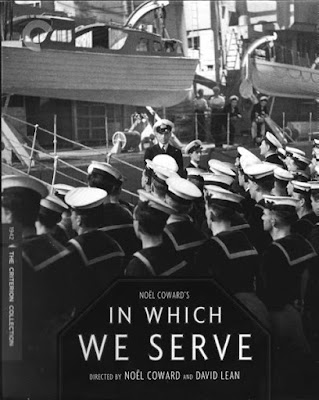
IN WHICH WE SERVE: Blu-ray (British Lion 1942) Criterion Home Video

Few wartime movies are as unabashedly patriotic, or as sentimentally moving as Noel Coward's In Which We Serve (1942); a glowing testament to those gallant fighters in Britain's merchant marine. Yet, the story is not at all about these brave men per say, but rather, the tale of a ship - the H.M.S. Torrin - and her faithful crew. Co-directed by David Lean and Coward (who also wrote the screenplay and the score, produced, and, starred in the film), In Which We Serve is an extraordinarily understated cinema classic. It is the film that brought Noel Coward out of his self imposed exile from the motion picture business (that the playwright always regarded as an inferior medium to live theater), and cemented an enduring friendship with his collaborators Lean, screenwriters Ronald Neame and Anthony Haverlock-Allen.


Reportedly, Noel Coward was enticed into making the film after he approached Prime Minister Winston Churchill (a close personal friend), offering to do his part in the war effort. Coward had eluded active duty in the First World War due to tuberculosis, and this had left him feeling rather disloyal to England. Churchill, however, was not moved by Coward's impassioned plea to partake in WWII as an enlisted man. In the meantime, Capt. Lord Louis Mountbatten (another personal friend of Coward's) had just returned on leave from duty after his ship, the H.M.S. Kelly had been sunk by Nazi torpedoes during the battle of Crete. Regaling Coward with this fateful tale gave the playwright his inspiration, as well as the impetus to write In Which We Serve (the only work Coward expressly wrote for the screen).


But it was a screenplay for a six and a half hour movie. Owing to Coward's immense stature and formidable reputation in the entertainment world, Haverstock-Allen tread lightly when suggesting that his masterwork would have to be re-written (or, at the very least, pruned down to a manageable size). Apart from being a genius and a wit, Coward was also one of the most congenial and compassionate writers of his generation. He wholeheartedly agreed, allowing Haverstock-Allen and Neame to edit his prose.


David Lean's contributions on the film were an entirely different matter. Although Lean was only a 'cutter' (the term for a film editor in those days) before filming began, Coward had admired his clever and intuitive pacing. He also knew that Lean desperately wanted to direct. But Lean was more shrewd about his future than that. Asked by Coward to 'assist' him on the film, Lean politely inquired first about the credits, agreeing to do the film only if his title card read 'Directed by Noel Coward and David Lean'. Coward, happily agreed and thereafter afforded Lean every professional courtesy on the set, choosing to 'work' with the actors on their performances while Lean concerned himself with the actual staging and execution of the scenes; a mutually rewarding and beneficial alliance that would ultimately yield three more screen collaborations.


The film opens with an odd declaration by Leslie Howard; "This is the story of a ship!" and for the next several minutes we are, indeed, privy to an extensive montage of clips depicting the construction, launch and battle manoeuvres of the H.M.S. Torrin; a destroyer stationed off the coast of Crete in 1941 and captained by E.V. Kinross (Noel Coward). The men under his command are embroiled in a merciless sea battle that ends tragically when the Torrin is mortally wounded in an aerial attack by a fleet of German bombers.


Forced to abandon ship, some of the officers and crew take refuge on a Carley float where they endure constant strafing from overhead. The rest of the story is told in flashback - at first clumsily so - as each survivor reflects on both his home life back in England, and his home away from home - the Torrin - now resting at the bottom of the sea.


We see the Captain comfortably in his middle class cottage before the war, with dotting wife, Alix (Celia Johnson) and his two children nestled at his side. We meet Chief Petty Officer Walter Hardy (Bernard Miles) and his wife, Kath (Joyce Carey) and her mother-in-law Mrs. Lemmon (Dora Gregory) who live in a London flat under constant fear of the blitz. And we are introduced to ordinary seaman, Shorty Blake (John Mills) who falls in love, and is eventually married to Freda Lewis (Kay Walsh). Freda is related to Hardy. After she becomes pregnant she moves in Kath and Mrs. Lemmon while the men are away at sea.


The Torrin is engaged in a naval battle off the coast of Norway and narrowly escapes sinking. During this skirmish a young powder handler (Richard Attenborough) cracks under the pressure and abandons his post. While Capt. Kinross is a stern commander, he also believes that a happy ship makes for a constructive crew. He lets the handler off with a warning, accepting part of his shame as his own for not having more time to properly train him before sailing into battle.


As fate would have it, not all the casualties of war are to be found on the front lines. As Freda nears the due date of her pregnancy, a bomb strikes the Hardy home, killing Kath and Mrs. Lemmon. After Freda gives birth in an Army Hospital she writes Shorty of the news and he stoically relays it to a disbelieving Hardy, who suddenly realizes he has lost everything he holds dear.


We return to the survivors of the Torrin still clinging to their raft. These few men are rescued by another ship and Capt. Kinross comforts the wounded and dying below decks. He also learns that more than half of the Torrin's crew was lost at sea. Telegrams are sent home, and both Alix and Freda learn that their husbands are safe. Kinross and the survivors are taken to Alexandria Egypt to regroup and recuperate. After being informed that his crew is to be broken up and sent to other ships to continue their valiant fight, Kinross offers a rousing speech to his men that is as inspirational as it is heartrending. An epilogue declares that bigger ships will come to avenge the fate of the H.M.S. Torrin.


In Which We Serve is undeniably rousing entertainment. Yet, its opening act rather inelegantly sets up each flashback with overwrought melodrama and somewhat disjointed vignettes. The first thirty minutes of the film seem quite uninspired - bordering on dull - with Coward somewhat out of place wearing Mountbatten's actual naval cap as he commands the crew of the Torrin.


Coward, it should be noted, did not come from a cultured upper class background. But throughout the 1920s he had cultivated an adroit wit and effete charm that seemed to belie his lower middle class upbringing. This became problematic when Coward cast himself as the star of In Which We Serve - and, in truth, during these opening scenes he remains a little hard to swallow as the modest everyman.


But about midway through the story, Coward sheds this carefully crafted public persona. He reveals to us an uncharacteristic humbleness and great humanity that is most sincere and quite devoid of his usual droll mannerisms, so much that when - as the Captain - he arrives at the last act of the film, proudly embracing the camaraderie of his surviving crew, we believe Coward in his every nuance and syllable. The fate of these heroic men has become quite personal, not only to the Captain, but also to Coward and his performance makes their plight (as well as that of the real fighting men) even more intimate and enduring for the audience.


In Which We Serve was hailed as a masterpiece upon its premiere and earned Noel Coward a special Oscar. Today, it remains an engrossing WWII 'propaganda' film with few equals. The collaboration between David Lean and Coward gave Lean his true start in films and yielded three more emblematic of the best in British cinema. It also allowed Coward to re-assess his initial opinion of the movies as an inferior entertainment. Although Coward would always regard live theater as his first love, the movies he made with Lean elevated the stature of that medium for him. Despite changing times and cinematic tastes, the emotional center of In Which We Serve remains as poignant and relevant as ever. This is a great film.


Criterion's Blu-ray, in conjunction with a meticulous 2008 restoration effort by the BFI, has resulted in a beautiful 1080p transfer with a few minor anomalies. The gray scale has been impeccably rendered. The finely detailed image is solid with a modicum of naturally occurring film grain. Even matte shots and rear projection look natural. What is regrettable is the hint of edge enhancement that continues to occur - however briefly - during a few key sequences. Because the rest of the film is razor sharp and solid, this intermittent anomaly is all the more apparent when it occurs. The audio is mono but has been very nicely restored for a smooth sonic representation that will surely not disappoint.


Extras include Barry Day's reflections on the making of the film, a profile featurette that covers a lot of the same ground with snippets from the film and interviews with Haverstock-Allen and John Mills, and an extensive 'audio only' 1969 Q&A that Richard Attenborough hosts with Noel Coward in front of a live audience. At present In Which We Serve is only available as part of Criterion's David Lean Directs Noel Coward box set that also includes Blithe Spirit, This Happy Breed and Brief Encounter. Highly recommended!


FILM RATING (out of 5 - 5 being the best)


4


VIDEO/AUDIO


4


EXTRAS


3

Thursday, March 29, 2012

BLITHE SPIRIT: Blu-ray (British Lion 1945) Criterion Home Video

Can the dead come back to watch over the living? This contemplation is at the crux of David Lean's Blithe Spirit (1945); an ethereally genuine - if slightly morbid - romp through the occult and spiritualism. Based on Noel Coward's whimsical drawing room comedy, the film's screenplay by Lean, Ronald Neame and Anthony Havelock-Allan sticks remarkably close to Coward's original.


Reportedly, Coward wrote Blithe Spirit from start to finish in five days at a seaside hotel while on holiday, with only two lines of dialogue changed before its premiere. Coward, who pilfered his title from Percy Shelley's poem 'To A Skylark' - and would later refer to it as 'superficial', was slightly unprepared for the controversy that arose amongst critics; most of whom thought that a play poking fun at death at the height of WWII was, quite simply, in bad taste. Critics aside, the public loved it and Blithe Spirit became a smash hit, running 1,997 performances.


Hollywood put in their bids to produce it. But Coward had been entirely unimpressed by previous translations of his work on the big screen in America and instead chose to sell the rights to Blithe Spirit to General Films - a British production company. As a film, Blithe Spirit has everything going for it; an exemplary cast, glowing Technicolor, Coward's acerbic wit, and masterful director David Lean at its helm.


Curiously enough, neither Lean nor star Rex Harrison wanted any part of it. Lean did not feel that comedy - dark or otherwise - was his forte, while Harrison took his cue from the London stage adaptation and was therefore afraid playing a middle aged man would harm his 'sexy Rexy' bachelor's reputation. As such the part was tailored to suit him as a 'younger' man.


Kay Hammond made the transition from stage to film as the rather randy 'blithe spirit'. But the only other West End alumni to make it to the screen was Margaret Rutherford - who had at first balked at playing the part. She was, in fact, a devote spiritualist herself and one who took umbrage to Coward's representation of the spiritualist in the piece as a dotty, cotton-headed, flighty fool. It was only after the playwright convinced the actress that his take was meant to delineate the true believer from the hapless charlatans, who report to dabble in the occult merely to make a quick buck, that Rutherford agreed to be in the production.


As a film, Blithe Spirit is rather unnerving, perhaps because it never takes the supernatural seriously. Without its ghostly trappings, the play is just like any other Coward stage vehicle from this vintage, with its long suffering, harridan-ridden protagonist longing to be free of his apathetic existence. Coward always saw the piece as a tragedy, rather than an outright comedy. And true enough, David Lean's film is neither as spooky as anticipated, nor quite so out and out funny as one might expect. What it remains is engrossing and inquisitive - both pluses for audiences to enjoy.


We open on the loveless, but pastoral life of a narcissistic writer, Charles Condomine (Rex Harrison) and his second wife, Ruth (Constance Cummings). Charles' first wife, Elvira (Kay Hammond) died prematurely of pneumonia and has been buried some seven years. In that interim it seems Charles and Ruth have lived an exemplary life together, waited on hand and foot by their frenzied maid, Edith (Jacqueline Clarke). Yet, Elvira's memory is still very much alive in Charles, perhaps as a perfunctory escape. For Ruth, despite all her culture and more obvious physical charms remains as waxen and emotionally frigid as a sculpture.


One evening, the couple decide to entertain old friends, Dr. George Bradman (Hugh Wakefield) and his wife, Violet (Joyce Carey). The only other guest is Madame Arcati (Margaret Rutherford); a spiritualist who has agreed to perform a séance after dinner. Charles has invited Madame Arcati strictly as part of the research he is conducting for his latest murder mystery novel.


And although everyone is amused by Madame Arcati's didactic behavior and peculiar recitations during the séance, no one - least of all Charles - is laughing when the evening's 'harmless' entertainment conjures up his first wife, Elvira (Kay Hammond) back from the dead. At first, no one except Charles can see her. This predictably leads to all sorts of marital misunderstandings, with Ruth becoming increasingly incensed by the way her husband is behaving. It is only after Charles begs Elvira to levitate several objects about the room that Ruth suddenly realizes he has been telling her the truth.


In life, Elvira was something of a trophy wife, indulging infidelities to occupy herself while Charles wrote his novels. In death however, she is something more of a devilish prankster who wants Charles for her own once again. Ruth goes to Madame Arcati to demand she reverse 'the spell' put on their home and send Elvira back into the great beyond. As Madame Arcati is quite unable to do this, Ruth becomes increasingly cold and aloof toward Charles.


Now it is Elvira who comes up with a plan. She fixes the brakes on Charles car and then asks him to take her for a ride. The inevitable fatal crash that is sure to follow will bring Charles' spirit to her side. Unfortunately, Ruth takes the car out for a spin instead. She is thrown and killed, her invisible, though very angry poltergeist returning home a few hours later to assault Elvira. Unable to rid himself of either his first or second wife's ghosts, Charles goes to Madame Arcati to beg for her help. She regales him with a previous case that inspires her to dive head strong into various incantations.


Nothing seems to work until Madame Arcati discovers that Edith is also a medium. She can see Ruth and Elvira as plainly as Charles can. Including Edith as part of her final exorcism, Madame Arcati drives Ruth and Elvira's spirits back towards the abyss of time. Unfortunately, even this attempt is not entirely successful. True enough, Ruth and Elvira's ectoplasmic manifestations are no more. But Madame Arcati continues to sense their presence in the house. Nervously, she encourages Charles to leave his home at once, preferably for a trip abroad. Charles agrees. His bags levitate toward him. The front door opens and the convertible top to his automobile is brought down.


What Charles is quite unable to fathom is that Ruth and Elvira are up to no good, reasoning that if they must spend their eternity together then Charles is going to join them with all speed. Sure enough, Charles loses control of his car and is killed off the same bridge where Ruth died, his spirit landing with a thud between his first and second wife - the three spirits doomed to spend what can only be anticipated as a highly charged and mildly toxic eternity together.


This ending was changed from the play to comply with censorship. In the play, Charles casually strolled out of his home while Elvira and Ruth hurled furniture and flatware at one another, declaring his great relief at being rid of them both. The Production Code absolutely forbade this conclusion, stating that, in resurrecting Elvira, who inadvertently kills Ruth, Charles also has become a co-conspirator in her murder and must therefore ultimately not go unpunished.


But the film's revised ending does more than satisfy the code. It draws out the audience's sympathy for these blithe spirits and forces our egotistical hero to face a most justly deserved fate. Arguably, Charles has never been in love with anyone but himself. But in death, he will be forced to confront and surrender this vanity or face a most unflatteringly complicated and utterly restless eternity.


If Blithe Spirit sounds like an odd duck, it is. There has never been a film before or since to challenge its unflappable wickedness or giddy ferocity. Curiously, such deftly calculated resentment and despair never unhinges the entertainment value of the piece, perhaps because so much of Noel Coward's own adroit humor is peppered throughout. Despite Coward's claim that the play is more tragic than anything else, the film trips along effortlessly with tongue firmly in cheek; its resilient approach to death and the undead refreshingly light without becoming silly.


Much has been made of the fact that Kay Hammond - alive or dead - was much too old to ever be married to Rex Harrison's Charles. And truth be told, in her garish green makeup and scarlet glowing lips and fingernails, she is something of an uncompromising fright. Nevertheless, one can infer that in the seven years since her expiration, an inevitable decay has further aged her into the present. And Hammond is a droll comedian besides - most readily amused by contributing to the deconstruction of Charles' current marriage to Ruth.


Rex Harrison's performance - one of stoic cynicism overturned into utter disbelief - is pitch perfect. Yet, despite his obvious charisma and comedic charm, the actor never quite takes center stage, leaving Margaret Rutherford's daft spiritualist as the cornerstone of the film's enduring success. Reportedly, David Lean thought Rutherford's performance wholly unfunny.


Yet, it became the only part in the film to garner universally good reviews from the critics. Viewed today, we can see better still, just how masterful Rutherford's performance is, her proud underpinnings of a real spiritualist at work, lending credence to her monumentally clever turn. She is at once brilliantly feather-headed, yet firmly a believer in her craft and that makes her performance all the more engrossing and genuine.


In the final analysis, Blithe Spirit is unsettlingly supernatural. David Lean preserves the play in a fairly straight forward adaptation. The film is moody - and at times, quite disturbing, and will undeniably continue to 'haunt' audiences for many good years yet to come.


Criterion's Blu-ray, in conjunction with a considerable restoration effort put forth by the BFI in 2008, yields a razor sharp 1080p presentation that will surely not disappoint. Still, the transfer is at the mercy of the original 3-strip elements and certain scenes continue to exhibit 'breathing' of the image and slight 'flicker'. Nevertheless, the Technicolor has been perfectly aligned to produce a gorgeously varied and textured visual presentation. Colours glow off the screen. Fine detail is evident throughout and age related artefacts have been greatly tempered. The audio is mono and well preserved, with minimal hiss and pop.


Extras include Barry Day's comments on the film and on Lean and Coward, an interview with Coward from the mid-1960s and the film's original theatrical trailer. I have one pet peeve. Criterion has woefully undernourished this disc with chapter stops. We get nine - count them - 'nine!' chapters for a two hour movie (ten, only if you count 'colour bars' as a necessary chapter stop). Frankly, this is pathetic and I cannot understand why Criterion continues to be so skinflint on this basic necessity in the digital format. Otherwise, Blithe Spirit on Blu-ray comes highly recommended. At present, it is only available as part of the David Lean Directs Noel Coward box set that also includes This Happy Breed, Brief Encounter and In Which We Serve.


FILM RATING (out of 5 - 5 being the best)
3.5

VIDEO/AUDIO
4

EXTRAS
3

Sunday, March 25, 2012

A NIGHT TO REMEMBER: Blu-ray (J. Arthur Rank 1958) Criterion Home Video

Roy Ward Baker’s A Night To Remember (1958) remains the definitive melodramatic yarn of the Titanic disaster. Instead of eschewing responsibility in giving credit to those fatefully stricken with their bitter end on the night in question, Eric Ambler's screenplay (from the book by Walter Lord) focuses on the real people aboard this ill fated luxury liner.

If what followed – in terms of plot - is as fictional as most other filmic accounts, then at least the essence of the piece, the very heart and spirit of Lord’s thoroughly researched book, is in the right place. Better still, Walter Lord had spent considerable time interviewing Titanic survivors, documenting their recollections with painstaking detail, so the resulting film had authenticity behind it from the start.

In absence of Hollywood star power, Kenneth More (a sizable British commodity) is top cast as Second Officer Charles Lightoller. It is mostly through Lightoller’s interactions that we are permitted into glimpses of the lives of Col. Archibald Gracie (James Dyrenforth), Thomas Andrews (Michael Goodliffe), Benjamin Guggenheim (Harold Goldblatt), Isador Straus (Meier Tzelniker) and Molly Brown (Tucker McGuire) among others; all legitimate passengers on the RMS Titanic.


We tread the familiar tale with a refreshing perspective that, quite simply, has not dated with time. Lighttoller takes his place amongst the crew, waxing affectionately about his good fortune to be aboard the grandest ship ever designed by man. The Titanic's designer, Thomas Andrews (Michael Goodliffe) as well as White Star chairman, J. Bruce Ismay (Frank Lawton) wholeheartedly agree. The Titanic is the world's first unsinkable liner. In fact, Ismay encourages Capt. Edward John Smith (Lawrence Naismith) to utilize the Titanic's expansive boilers to maximum capacity in an attempt to break the transatlantic crossing record on their maiden voyage. As fate would have it, their journey is to come to a harrowing and catastrophic end.

In Britain, A Night To Remember generated considerable audience interest and box office revenues. Regrettably, not much of either was forthcoming in the U.S. where the story had already been played out in Jean Negulesco’s 1953 glossy, if slightly idiotic disaster epic, Titanic. In hindsight, what is particularly remarkable about A Night to Remember is how well its staging and SFX hold up under today's closer scrutiny. Yes, the boat is obviously a miniature, but photographed with such attention to detail that one can easily suspend disbelief for the few brief moments the vessel is shown in long shot. Eerie too is the way the ship’s sinking is handled.

Unlike Hollywood versions which tend to afford the fateful moment a crescendo in denoted panic-driven music cues (most survivors have attested that the actual striking of the berg went almost unnoticed at first by passengers), A Night To Remember quietly acknowledges the moment this sea-faring leviathan struck its cold emasculator, but without much in the way of foreshadowing or fanfare.

Hence, A Night To Remember plays ominously like newsreel footage rather than a re-enactment in dumb show. We feel the terror creeping into our hearts as palpable and chilling as icy Atlantic seeping into the mail and cargo hold. The result; a thoroughly haunting, absolutely absorbing cinema 'document' - not a heartrending exercise in melodramatic pathos that threatens to drag history down twice, then once more for the count.


Criterion's 2k restored Blu-ray rectifies the great sin of their lackluster DVD from some years back. This 1080p transfer - enhanced at 1:67.1 for widescreen TVs - delivers the goods with a beautifully balanced gray scale, very clean whites and deep solid blacks. Fine detail is nicely realized throughout and film grain has been accurately reproduced.


The original DVD had a very flawed, digitized look to it. The Blu-ray is more fluid, more film like in every respect. If you've only experienced this film from Criterion's DVD, then the Blu-ray is sure to be a revelation. Quite simply, the image is breathtakingly sharp. The audio is mono and very nicely cleaned up and presented at an adequate listening level.


In addition to Ken Marschall and Don Lynch's exemplary audio commentary and the exceptional ‘making of’ documentary produced by the BBC (featuring Walter Lord and accounts from Titanic survivors - both extras previously made available on Criterion's DVD) we also get an archival interview with survivor Eva Hart, the 1962 Swedish documentary with more survivors telling their stories, and the feature length 2006 documentary, The Iceberg That Sank The Titanic. Bottom line: despite James Cameron's best efforts, A Night To Remember remains the definitive Titanic disaster movie. The Criterion upgrade is a no brainer. You must own this disc! Highly recommended!

FILM RATING (out of 5 - 5 being the best)
4.5

VIDEO/AUDIO
4.5

EXTRAS
3.5

CASABLANCA: 70th Anniversary Blu-ray (WB 1943) Warner Home Video

No one film will ever satisfy everyone’s opinion as being the greatest of all time. But if a decision had to be made, Michael Curtiz’s penultimate wartime melodrama Casablanca (1943) is a worthy contender. Based on an unproduced play, 'Everybody Comes To Rick's' by Murray Burnett, the screenplay finally fleshed out by Howard Koch and Julius and Philip Epstein plays fast and loose with its assortment of unsavoury characters, their past indiscretions and current scheming - all in an attempt to escape Nazi occupation on a plane bound for Lisbon.


In retrospect, it all seems to fit so neatly together. But at the time, there was great chaos behind the scenes. In truth, Casablanca was just one of 52 films on the Warner slate for 1942 - a well-timed bit of pro-Allied war propaganda. For years, rumours have abounded that Ronald Reagan and George Raft were first considered for the role of Rick; the hard bitten realist saloon keeper who comes face to face with the girl he thought he had finally flushed from his system back in Paris.


In fact, neither Reagan nor Raft were ever notified as forerunners for the part. As for Humphrey Bogart; he had been a Warner contract player for more than a decade, yet largely relegated as a second string thug on the lam in gangster pictures starring Edward G. Robinson or James Cagney.


In many ways Casablanca was Bogart's graduation from that murderer's row. If he had not proven himself amiable as a leading man there is little to suggest his career would have survived the folly. He was hardly Hollywood's ideal of the romantic figure. Yet, Bogart is every bit a lady's man in Casablanca; his cynical dispatch with lovers, friends and foes alike and his bitter, careworn inner torment proving irresistible to women.
Shooting began under a tight deadline. The schedule was anything but smooth. Convinced that her husband might be having an affair with his co-star, Bogart's first wife, Mayo Methot kept close watch on the set, causing Bogart to be overtly aloof toward Ingrid Bergman. The actress would later comment, "I kissed him but I never knew him." Yet, that tension behind the scenes seems only to have enhanced each performance. Together, Bogart and Bergman are the quintessential war torn lovers - destined to be apart even though, as the audience, we come to realize they ought to be together.


As rewrites arrived almost daily to the set, Bogart and his co-stars grew more impatient and uneasy about the last act. Would Isla Lund (Ingrid Bergman) go away with her husband, freedom fighter Victor Laslo (Paul Henreid) or remain behind with the man she truly loved - Richard Blane (Bogart)? The Epsteins could not decide and as filming progressed, establishing this resolution became more immediate. In a moment of sheer brilliance - or perhaps mere exhaustion for a conclusion to their story - the Epsteins turned to one another and simultaneously spoke the same line of dialogue - "Round up the usual suspects!" It was an inspired bit of creativity.
For those who have never seen Casablanca (and, I understand there must be those who have not...to quote Ugarte - "Poor devils!") our story opens with Nazi Major Strasser (Conrad Veidt) arriving in Casablanca to oversee the capture of Ugarte (Peter Lorre); a man who murdered two German couriers in the unoccupied dessert. Strasser is first greeted by French Prefect of Police, Louie Renault (Claude Rains), whose roving eye is frequently focused on the desperate, though attractive refugee girls seeking letters of transit to immigrate to America.


Louie and Rick are fair-weather friends; Rick allowing Louie to win at his casino tables to keep his official capacity from interfering in the daily operations of his cafe. Rick's Cafe Americain is a hub of black market activity where everything from diamonds to human cargo is traded to the highest bidder. This lucrative hotbed is not wasted on Senior Ferrari (Sidney Greenstreet); a slave trader who also owns the seedy 'Blue Parrot bar just down the street. Nor is Louie entirely convinced that Rick's stoic cynicism is anything more than mere smokescreen for the mysterious reason Rick had to leave America. "I like to think that you killed a man," Louie tells him, "It's the romantic in me!"


To any and all inquiries, however, Rick is silent. When Louie informs him that he plans to arrest Ugarte (Peter Lorre) for the murder of the couriers, Rick's response is "I stick my neck out for nobody." Ugarte is arrested after a shootout at the cafe and later 'dies' of wounds inflicted by his Nazi captors. But Strasser has a Nazi dossier on Rick that illustrates a previous pattern of providing aid and assistance to enemies of the Third Reich.


Enter the luminous Ilsa Lund (Bergman) on the arm of freedom fighter, Victor Laszlo (Henreid). Described by Louie as the most beautiful woman to ever visit Casablanca, Ilsa's mere presence in the cafe is enough to send shockwaves of contempt through Rick. After the cafe closes for the night, Rick quietly gets drunk while his piano player, Sam (Dooley Wilson) looks on. The halcyon haze from this binge generates a memorable flashback. We see Rick and Ilsa in their prime some years before, passionate lovers in Paris before the occupation. On the eve that Ilsa is supposed to meet Rick at the train station she instead sends him a cryptic letter, explaining that they can never be together. Understanding that Rick's life is in danger if he stays behind, Sam coaxes him onto the last train out of France.
Rick awakens from his stupor in the wee hours of the morning to discover Ilsa at his side. She attempts to explain herself, but Rick cannot see beyond his own bitterness and jealousy. He admonishes Ilsa, driving her out of his cafe with dark, cold words. The next day Victor asks Rick if he will sell Ugarte's letters of transit to him. But Rick denies this request and tells Victor to ask his wife instead.


Ilsa confesses to her husband the more superficial details about her affair with Rick, then quietly sneaks off to the cafe to beg - then threaten - Rick for the letters herself. After some romantic friction, the two share a night of passion and Ilsa informs Rick that she can no longer resist him. She will do whatever he says.


Rick asks Ilsa to bring Victor to the cafe after hours the following night where he intends to hand over the letters of transit only to him while keeping Ilsa for himself. However, when Victor and Ilsa arrive at the cafe they find a preening Louie Renault ready to arrest Victor as part of the conspiracy for the murder of the two couriers. In a moment of inspired brilliance, Rick double crosses Louie, holding him at gun point while he forces him to sign Ilsa and Victor's safe passage. Rick then tells Louie to telephone the airport's radio tower to confirm their reservations. Instead, Louie calls Strasser with a cryptic message, thereby alerting him of their plan of escape.
Rick, Victor, Ilsa and Louie arrive at the airport where Rick explains to Ilsa in private how their love can never last. She is getting on the plane with Victor while Rick stays behind to make sure their takeoff is successful. As the plane begins to taxi the runway, Strasser arrives and is killed by Rick in a shootout. Louie, who now has the opportunity to arrest Rick for the murder, instead informs his officers to "Round up the usual suspects." Louie tells Rick that it is best he go away for awhile, adding his own intensions to accompany him. "Louie," Rick exclaims before the two men fade into the night fog for parts unknown, "This looks like the beginning of a beautiful friendship!"


And so it has been between the film itself and moviegoers around the globe for 70 years. Anyway you analyse it, Casablanca is a milestone motion picture. Under Michael Curtiz’s unerring direction Casablanca emerges as the most adroit, romantic and satisfyingly stylish film of the 1940s. It is perfect entertainment!
In retrospect, Dooley Wilson’s Sam is the film's most remarkable character. At a time when black performers were considered little more than servants or comic relief, Sam is neither, but in fact, Rick's equal, and at times, even his salvation. It is Sam who first encourages Ilsa to leave his employer alone; Sam, who saves Rick from certain Nazi capture at the train depot in Paris; Sam, who looks after Rick after he has succumbed to drunken self pity and despair.


It goes without saying that Bogart and Bergman (the latter on loan from David O. Selznick) are at the top of their game. Their on screen chemistry is 'the stuff that dreams are made of'. As the audience, we yearn for the reconciliation of Ilsa and Rick in the first act, are glad when it sort of happens at the beginning of the third, but have our hearts torn asunder by the final reel. In the process, we all become the disillusioned romantic that Rick used to be - while recognizing that the ending is just as it should be. That's an extraordinary cinematic achievement, because in the final analysis we are both sad, yet satisfied with the ending.
Casablanca frequently hovers in the top five on most critics’ ‘greatest movies ever’ lists. It is also one of the most oft' misquoted movies in film history. For the record, Rick never says “Play it again, Sam,” but rather, “Play it. If she can stand it, I can.”


After viewing Casablanca in excess of 100 times throughout the course of my life, I have to say that I still consider it the greatest movie ever made, if for no better reason, because it continues to generate a perennial freshness each time I watch it. The film has not dated. In fact, it continues to hold me spellbound in the dark. Hence, Casablanca remains that rarity amongst film art, or as playwright Murray Burnett wisely assessed of a true classic some time ago, it is, "true yesterday, true today and true tomorrow." So, Sam, play it. Not for old time's sake, but again and again... for all time's sake!Casablanca was one of Warner Home Video's early 'Ultimate Edition' Blu-Rays with a very crisp, yet slightly homogenized image quality. For the film's 70th anniversary, Warner has rethought its mastering efforts to create a brand new, arguably 'more film-like' presentation in 1080p. Yet, I'm not entirely certain I appreciate the efforts. First and foremost, I should point out that there is nothing wrong with this new minting.
But by direct comparison to the aforementioned 'Ultimate Edition', this 70th Anniversary transfer is much darker, with more film grain present and a loss of fine detail due mostly to its darker rendering. Arguably, this is how the film looked when audiences saw it back in 1943. But is this how audiences in 2012 want to enjoy it? Ah, that remains open for discussion.


The DTS mono audio is as bombastic as ever. Doing a direct comparison between the UE and 70th I can't say that I detected any sonic differences and/or improvements. Where the 70th Anniversary excels is in its extra features. Some 13 hours of archival and newly produced featurettes have been assembled on all things 'Casablanca' and Warner Bros.
First up is You Must Remember This – the making of Casablanca, followed by Bacall on Bogart – a marvellous retrospective of Bogie’s career. Then there's Carrotblanca – the Bugs Bunny cartoon spoof, and, of course, the original pilot for a 1950s television series that proved a colossal flop. We also get 'As Time Goes By: The Children Remember; a loving tribute from Stephen Bogart and Pia Linstrom. There are also audio and video outtakes, deleted scenes, interviews and expert audio commentaries from Roger Ebert and Rudy Behlmer - all previously made available as part of the UE.


Regrettably, Warner continues to play these extras little mind in terms of image quality. All are in 480i and many are in rough shape from a visual standpoint. Warner's Night at the Movies recreates the experience of going to the cinema circa 1943 with trailers for Now Voyager, plus vintage newsreels and Merry Melodies cartoons.
Casalbanca: An Unlikely Classic is a new featurette with contemporary filmmakers affectionately waxing about the film's enduring magic and appeal. We also get the 1947 radio broadcast of the film and Max Steiner's scoring sessions that provide some fascinating alternative takes of the songs and tracks best remembered in the film.


Michael Curtiz: The Greatest Director You Never Heard Of is also new, a very entertaining, if somewhat brief, look at Curtiz' miraculous career at WB and elsewhere. Fans will eat this one up. Three feature length documentaries round out this comprehensive compendium of extras. Jack L. Warner: The Last Mogul, and The Brothers Warner both critique the creative family that gave us one of the most celebrated film studios in the world. And then there's You Must Remember This: The Warner Bros. Story. Though hardly as comprehensive as MGM: When The Lion Roars - at five hours, Richard Schickel's tribute to the studio and its enduring cinema classics is a must have documentary that spans the entire history of Warner Brothers.
Like all of WB's other oversized box sets, this one comes with its assortment of tangible extras too: a 62 page book that is heavy on photos but light on text, four drink coasters in a faux leather box and reproduction of the 1942 French poster.


Bottom line: this is Casablanca. Even without all the hoopla and extras it is a film that belongs on everyone's top shelf, right next to Ben-Hur, Gone With The Wind, The Wizard of Oz, The Sound of Music, The Ten Commandments, Citizen Kane, The Bridge on the River Kwai, The Godfather and the as yet unreleased Lawrence of Arabia!


FILM RATING (out of 5 - 5 being the best)
5+


VIDEO/AUDIO
4


EXTRAS
5+

Saturday, March 17, 2012

THE ADVENTURES OF TINTIN: Blu-ray (Paramount/Columbia/Dreamworks/Amblin 2011) Paramount Home Video

In 1929 Belgian artist George Remi (who wrote under the nom de plume Herge) debuted a beloved children's hero in 'comic album' form as a supplement to the newspaper Le XXe Siecle. Instantly embraced by readers young and old, the series eventually became known throughout the word as The Adventures of Tintin (pronounced Tauntaun); reproduced in 50 languages and selling more than 200 million copies worldwide: a publishing phenomenon by most any standard. Herge, who parlayed his fictional character into a successful Tintin magazine, and then an entire studio in 1950, produced twenty-four comic albums, many eventually adapted for radio, theatre, TV and finally, the movies.


In many ways, Tintin is a most unlikely hero. Though only a boy, he already has a lucrative career as a reporter, accompanied on his many explorations by Snowy (Milou in French); his ever-faithful fox terrier. He is intellectual and well-rounded, with a probing fascination, yet naive understanding of the world. Critics have often misconstrued Tintin as 'bland'. But what Herge has done is to give his reader a sort of 'everyman' blank slate, allowing us to become Tintin and enter these misadventures through his thought-provoking mind.


Herge, who never quite came around to explaining how his prepubescent, red-headed protagonist evolved at such an early age to live alone, with no parents or even parental heritage to speak of, at least afforded Tintin some adult companionship along the way - most notably, the brazen liquor-soaked Irish mariner, Captain Haddock, the intellectually stimulating/but quite deaf, Professor Calculus (Professor Tournesel in French) and a pair of bumbling detectives, Thomson and Thompson (Dupont et Dupond); a contemporary derivative of Lewis Carroll's Tweedles Dee and Dum.


What is perhaps most remarkable about this series, apart from its signature ligne claire drawing style, are its engrossing and meticulous - occasionally clairvoyant - plotlines that span the spectrum of literary genres from action/adventure and thriller/mystery to urbane political/social commentary - always tinged with adroit humor, intelligent insight into the human condition, and great good taste.


And now comes The Adventures of Tintin - the movie (2011); a long awaited, very elaborate, utterly fast paced and occasionally enchanting 'motion capture' experiment from director Steven Spielberg and producer Peter Jackson. Both men are long time ardent fans of Herge's work. In fact, following the release of Raiders of the Lost Ark (1981) Herge and Speilberg began transatlantic talks of translating Tintin to the big screen. Regrettably, their face to face meeting never materialized.


As Spielberg and his production partner Kathleen Kennedy were wrapping up on The Temple of Doom (1983) Herge died, leaving their pending project in limbo. Although his widow willingly allowed Spielberg to option her late husband's stories the next year, Spielberg was never entirely satisfied with the script treatments that kept coming down the developmental pipeline.


Furthermore, he feared that the more fanciful aspects of Herge's stories could not be satisfactorily translated into live action. The project was put into turnaround and Spielberg eventually allowed his option to lapse. Then, in 2001 Spielberg announced he would be renewing his option to produce a Tintin film with Dreamworks' computer animation division.


Again, the project ping-ponged back and forth as Spielberg toyed with reconsidering live action. To this end, Spielberg contacted Peter Jackson at Weta Digital to inquire about the feasibility of creating a computer-generated Snowy. Jackson, who adored Herge's books as much - if not more than - Spielberg, shot test footage with himself playing Capt. Haddock while a digital Snowy playfully hopped around his feet. But the more both men assessed this footage the more they recognized that such a melding of live action and computer animation simply did not serve the story well.


At this point, Jackson suggest photorealistic 'motion capture' technology as a possible solution. Although impressed with the results, Tintin's creative gestation was once again interrupted. First, screenwriter Steven Moffat became embroiled in the 2007 writer's strike. Afterward, a conflict of commitments to the Doctor Who series precluded his further involvement on Tintin. Edgar Wright and Joe Cornish were assigned to do a complete rewrite. Then, Universal Studios (who had initially agreed to co-produce) declined to pursue the project, citing disappointing box office on Monster House and Beowulf, as well as Spielberg's request for his usual 30% of the domestic gross as their reasons.


Eventually a deal was ironed out between Spielberg, Jackson, Paramount and Sony Pictures (under the Columbia banner). Paramount had already spent $30 million on Tintin's preproduction, but refused Spielberg's gross percentage request. Sony, however, backed the deal, ensuring that at least the first two films in Spielberg's envisioned Tintin trilogy would come to fruition.


Like all Hollywood interpretations of great literature, the filmic Tintin takes artistic liberties with Herge's work. We are introduced to Tintin (vocal by Jamie Bell) at a Belgian street market, having his portrait painted by Herge himself. Tintin becomes fascinated by a model of the tall ship Unicorn and purchases it from a vendor. Moments later, Tintin is accosted by a mysterious stranger, Barnaby (Joe Starr) who warns Tintin to leave the ship amongst the other forgotten relics on sale.


Barnaby's warning only serves to galvanize Tintin's resolve. Ditto for his confrontation with Ivan Ivanovitch Sakharine (Daniel Craig), who offers Tintin whatever he wants for the model, then breaks into his apartment while Tintin is out to steal it. Before this theft, the model is damaged when Snowy has a minor confrontation with a stray cat. In the scuffle, the ship's mast breaks apart and a tiny metal flask with a cryptic message inside rolls beneath Tintin's dresser.


Meanwhile, detectives Thomson (Nick Frost) and Thompson (Simon Pegg) are 'not so' hot on the trail of local pickpocket, Aristide Silk (Toby Jones). Tintin returns to his apartment to discover it ransacked and the Unicorn gone. But Snowy alerts Tintin to the metal flask under his bureau. Tintin discovers the message inside and tucks it into his wallet, later stolen by Aristide.


Venturing to Marlinspike Hall; Sakharine's foreboding country estate, Tintin and Snowy are assaulted by Sakharine's men, Tom (Mackenzie Cook) and Allen (Daniel Mays). They abduct Tintin and Snowy and take them aboard the Karaboudjan - a rusty cargo ship. There, Tintin and Snowy are introduced to another prisoner, Capt. Haddock (Andy Serkis) whose men have mutinied against him, thanks to Tom and Allen's goading. Tintin convinces the chronically inebriated Haddock to invest in their adventure, and together these three escape their captors aboard a lifeboat.


The next day Sakharine sends Tom and Allen in a seaplane in search of Tintin and Haddock. But Tintin skillfully shoots the plane down and, with Haddock's assistance, takes Tom and Allen hostage. Making the necessary repairs, Tintin and Haddock fly toward the Moroccan port of Bagghar, but crash land after a storm in the desert. They are rescued by foreign legionnaires. Haddock now regales Tintin with the story of the Unicorn. Haddock's ancestor, Sir Francis, was its captain, assaulted during a sea battle by Red Rackham, Sakharine's blood relative. Sir Francis chose to sink the Unicorn's bounty of treasure in the ocean rather than surrender his ship to Rackham.


Now Sakharine is in search of that treasure and the three models of the Unicorn - each containing part of a cryptic message that, once reassembled, holds the coordinates to locating the sunken ship. Sakharine already has the first part of the message. Tintin, the second. But the third remaining piece of the puzzle belongs to a wealthy sheik, Omar Ben Salaad (Gad Elmaleh) - though not for long.


At a lavish reception at Salaad's palace, Sakharine sends his trained falcon to retrieve the model. This results in an extraordinary chase through Bagghar's crowded streets, with Tintin and Haddock eventually cornering Sakharine and his men at the docks - thanks to the last minute intervention of Thomson and Thompson. It seems that, having retrieved Tintin's wallet from Aristide Silk, this bungling pair have inexplicably managed to tail Tintin and Haddock to Bagghar.


Reuniting the three Unicorn scrolls, Tintin and Haddock learn that Marlinspike Hall was built by Sir Francis. Returning to the estate, they discover a small consignment of the Unicorn's plunder hidden behind a wall in the cellar. Haddock, now sober and fascinated by his own ancestry, vows to assist Tintin in salvaging the rest of the Unicorn's lost sunken treasure.


The Adventures of Tintin is a mostly enjoyable action/adventure yarn with elements of film noir peppered throughout. From a purely visual standpoint the film is a wondrous, if mildly absurd, amalgam of blisteringly surreal images. What is less successful is Spielberg's hurling his camera about this meticulously crafted computerized realm as though it were a pinball flipped about with nauseating results.


We soar up, then down through stormy skies over the ocean, dive deep into the sea during a flashback sequence aboard the Unicorn, and careen with violent abandonment through the streets of Bagghar on a motorcycle. This sort of constantly moving backdrop will appeal mostly to today's generation, weaned on rapidly edited music video pulp and video game nonsense. However, as an artefact of pure cinema the results tend to overpower, rather than excite, our senses.


Perhaps Spielberg has forgotten that 'action' is best explored through the motivations and confrontations between a film's pro- and antagonist - not the immediate result of some manic manipulations of the cinema space through choppy camera work and heavy-handed editing.


Mingzhi Lin and Charles Pottier's SFX are first rate, creating three dimensional flesh and blood renderings of Herge's one dimensional cartoon drawings. Yet, in perusing the pages of Herge's comic albums, I was struck by how much emotional content there was in that one dimensional (and simply drawn) world. Perhaps, this is where the books advance over their filmic counterpart.


While the characters in Spielberg's film all look like reasonable facsimiles of Herge's imagination, and move realistically as they should, they somehow never entirely come to life on the screen. Technologically proficient in all their vastly superior detailing, they nevertheless lack that intuitive humanizing quality to truly be believed.


The Moffat, Wright, Cornish screenplay brilliantly binds three of Herge's most memorable tales into one cohesive narrative that moves along nimbly and with a genuine feel for its source material. John William's score is epic, yet playfully adventurous, striking just the right chord. The Adventures of Tintin will satisify most who see it. But it lacks the warmth and charm of Herge's original drawings, and the staying power of a truly classic adventure yarn. Unlike Herge's stories that have endured the test of time, we probably won't be celebrating this film in the next century.


Paramount Home Video's Blu-ray has been given the A-list treatment. We get a beautifully rendered image that extols all the crisp, refined details of this digitally inspired fantasy world. The extraordinary and subtly nuanced palette of textures and colors all look gorgeous and razor sharp. Truly, nothing to complain about here. And you won't find gripes from this critic over the bombastic DTS 5.1 audio that rocks all of the surround channels.


We get a series of in-depth featurettes that cumulatively represent one comprehensive documentary on the making of the film. Here, you will find an extensive catalogue of all things Tintin - the movie - put together with fascinating insight and interviews from virtually all of the cast and crew. Bottom line: If you're a fan of this film, then Paramount has outdone themselves on ensuring all your needs have been met. But if you're a fan of Herge's Tintin, the final results achieved in this film may occasionally leave you wanting for something more.


FILM RATING (out of 5 - 5 being the best)
3

VIDEO/AUDIO
5

EXTRAS
3.5