Monday, January 28, 2013

THE QUIET MAN: Blu-ray (Republic 1952) Olive Films


John Ford’s directorial career ought to be taught as perhaps the foremost peerless example of how to create movie magic of the highest order. It is one of Hollywood’s small ironies that Ford, the curmudgeonly director of so many iconic westerns, is today chiefly regarded and admired for two films removed from this artistic milieu in a genre he helped define: How Green Was My Valley (1941) and The Quiet Man (1952). Ever since Ford had been forced to sacrifice plans to shoot How Green Was My Valley on location and in Technicolor (due to wartime restrictions) the director had been looking for another project to fulfill both desires. In retrospect, The Quiet Man is the perfect vehicle; its romantic/dramatic and comedic whimsy full of the blarney stone so authentically replicated in this film. However, getting a studio to believe in the project was an entirely different matter.
Ford shopped the story around but was politely refused at virtually every major studio despite the fact that he had a flawless track record for producing smash hits dating all the way back to the silent era. Ford, a caustic individualist, was nevertheless unrelenting in his quest. Those who knew Ford best also knew he usually had his way. And so it came to pass that Ford eventually found support for The Quiet Man from Herbert Yates at Republic Pictures. The alliance, however, was not without its concessions. Yates agreed to fund The Quiet Man in trade for the director doing a western for Republic first. The film, Rio Grande (1950) took Ford and his favorite star, John Wayne, once more back to familiar territory in Death Valley – becoming the last installment in what is now regarded as John Ford’s ‘cavalry trilogy’.
Ford was infinitely rewarded by the experience when Wayne and then first time co-star Maureen O’Hara generated sparks of romantic chemistry on screen. Their syncopated working relationship convinced Ford to re-cast the duo again in The Quiet Man. Indeed, viewing Rio Grande today, one is immediately struck by how well suited Wayne and O’Hara are to each other; the rugged majesty in his stoic manly grace pitted against her lush and fiery vigor.  
If How Green Was My Valley represents Ford at his most lyrically sentimental, then The Quiet Man is undeniably the director at his most disarmingly quaint and humorous. Herbert Yates was acutely aware of two things: first, that Republic was a fledgling at best that could not really afford to make The Quiet Man unless Rio Grande was a big hit, and second, that hiring talent like Ford and Wayne could only enhance the reputation of his poverty row company. Ultimately, both Yates and Ford were to have their success with Rio Grande and then, The Quiet Man.  Prior to the triumphant premiere of Rio Grande, Yates did attempt to convince Ford to shoot The Quiet Man in his own patented process of TruColor – infinitely cheaper than Technicolor, though hardly yielding as impress results. Ford remained steadfast in his demands. After Rio Grande’s box office tallies began to enrich Republic’s coffers, Yates gave in to Ford’s demands.
The Quiet Man’s screenplay, based on a 1933 Saturday Evening Post short story by Maurice Walsh, was a charming parable about a man unwilling to sacrifice his principles except, of course, to prove his loyalty to the woman he loves. In expanding the narrative into a two hour movie, Walsh was ably assisted by veteran scenarist Frank S. Nugent and novelist Richard Llewellyn who had written How Green Was My Valley and won the Pulitzer for it. Ford, who treasured working with time-honored friends as opposed to first time collaborators, insulated himself with familiarity on The Quiet Man. The film became something of a family affair with real life siblings and Ford’s extended family augmenting the cast and crew to create a homespun and close knit atmosphere on the set. Maureen O’Hara’s brothers and sister had bit parts in the movie, as did real life brothers Barry Fitzgerald and Arthur Shields.
The Quiet Man is essentially a romance – but one peppered in bouts of serious drama and justly celebrated for its rambunctious comedy.  We begin with the arrival of Sean Thornton (John Wayne) by train to the pastoral community of Innisfree. After a profitable stint in America, Thornton has come home to Ireland to stake his claim on his former family’s home; a modest cottage currently owned by Widow Tillane (Mildred Natwick); a wealthy landowner who has thus far refused to sell to loud-mouthed Squire Will ‘Red’ Danagher (Victor McLaglen). Thornton is a charmer. That much is for certain. Moreover, he is a handsome, broad-shouldered stranger in these parts, met with equal portions of curious skepticism and mild fascination from the locals.
After some feckless debate with the locals as to the whereabouts of the widow, carriage driver Michaeleen Oge Flynn (Barry Fitzgerald) agrees to drive Thornton to her estate. Along the way Thornton is bewitched by the sight of Mary Kate Danagher (Maureen O’Hara) tending her sheep along a stretch of idyllic countryside. Michaeleen can see for himself that Thornton’s immediate infatuation will lead to trouble. He spirits Thornton to the widow’s parlor. Although she initially refuses Thornton his request – even after she learns that he is no stranger to these parts – Tillane is swayed to sell the cottage to him upon Will’s bursting into her parlor to demand she reconsider his bid for the property. Thornton outbids Will and makes an immediate enemy of him.
Learning that the new stranger in town has managed this minor coup Mary Kate becomes immediately intrigued and decides to surprise Thornton by helping him to fix up the cottage which has fallen into a delicate state of disrepair. Thornton attempts to seduce Mary Kate one windswept and very stormy night. Superficially, she is appalled by his cheek and slaps his face. But as the days wear on, Mary Kate inevitably changes her tune. Thornton desires to court Mary Kate on his own terms. But the time-honored customs, and moreover, hushed hypocritical scrutiny of the villagers, prevents their romance from blossoming. Without Will’s permission, Mary Kate cannot accept Thornton for her beaux.
Michaeleen has other ideas however, and encourages Rev. Cyril Playfair (Arthur Shields) and Father Peter Lonergan (Ward Bond) to play along. After all, Will is not very highly regarded in the community. In fact, he’s nothing more than an uncouth blowhard whose wealth solely dictates his self-importance as a solid citizen. Michaeleen, Playfair and Lonergan convince Will that the reason the widow has been unreceptive to his overtures – both romantic and economic - is because of Mary Kate’s presence in his house. A home can have only one mistress. Because Will harbors true affections for the widow he reluctantly agrees to Thornton and Mary Kate’s courtship and eventual marriage. Regrettably, the ruse turns sour on Mary Kate’s wedding day when Will makes an impromptu proposal to the widow, only to discover she is still reticent to entertain his affections.
Enraged at having been duped, Will declares that Mary Kate shall never have her dowry. The money means nothing to Thornton. But it remains a sense of pride for Mary Kate, who refuses to sleep in her husband’s bed until he can stand up to her brother and get back the things left to her by their late mother. Will sucker punches Thornton, revealing a flashback in Thornton’s subconscious. In his previous life in America Thornton had been a prize fighter of some repute – Trooper Thorn - who accidentally killed his opponent in the ring and thereafter retired his boxing gloves in favor of becoming ‘a quiet man’.  Only Rev. Playfair knows of Thornton’s past – being an avid fan of the sport and thus having collected a scrapbook full of memories about his favorite fisticuffs champions.
Mary Kate allows pride to get the better of her, repeatedly refusing to share her husband’s bed because she has deemed his reluctance to face Will as pure cowardice. This rift steadily grows and Thornton’s patience is repeatedly tested. Michaeleen and a few of the town’s folk manage to finagle Will into relinquishing some of Mary Kate’s belongings. But Will absolutely refuses to give Kate her mother’s monetary dowry, stating that if she wants it Thornton will have to fight him for it. Despite this bitter impasse, Mary Kate is drawn to her husband’s side. The couple shares a passionate night together – their first since the wedding – but afterward Mary Kate sneaks off to the Castletown depot to catch a train bound for Dublin.
Michaeleen alerts Thornton, who has finally had enough. Forcibly retrieving his wife from her railroad car, Thornton physically drags her by the back of her neck to her brother’s farm with the whole town in hot pursuit to watch as the sparks fly. Will pays Thornton for his sister’s dowry that both Thornton and Mary Kate share a part in tossing into the fire of a nearby furnace; she thereafter suddenly proud to be his wife. But Will decides to start a fight with Thornton that quickly escalates into an all-out brawl. The town lustily cheers as the two drag and pummel each other about the rustic landscape, with Thornton eventually winning the match by knocking Will into a nearby stream. Justly beaten, Will acquires a curious admiration for Thornton. The two men return to the local tavern to clean up, drink up and shake hands. Afterward the widow and Will begin a courtship under the town’s watchful gaze and Mary Kate and Thornton reconcile, heading back to their cottage, presumably to christen their marital bed once more.
The Quiet Man is un-apologetically farcical in its final act; a near negation of its rather austere beginning and central romantic theme. Arguably, John Ford has allowed his heart to run away with his head – the sentimental treacle a tad too thick to be properly digested. And yet, The Quiet Man is a sheer delight – almost from its first moment to its last. Part of the film’s enduring appeal has to do with its central casting of John Wayne and Maureen O’Hara.  One can genuinely believe in Wayne embodying the dichotomous ‘fighting/quiet’ man, capable of both kicking and kissing the girl as propriety demands, while O’Hara remains the archetypal fiery Irish lass, stirring both passion and ire within the heart of her man.
The other inimitable charm the film has going for it is its supporting cast; a veritable potpourri of veterans who bring enough of themselves as they continue to augment each other’s performance in the ensemble. One gets a very real sense of community within this film – a genuineness extending far beyond the lush green moors and cozy firesides that Ford lovingly evokes throughout the story. The Quiet Man was mostly filmed on location in Cong, County Mayo on the grounds of Ashford Castle. In retrospect, it is a genuine pity that Ford didn’t choose to lens all of his exteriors there, since two pivotal sequences; a horse race, and, the first romantic pas deux between Mary Kate and Thornton (set, supposedly in a ruined church courtyard overlooking a cemetery) reveal the obviousness of sets and rear projection matte work that momentarily take us out of the story.
The Quiet Man has had a disastrous tenure on DVD. For decades the original Technicolor elements have looked more like a flubbed attempt at colorization, while the general quality of the image has been disgustingly subpar – more like viewing a badly worn print from a TV with rabbit ears, the broadcast taking place during an exceptionally violent thunderstorm. The Quiet Man’s public domain status had several shoddy releases under the old Artisan banner on DVD.
But the new 60th Anniversary Blu-ray from Olive Films is cause for celebration. Although The Quiet Man still sporadically suffers from hints of age related flicker and damage, the overall results are superb beyond most expectations. Colors are at long last vibrant but not pronounced; the Technicolor sparkling as it should without mis-registration or bumped up to make it look cartoony and garish. Winton Hoch and Archie Stout’s cinematography is a sumptuous feast for the eyes. The ‘wow’ factor is frequently in evidence – particularly during exterior location photography – revealing a vast amount of fine details in the flora and fauna. Close ups yield even more startling clarity in flesh, hair and fabrics. Yes, there are still inconsistencies to be had in this transfer – occasional fading and/or weaker than anticipated color saturation infrequently spread throughout this presentation. But the pros far outweigh the cons.
The DTS audio is also something of a minor revelation; mono, but capturing the howling winds and distant babble of the brook in all their subtle composure. Dialogue sounds very natural as do effects and music. Bottom line – you won’t find anything to complain about here. The one complaint I still have is in the extras. We get a ‘making of’ documentary running just under a half hour and hosted by Leonard Maltin that is at least twenty-five years old and superficially glosses over the film’s production at best. The visual quality of this featurette is just awful. There’s also a rather fascinating booklet essay provided by Joseph McBride that fills in the blanks quite nicely. Bottom line: The Quiet Man is essential John Ford: a film to be treasured over and over again. Olive’s Blu-ray reissue makes this prospect a reality for the very first time. Highly recommended!
FILM RATING (out of 5 – 5 being the best)
4
VIDEO/AUDIO
3.5
EXTRAS
1

Wednesday, January 23, 2013

INDISCREET: Blu-ray (Warner Bros. 1958) Olive Films


Norman Krasna’s play ‘Kind Sir’ provided the basis for Stanley Donen’s Indiscreet (1958); an elegant champagne cocktail reuniting Ingrid Bergman and Cary Grant, this time as a pair of enigmatic lovers who manage to live happily ever after in spite of themselves. Bergman’s sagging film career had been resurrected by an Oscar win for Anastasia just a scant two years before. Yet, Bergman’s role in Indiscreet, that of celebrated actress Anna Kalman, seems eerily to parallel her real life circumstances – perhaps even poke fun at those peccadillos with a wink and a nudge. Like Anna, Bergman unrepentantly threw herself into an extramarital affair, ostensibly unaware, or at the very least disinterested, in its repercussions.
Bergman’s romance with Roberto Rossellini in 1950 erupted into an international scandal that all but submarined her professional aspirations to continue acting in America. Public sentiment instantly turned against her and she was even decried on the floor of the Senate as a wanton who should be barred from ever returning to the United States. Bergman’s alter ego in Indiscreet doesn’t go quite so far down this rabbit hole; her liaison with ‘married’ economist Philip Adams (Cary Grant) tempered by the fact that Adams is a devilish rake misleading his leading lady. He isn’t married at all, merely pretending so that Anna won’t get any ideas about settling him down. 
Still, and for its time, Indiscreet is pretty chancy stuff. Anna is introduced to us as a woman of means who has frivolously run off with, then just as freely ditched a Greek Ambassador, simply because he spoke broken English and spent more time and interest on other pursuits apart from her own. Anna, who resides in a fashionable apartment in London also has a faithful suitor on the side; considerably younger than she who courts and calls her on the telephone. Bluntly put: Anna has no shortage of male companions. Still, she’s bored – un-apologetically and without even the slightest moral contrition for being middle-aged, single and playing the field.  
Anna’s rather frank and flirtatious pursuit of Philip Adams – a man met quite by accident – is just as impetuously guided. Anna doesn’t need convincing to accept an invitation from her sister, Margaret Munson (Phyllis Calvert) and brother-in-law, Alfred (Cecil Parker) to attend a rather lavish, but stuffy monetary conference. After all, it is an opportunity to sit and gaze with mounting adoration at Philip as he waxes about investment funds and rising stock options that, even when expounded upon by the luscious Cary Grant, are about as captivating as watching ceiling paint dry.
Anna throws herself into the depths of their passionate pas deux, even after Philip tells her that he is married. Alfred, who has been desperately trying to convince Philip to come and work for NATO finally secures his participation, but only because being stationed in London will afford Philip the chance to court Anna. Over the next twelve months the two become inseparable. Stanley Donen’s deft use of montage effortlessly flips through an album of snapshots illustrating the natural progression of love, culminating in Anna’s blissfully obtuse happiness; cause for mild concern from her ever-devoted servants, Doris (Meg Jenkins) and Karl (David Kossoff).
It stands to reason that Anna’s heart will eventually be broken. Philip has not offered to leave his wife for her. Alfred learns from Philip’s dossier that he is a single man and confronts him with this deception. But then Philip explains his predicament: that for any man to lead a woman on without divulging that he is married would be cruel. But to lie up front about a wife where one does not exist actually has the opposite effect; the man having laid his cards on the table, thereby giving the woman every opportunity to turn him out beforehand. In Anna’s case, her choice to remain content as ‘the other woman’ is entirely her decision, absolving Philip of guilt and responsibility. Alfred doesn’t entirely respect this analogy, but cannot bring himself to disavow it either. And herein, one immediately comes to appreciate the absolute necessity in a star like Cary Grant to play the part. Grant’s inimitable branding as the uber-sophisticate, chic yet easy going, positively oozes congenial charm. Any woman could forgive him anything.
However, when Margaret intrudes on this fool’s paradise, confronting Anna with the truth, Anna decides that one wily deception deserves another. She grows coy and aloof toward Philip, deliberately using lines he has heard in her latest stagecraft – her seductiveness now beginning to sound tinny and insincere. Next, Anna plots a confrontation. She invites a former suitor to late supper in her apartment, knowing beforehand that Philip is intending to surprise her there on her birthday. The ruse turns sour when the suitor suffers acute appendicitis and is unable to attend the trap. Anna is forced, rather unscrupulously, to use Karl instead – who is much too old to play the part. Anna’s plan doesn’t fool Philip and the two find it necessary to confront their fears head on; hers, a middle-aged insecurity to grow old alone, and his, commitment shy to remain faithful to any woman unless she believes there is no future in the relationship.       
The button-down ultraconservatism of the 1950 would have shunned any flesh and blood couple attempting as much double entendre for the sake of their grand – illicit – amour. Curiously, this austere reviling of passion did not extend to fictional characters. Our lovers are hardly considered illegitimate – even if they are, as the film’s title suggests, very ‘Indiscreet’. But Cary Grant and Ingrid Bergman are self-possessed and Teflon-coated; their sterling star personas extending far into the fictional realm of their alter egos. As such, their eroticism is more luxurious than ludicrous; even more rich and confident in its strength of sentiment.
Freddie Young’s soft focus cinematography does more than merely flatter its stars. It creates a sublime relaxation. The enchantment between Anna and Philip remains slightly blurry – seen through the reciprocated viewpoint of each other’s rose-colored glasses. At times Indiscreet can be visually arresting. But Young’s pastel approach to impure love does not subdue the glamour. Instead, it places the audience amidst this halcyon. We can fall for Bergman and Grant and their fictional counterparts because the visuals are an extension of their inner most desire for each other.
And Ingrid Bergman and Cary Grant have that most intangible of all commodities essential to a celluloid romance licked – on-screen chemistry. You cannot quantify, label or manufacture it – even when the actors are clever about their craft and willing to partake. But once seen, chemistry cannot be denied. Bergman and Grant first appeared together in Hitchcock’s Notorious (1946): their relationship in that movie, tempestuous and predicated on a mutual contempt that reaches its deeper revelation only when one is placed in, and then rescued from, imminent peril by the other. In Indiscreet this narrative arch is subverted; the two beginning as friends, escalating to lovers, until one becomes determined to wreck all they have built upon together.
Primarily known for his collaborative association on MGM musicals starring Gene Kelly, Stanley Donen herein illustrates that his artistic eye and sense of critical timing are adept to handle a variety of genres. Donen would, of course, continue to exercise his creative brilliance throughout the 1960s in films like Charade (1966) and Two For The Road (1967). In retrospect, Indiscreet seems like a test run for these latter achievements; Donen experimenting within the boundaries of star power to deconstruct the fundamental flaws of a relationship.  In this regard, Indiscreet is a very adult movie; adhering to time-honored elegance, but with Donen allowing his camera an occasional glance beyond the velvet curtain of this otherwise light-hearted love affair.
When Bergman’s Anna – still unaware that Grant’s Philip is unmarried - suddenly catches herself wishing aloud for their lives to be spent together for eternity, we sense that strange undercurrent to her moral ambiguity and sexual frustration simultaneously at play. When Anna discovers the truth about Philip and plots to give him a taste of his own medicine we become acutely aware of her willful desire, as powerful as passion, to wreck that mythology he has constructed for them without her permission, if for no other reason, than she quite simply can.  These moody pieces of exposition elevate Indiscreet from trivial froth to eloquent sophistication. The net result is still a very stylish movie. But underneath all the Dior and diamonds are two people who would rather be let naked together and left quietly undisturbed.                    
Olive Films' Blu-ray is a vast improvement over the previously issued catastrophes on DVD from the now defunct Artisan Home Video label.  For one thing, the 1:85.1 aspect ratio has finally been enhanced for widescreen TVs. Indiscreet gets a modest single layer transfer, and although colors and contrast improve, the image is still inconsistently rendered. Freddie Young’s softly focused images look fuzzy rather than creamy. Film grain is rather thick and unnaturally reproduced in spots, while practically nonexistent in other scenes. Colors are subdued, leaving most of the image rather flat. Flesh tones are pinkish in tone. Still, the visuals are mostly free of age related artifacts that utterly plagued the old DVD transfers. And the DTS mono audio is a vast improvement too; not nearly as strident or grating on the acoustic nerve. Both visually and aurally Indiscreet advances in all of the expected ways, but it still won’t win any awards. Without a complete restoration this is likely the best this film will ever look in hi-def. That’s a shame. Worse still, there are no extras. Regrets. Bottom line: recommended, but with modest reservations.    
FILM RATING (out of 5 – 5 being the best)
3.5
VIDEO/AUDIO
3
EXTRAS
0

Thursday, January 17, 2013

WILD RIVER: Blu-ray (2oth Century-Fox 1960) Fox Home Video


Elia Kazan’s Wild River (1960) is one of those overlooked movie gems long overdue for audiences’ rediscovery. It is worthy not only of our renewed viewing, but an unerring appreciation for Kazan’s breadth and prowess as a film maker. That this film has been so fundamentally forgotten by the general public for so long is indeed a tragedy. For in Wild River Kazan manages to do what, arguably, Kazan always did best; pick at the scab of a social injustice, looking at the issue from both sides, ascribe no blame to either side, discover the humanity in the cause itself, and dissect the essential flaws in the characters inhabiting his narrative to reveal a parable about human suffrage and redemption. In this latter respect, Kazan is working with superior talents; Montgomery Clift, Jo Van Fleet and Lee Remick, each giving powerful performances that have not aged since the movie was made.
It should be noted that the trajectory of Montgomery Clift’s movie career was forever changed by a 1956 automobile accident. Until then he had been primarily known as a devilishly handsome leading man, capable of interjecting a complexity of deep-rooted angst and inner turmoil into his characterizations. But the gruesome injuries sustained as a result of his smashing into a telephone pole did more than alter his looks. It seems to have deprived Clift of that thin veneer so necessary to keep his true self guarded from the outside world. It is as though the accident exposed his closeted insecurities. For the rest of his career Clift constantly played his heroes with an awkward stutter, becoming all too easily flustered and occasionally over dramatic in his attempts to keep the outsider’s fascination with his deteriorating sense of self at bay. In the end, nothing Clift did seemed to work. His excruciatingly deliberate mental and physical decline – the latter the result of a bout of dysentery – has been described as the slowest suicide on record.
In Wild River we get glimmers of Clift on the wane; the way he allows his character, Tennessee Valley Authority (TVA) administrator Chuck Glover, to be readily manhandled by both men and women alike throughout the narrative, suggests the man – instead of his fictional alter ego – simply going through the motions in a role, career and life he so desperately wants to escape. That isn’t to suggest that Clift phones in his performance in Wild River. On the contrary, he is both genuine and affecting as the put upon quiet man, desperate to evict a tired old woman from her beloved homestead before a nearby dam floods her property. But there is also a sense of weariness to Clift. Arguably, this bodes well with both his character and the film’s subject matter – but upon closer inspection the choices he makes seem inspired more by his own exhaustion than any artistic merit.
At the crux of Wild River is a problematic romance between a man, who has allowed his social conscience to deprive him of human intimacy, and a careworn twenty-something widow desperate to rekindle her youthful passions; even if the material chosen to replace her late husband is less of a man and even more the softy. The confusion over just what place the middle aged Chuck (Clift) intends to occupy in this young girl’s life goes beyond what we now know about Clift’s own proclivity as a practicing homosexual.  As example, knowing that Rock Hudson was gay today does not spoil the charm of his performances as a romantic leading man opposite Elizabeth Taylor (Giant), or Doris Day (Pillow Talk) back then, because Hudson’s manufactured persona is stronger than the reality hidden behind the myth of his own star power. However, in Clift’s case, knowing he was gay adds yet another layer of complexity to his performance as Chuck Glover – one not anticipated or perhaps even aspired to, but nevertheless present and distracting as the film’s romantic scenario gets repeatedly sidelined.      
Wild River opens with a devastating B&W montage of 1937’s Ohio River Flood – a massive natural disaster that claimed 385 lives and left hundreds homeless after its apocalyptic devastation.  We transition to color footage: the cabin of a plane, presumably flying overhead and surveying the wreckage, but actually a very obvious studio bound process shot married to aerial footage photographed by a second unit. Chuck Glover arrives in a small Tennessee backwater as the new administrator of the Tennessee Valley Authority. The TVA is a government organization funded by the Roosevelt administration for the express purpose of appropriating local farmland. Chuck is the third administrator to be given this plum assignment; convincing the more stalwart locals to agree to their relocation. But eighty year old Ella Garth (Jo Van Fleet), who lives on a remote island in the middle of the river, isn’t about to go quietly. In fact, she absolutely refuses to decamp.
Chuck’s first attempt to convince Ella is a complete disaster when her nephew, Jo John (Big Jeff Bess) takes it into himself to toss Chuck into the icy cold waters. Ella’s granddaughter, Carol (Lee Remick) is more reticent in her judgments. She understands well enough that the government will win this battle in the end. Her concern is for her grandmother’s safety if the law is invoked to forcibly remove them from their land. Carol befriends and follows Chuck to the mainland. She tells him about her late husband Jim Baldwin, and shows him the house they were once so happy to live in with their two children, Jim Jr. (Jim Menard) and Barbara (Judy Harris).
Carol leaves out a few details, however – chiefly that she has begun seeing Walter Clark (Frank Overton); a man for whom she has no romantic feelings but who undeniably desires to become her second husband and a father to her two children. In the meantime, Ella grants Chuck a second audience on her farm. She explains that her late husband is buried on this land and that she too will one day soon be laid in the earth next to his. She then attempts to explain the incongruous nature of the government’s plan to take her land away without her consent by offering one of her hired hands money for his beloved dog. When the man refuses to sell the animal, Ella tells him that it doesn’t matter, because whatever his decision she intends to take the dog anyway; thus proving her point.
Chuck is sympathetic to Ella. Moreover, he begins to understand how utterly lost she would be without the isolation of the island as her comfort. Regrettably, the decision is not his to make. In the meantime Walter has joined Sy Moore (Malcolm Atterbury) and Hank Bailey (Albert Salmi) – a pair of well meaning, but thuggish local businessmen who want Chuck and the TVA out of their county permanently – particularly after Chuck implements a plan that hires ‘coloreds’ to work alongside white laborers and pays both the same fair wage.
After witnessing an overnight rendezvous between Carol and Chuck through the window of her shack, Walter agrees to set Chuck up for a little homecoming of his own. At the last possible moment, however, Walter get cold feet and backs out of this arrangement, pleading with Chuck not to return to his apartment in town where Hank is waiting for him. Against his better judgment Chuck goes upstairs anyway. Hank demands to be paid four dollars as compensation for a ‘colored’ who crossed over into Chuck’s work program. When Chuck refuses to pay, Hank beats him up and takes the money anyway.
Shortly thereafter, Chuck attempts to walk away from Carol – presumably because his work in the region will soon come to an end. Instead he realizes he has fallen in love with her. The two elope to a neighboring county and are married by a Justice of the Peace. Several nights later Hank and Walter descend on Carol’s house with a lynch mob. Chuck is pummeled by Hank. Carol is knocked unconscious with a rock. The mob smashes into Carol’s house with a truck and overturn Chuck’s TVA car, dumping it into the river.
Realizing that time has run out, Chuck evokes the law to forcibly evict Ella from her land. In preparation for the already inevitable Chuck has arranged for a comfortable house and enough land to keep Ella, her hired man and her beloved cow together. The farm is leveled by government workers and the house burned to the ground. As the floodgates of the dam are opened and the water rises, swallowing the island, Chuck receives word from Carol that Ella has quietly died. The film ends with Chuck, Carol and her two children leaving the region in the same plane that brought Chuck to the area in the first place.
Wild River is an exceptionally well crafted drama; solidly acted and with a subliminal socialist undercurrent that critiques the role government has in the life of an individual. Based on competing novels by William Bradford Huie and Borden Deal, Paul Osborn’s screenplay makes its points subtly without becoming sanctimonious. Kazan’s direction yields to a rich tapestry of star caliber performances; the standout arguably belonging to Jo Van Fleet as the curmudgeonly last hold out on the river. A sadly underrated actress today, Van Fleet is exceptionally good herein; achieving a sustained likability, despite her more obvious outward bitterness.
Clift is very good in his confrontations with Van Fleet. The two share some wonderful sparring that crackles across the screen with a genuine excitement.  The same, regrettably, cannot be said for Clift’s emoting opposite Lee Remick. He seems, if not incapable, then entirely unwilling to go the distance in order to make their relationship believable. Chuck’s acquiescence to Carol’s proposal of marriage is perfunctory at best; Clift’s interaction well-rehearsed yet undeniably awkward. Somehow, Clift is unable to convince us that Chuck cares for Carol – not just sexually, but emotionally or perhaps at all. This lack of on screen chemistry leaves the movie with a gaping hole through its middle – only superficially plugged by some deft writing and believable vignettes that divert the action away from the romance and carry us through to the final act.
It is to Elia Kazan’s credit that despite this glaring misfire Wild River is compelling to watch. Kazan’s pacing is unencumbered by Cinemascope – its screen proportions having proved the undoing for so many other great film makers along the way. But Kazan uses the 2:35:1 aspect ratio effectively, his compositions quite natural, yet artistic at the same time. In the final analysis, Wild River is a minor work in Kazan’s canon, but one that deserves much more playtime than it has been given in the intervening decades.
Fox Home Video’s Blu-ray is only a single layer transfer, and infrequently the image tends to look thin, with pale colors that favor a strange teal palette. Eyes, that I assume were blue at one point, have an unnatural robin’s egg pallor. Flesh tones are sometimes ruddy and occasionally a tad too pink. Overall, we get crisp visuals with a very solid rendering of fine detail and fairly accurate contrast that only occasionally looks weak. I am not entirely certain how much better the film might have looked if the full 50 gigabytes had been utilized on this disc, but I’ll venture a guess that sharpness and grain structure would be the primary benefactors.
While the overall image doesn’t look as painfully waxen as some Fox Blu-rays have in the past, there is smoothness to the visuals throughout that I am entirely certain is not in keeping with the original Eastman stock. The audio is 5.1 DTS – and very well represented with directionalized dialogue and SFX. You won’t be blown away by this sonic experience, except that it sounds very indigenous to its source material and that’s very good indeed. Extras are limited to an audio commentary and theatrical trailer. Bottom line: recommended. 
FILM RATING (out of 5 – 5 being the best)
3.5
VIDEO/AUDIO
3.5
EXTRAS
1

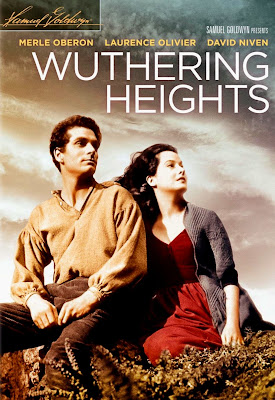
WUTHERING HEIGHTS (Samuel Goldwyn 1939) Warner Home Video


Emily Bronte’s Wuthering Heights has been a cornerstone of British literature practically ever since its publication in 1847. The novel’s gothic moodiness and grueling depictions of mental and physical cruelty found modest indifference amongst Bronte’s contemporaries. Still, the novel’s reputation has steadily grown thereafter and ever since. So, what would Bronte have made of William Wyler’s 1939 cinematic version? As scripted by Ben Hecht, Charles MacArthur and John Huston, the film basically lops off the last fifteen chapters of her book to concentrate almost exclusively on the doomed romance between a very temperamental Catherine Earnshaw (Merle Oberon) and her sinister, long suffering paramour, Heathcliff (Laurence Olivier).
Even so, Wuthering Heights is remarkably faithful to the first fifteen chapters of Bronte’s masterwork; heavily influenced by Wyler’s light touch when dealing with textually dense subject matter, and immeasurably aided by Laurence Olivier’s compelling portrait of all consuming self-loathing. Today we forget that the creative zeitgeist that was Laurence Olivier had yet to prove his metal in the movies. In fact, Olivier’s initial foray in Hollywood almost didn’t happen; his looks judged as lacking that necessary spark of rugged handsomeness that American movie audiences crave in their male stars. But Olivier had another strike against him; his extramarital relationship with the equally unknown Vivien Leigh – who would make a name for herself even greater than Olivier’s in Selznick’s Gone With The Wind this same year.
Between producers Samuel Goldwyn and David O. Selznick it was mutually decided that Olivier and Leigh could not live together during the making of either movie. The hypocriticalness of the Catholic League of Decency forbade ‘living in sin’ – at least, in theory, while all too readily turning the other cheek to Hollywood’s hedonism behind closed doors elsewhere. In truth, neither Goldwyn nor Selznick much cared what Leigh and Olivier did in private so long as they kept their liaison guarded from the press and the paying public. Then, Hollywood prided itself on perpetuating the myth of perfect people with high moral character in all things, living idyllically amongst the swaying palms. Obvious, it served a purpose – that of sweet escapism during the Great Depression.   
Wyler’s Wuthering Heights lacks the gothic feel of Bronte’s novel; James Basevi’s production design owing more to the school of stark German expressionism a la Universal horror movies from this vintage. Gregg Toland’s deep focus cinematography merely hints at the pervasive cynicism that plagues the manor house, while the atmosphere at Thrushcross Grange – the adjoining property - is as warm and stately as any estate featured in Architectural Digest. For obvious reasons, this contrast between the Grange and Wuthering Heights – the ancestral home of the Earnshaw family, serves as visual counterbalance. It works. It just isn’t particularly indigenous to Bronte’s original intent.
Our tale begins with the arrival of Mr. Lockwood (Miles Mander), the new tenant of the grange, to Wuthering Heights; the bleak manor house nestled atop the craggy moors.  Lockwood has lost his way in the dark and in the middle of a harrowing blizzard. He is bid entrance into the dark cavernous interior by stoic footman, Joseph (Leo G. Carroll). However, Lockwood quickly discovers a dower mood permeating the rest of the household who have assembled to warm themselves near a roaring fire. Housekeeper, Ellen (Flora Robson) and Heathcliff’s wife, Isabella (Geraldine Fitzgerald) cast careworn, bitter and accusatory glances in Lockwood’s direction, their contempt paling to the abrupt tongue-lashing that the sunken-eyed, gray haired lord of the manor, Heathcliff (Laurence Olivier) gives his guest.
Lockwood is reluctantly permitted lodgings for the night inside an abandoned bridal chamber upstairs – a desolate room with no furniture, save a very uncomfortable bed. But midway through his slumber, Lockwood is awakened by the cries of a young woman calling out to Heathcliff from Peniston Crag. Alarmed by this apparition, Lockwood shouts for Heathcliff, who burst into the room admonishing his guest, then ordering him out before rushing to the window in the hopes of seeing it with his own eyes. Hearing an all too familiar voice faintly call to him from the Crag, Heathcliff ventures into the storm shouting “Cathy!” Lockwood tells Ellen what he has seen and she confirms that the spirit at his window must have been that of Cathy Earnshaw.
We regress in flashback to the Wuthering Heights of Cathy’s youth – a rugged, but thriving estate overseen by a benevolent patriarch (Cecil Kellaway). Mr. Earnshaw has just returned from a trip to London with Heathcliff (Rex Downing); a boy he rescued from certain death in the slums. The two are met on horseback at the gate by Dr. Kenneth (Donald Crisp) and by Earnshaw’s children, Cathy (Sarita Wooten) and Hindley (Douglas Scott). Dr. Kenneth cannot understand what has prompted Earnshaw to bring this rather belligerent urchin into his home, while Hindley and Cathy are immediately insulted at the prospect of having to share what they have with Heathcliff.
While Cathy’s ignorance quickly abates, Hindley harbors resentment and jealously toward Heathcliff that will only continue to fester and ripen with time. Cathy and Heathcliff become inseparable; sharing long passionate rides on horseback to Peniston Crag. Cathy suggests the Crag for their imaginary castle and Heathcliff declares Cathy to be his queen. Upon Mr. Earnshaw’s death, Hindley immediately asserts himself as master of Wuthering Heights and relegates Heathcliff to the stables as his servant. As the years pass, Hindley’s hatred of Heathcliff consumes his every thought. Hindley (now played by Hugh Williams) becomes slovenly, ill-mannered and even more ill-tempered – wiling away the hours with petulant insults and whittling down his family’s fortunes with mounting gambling debts.
Cathy and Heathcliff take rides to Peniston Crag where Cathy confesses her undying love; yet, in the same breath she encourages Heathcliff to go away and make his fortune so that they might live together far away from Hindley’s influence and in resplendence and luxury. Hearing music coming from the grange, Cathy and Heathcliff follow the sound. The two come upon a lavish estate currently managed by Edgar Linton (David Niven) in the midst of an elegant dinner party. Cathy is immediately enamored with the courtly elegance and social graces of the guests. However, their secretive presence arouses the Linton’s Great Danes who attack and wound the pair as they attempt to flee in terror from the grounds. Cathy is carried into the parlor by Edgar, her bloody ankle immediately attended to by Dr. Kenneth. But Heathcliff, who has been bitten in the arm, is virtually ignored. Edgar and his guests are insulted by Heathcliff’s admonishment of them, even though their manners have been equally lacking toward him.
Cathy tells a very reluctant Heathcliff to return to Wuthering Heights. In the weeks that follow her recuperation, Cathy is lovingly tended to by Edgar’s sister, Isabella at the grange, while Edgar quietly becomes smitten with her – even dressing Cathy in some of Isabella’s more fashionable clothes for her return. But upon Cathy’s arrival to Wuthering Heights, Heathcliff immediately criticizes her for putting on airs. Edgar gallantly challenges Heathcliff, demanding that he apologize at once, but Cathy instead takes Heathcliff’s side against Edgar – ordering him off the estate.
Cathy’s sexual frustrations gnaw away at her and will not abate. She desperately wants to belong to Edgar’s world but will forever be a part of Heathcliff’s heart – the two apparently cut from the same fiery and very self-destructive cloth. In the novel, Cathy and Heathcliff express their love more concretely at Peniston Crag. However, under the scrutiny of the production code, no such lustful liaisons occur in the film. Nevertheless, as time passes Cathy is again lulled to pursue a relationship with Edgar; simultaneously growing wearier of Heathcliff’s lack of initiative and utter complacency to remain in service to her vial brother. Sensing that he might lose his beloved forever, Heathcliff departs for America in a rage. His intensions unknown, in a moment of weakness Cathy decides to marry Edgar instead.
The years pass. Hindley has squandered most of the family’s money on drink and gambling debts. He lives with Joseph in the squalor that once was his proud ancestral home. Ellen has since moved into the grange with her mistress. Cathy and Edgar are contented; he more so and utterly blinded to her ardor, adoring his wife completely, while tolerating her infrequent bouts of melancholia. However, with Heathcliff’s return whatever happiness Edgar and Cathy might have shared is immediately shattered. The years have been good to Heathcliff. He has amassed a small fortune with all the trappings of a gentleman, but still utterly lacking in the more gentile social graces.
Heathcliff has paid off Hindley’s mounting debts in secret. Thus, Wuthering Heights now belongs to him. Heathcliff taunts Hindley with foul insults and drink, destroying his sense of pride and his health, effectively making Hindley a servant in his own house. But Heathcliff’s wicked desire to command and/or consume those who have done him wrong will not rest. He now turns his attentions to Isabella – still a dewy-eyed green girl - who regards him as a sinfully romantic figure. Seducing Isabella for the express reason of ruining her sisterly relationship with Edgar and to stir up jealousies in Cathy’s heart, Heathcliff makes Isabella his wife. Their marriage is loveless and Isabella quickly realizes that Cathy’s previous forewarning of her looming unhappiness, should she pursue Heathcliff, has come to pass. Curiously, Isabella does not blame Heathcliff for this lack of affection, but rather Cathy, whom she believes has stolen her husband’s heart and will always remain a threat while she lives.
Cathy, who has taken off on horseback during a violent thunderstorm to console her grief, falls ill. Her unspoken confession of love for Heathcliff shatters Edgar’s faith in their marriage. Realizing that she has painted herself into an impossible corner, Cathy lays in bed, waiting to die. Learning of her grave condition, Heathcliff barges into her bedroom with Ellen’s complicity. Yet his final words to Cathy are both a conflicted confession of his own feelings and a final admonishment of her decision to forgo their obvious love in favor of living a lie with Edgar. Heathcliff carries Cathy to the window so that they can gaze out at Peniston Crag together one last time. She dies in his arms and Heathcliff declares before Edgar and Dr. Kenneth that Cathy must not ever leave him, but continue to haunt his wicked heart and soul with her enduring memory.
We return to the present with the glimmer of a new dawn cresting over the window sill. Astonished by Ellen’s story, Lockwood is even more amazed when Dr. Kenneth burst into the room to suggest that he saw a man and a woman walking hand in hand toward Peniston Crag. Yet only Heathcliff’s frozen remains have been discovered. “Is he dead?” Lockwood inquires. Dr. Kenneth nods. But Ellen reassuringly assesses that “It was Cathy! No – not dead, Dr. Kenneth. And not alone. He’s with her. They’ve only just begun to live.” The final shot in the film shows a snowy Peniston Crag with the apparitions of Cathy and Heathcliff in their prime, ascending its rocky cliffs.
Despite its lack of faithfulness to Bronte’s novel, the filmic Wuthering Heights is an enduring melodrama; the obsessiveness in the ill-fated romance so palpable and, at times terrifying, that we can almost forget the last third of the book in its entirety. In the novel, Heathcliff and Cathy both have children by their respective spouses, the offspring later pursuing their own conflicted fascinations, thus ensuring that the cyclical nature of their parent’s haunted affair has not perished. This generational renewal is absent from the movie, but it really doesn’t matter because the performances throughout are quite simply very good. Laurence Olivier and Merle Oberon sell this strangely compulsive dedication of Bronte’s bitter lovers with a palpable sense of tragedy that grows ripe upon renewed viewing. We not only sense their erotic exacerbation, but can genuinely empathize with their bizarre desires to, at once, possess, consume, punish and, ultimately destroy each other.
Olivier, whom I generally have found rather stilted on film, and never much regarded as a ladies man, herein exudes a brutal manliness that is very exhilarating and sexually charged. His Heathcliff is a disturbing sadist – annihilated by some inexplicably awful passion, and yet, even more uncannily a figure worthy of our empathy, understanding and forgiveness. Merle Oberon has a much tougher hurdle to overcome. Her Cathy must go through a transformation – a greedy girl brought to heel at the rule of her own craving for Heathcliff that ultimately finishes her indomitably proud spirit. For the most part, Oberon manages this coup quite nicely – despite the fact that the film’s ultra-condensed narrative and very meager 103 min. run time often forces her to ricochet between these polar opposites from scene to scene.
William Wyler’s direction seems effortless. But it just seems that way. Behind the scenes, Wyler toiled and took great pains to handcraft his narrative into an impeccable example of the Hollywood system at its zenith with all its varied creative pistons firing at full steam. His attention is invisible to the naked eye as it should be, yet intangibly evident in every single frame of the finished film. There have been many interpretations of Bronte’s novel in film, television, radio and on the stage in the intervening decades; some far more faithful to the book –  but none as poetically realized or as enduring as this 1939 five star weepy.
If only we hadn’t Warner’s abysmal DVD transfer to cry over this might have been a highly recommended video reissue. Wuthering Heights has long been absent from home video. After its initial release from HBO, the movie all but disappeared. MGM/Fox never put out a competing edition after acquiring the rights to the Samuel Goldwyn library. Only after viewing Warner Home Video’s shoddy efforts – derived from the same fundamentally flawed elements – can we perhaps truly appreciate the reason why Wuthering Heights has been MIA for so many years.
The original film elements are in a delicate state of disrepair. Age related wear and tear is present everywhere. Worse, contrast levels have been bumped up, fading fine details throughout. The mid register tonality in the gray scale is gone, leaving blooming whites and murky blacks. But the worst offender is edge enhancement, present everywhere and wreaking havoc that thoroughly distracts from one’s viewing experience. The audio is mono as originally recorded, with minute traces of hiss and pop. Very disappointing, indeed. With the acquisition of the Goldwyn library I had hoped Warner Home Video would take the high road when reissuing this long absent catalogue title. Sadly, they have not.  Bottom line: not recommended.   
FILM RATING (out of 5 – 5 being the best)
4
VIDEO/AUDIO
1
EXTRAS
1

Wednesday, January 16, 2013

THE BEST YEARS OF OUR LIVES (Samuel Goldwyn 1946) Warner Home Video


I know of no other movie in cinema history that can justly be considered both as perfect entertainment and as nourishment for the nation’s collective soul. But director William Wyler’s The Best Years of Our Lives (1946) is arguably both - its poignantly disquieting critique of the changing American landscape G.I.s faced upon their return from WWII resonating with audiences then and delivering a potent message that time has been powerless to disavow since. By 1946 Hollywood’s interpretation of the war had decidedly shifted from more glamorous fare like Mrs. Miniver (1942) and Since You Went Away (1944) to frank and sobering reflections. The harshest realities would not surface on celluloid for a few decades more, perhaps because the Hollywood moguls wisely perceived that those who had lived through the hardship wanted to place their painful memories in the past and move forward.
However, the transition from war to peace time would prove anything but smooth for thousands of returning veterans. Grittier critiques (Twelve O’Clock High 1949) examining the psychological fallout of war would all come later. But The Best Years of Our Lives captures the truthful essence of that hopeful anxiety facing the conquering hero; his re-assimilation into a complacent civilian world, perhaps even misplaced as a distant dream, already moved on without him.
Written by Robert E. Sherwood and Mackinlay Kantor, The Best Years of Our Lives charts this bittersweet and occasionally very awkward period of transition with frankness, honesty and a sense of empathy. Director William Wyler had the original ailment of post-traumatic stress syndrome shifted from the character of Homer Parrish, the sailor, to Fred Derry, the pilot bombardier and then actively sought out Harold Russell – a real life double amputee – for the role of Homer; the only non-actor in the film’s ensemble cast. Russell’s performance proved so enigmatic as the linchpin of the story that he won two Oscars; one for Best Supporting Actor, the other an honorary statuette in acknowledgement of his extraordinary bravery in bringing social acceptance about for the physically disabled.
The three service men whose lives become intertwined once their uniforms have been shelved in mothballs are bombardier Fred Derry (Dana Andrews), platoon sergeant, Al Stephenson (Fredric March) and sailor Homer Parrish (Harold Russell); men of varying social backgrounds brought together in the twilight’s last gleaming after D-Day as they travel back to their home town of Boone City in the nose of a B-52. Anxious for different reasons, Homer, Fred and Al quietly observe the relatively unchanged landscape of their home town by air, taking comfort in the fact that most of what they see is sweetly familiar. But the similarities witnessed from above are, of course, superficial and cosmetic. For upon closer inspection at ground level it becomes immediately apparent that the community around them has changed, the ground beneath their feet having shifted further still.
Fred and Al are quietly impressed by Homer’s agility, and perhaps even more with his seeming sunny outward optimism. Despite the loss of both hands from burns sustained after his aircraft carrier was sunk, Homer is able to sign his name with a pen, carry his own duffle bag, and even light a cigarette using his prosthetic metal hooks. After their plane ride, the boys share a cab. Homer points out Butch’s Bar – an old haunt owned by his uncle that he, Fred and Al vow to return to once they have settled into their old lives. But as the cab approaches Homer’s address his confidence drains. He nervously suggests they turn around and have a drink at the bar now, before ‘going home’. Al wisely forces Homer out, saying “You are home, soldier.” But Fred delays the cab a moment as Homer is reunited with his aged parents (Walter Baldwin and Minna Gombell) and former sweetheart Wilma Cameron (played to winsome perfection by newcomer, Cathy O’Donnell).
Al’s reunion with his family is no less poignant. He is met at the front door by his stunned and tearful daughter, Peggy (Teresa Wright) and overjoyed son, Rob (Michael Hall); encouraging both to keep his arrival a secret from their mother, Milly (Myrna Loy) until she suddenly becomes aware of the deafening silence in the next room, emerging from the kitchen with her simple joy fulfilled at being reunited with her husband.
The least welcome of all the homecomings is Fred’s; returning to a cramped little shack he once shared with Marie (Virginia Mayo); the war bride he married on the fly while still in basic training. Marie is a heartless creature, more enamored with Fred as a flyer than she is with him as a man – even less so when he informs her that due to limited employment opportunities he is returning to his former career as a drug store soda jerk. Marie, who has since become a cocktail waitress at a nightclub, is accustomed to high times and wild parties. She wants excitement, money and uninhibited fun; tangibles that Fred can neither afford or finds particularly unattractive since his sobering return from the war. 
Al’s future is hardly as bleak. In fact, the bank where he once worked has offered to reinstate him with a promotion and a raise, viewing his war record as an asset when dealing with other vets seeking loans from the bank. Al gratefully accepts this position, but like his two contemporaries, has already begun to suffer from some deep seeded social angst. In Al’s case, he manages to console his reoccurring fears with alcohol. When the bank decides to hold a dinner in his honor, Al regrettably arrives mildly inebriated but still manages to impart an eloquent speech that champions the bank aligning its interests to help servicemen rebuild their lives in a country whose precepts they defended in the war.   
Meanwhile, the relationship between Homer and his parents becomes strained. Mrs. Parrish in particular cannot bring herself to anything but tearful frustrations over the loss of her son’s hands while Homer’s father seems unable to articulate his worried confusion beyond evasive reflections about the past. Although engaged to Wilma before the war, Homer now encourages her to leave him and seek her happiness elsewhere. But Wilma has been in love with Homer for many years. The loss of his hands has not changed her affections and she remains steadfast in her devotion – not out of a sense of pity or even moral duty – but from a genuineness and unerring love that Homer is reluctant to realize as pure of heart.
Peggy and Fred accidentally meet after she arrives to collect her father from Butch’s Bar where the three old buddies have reunited to drink themselves into oblivion. On the surface Fred pretends that his life is solid and secure. But nightly he suffers from terrors and sweats that Marie is unable, or perhaps unwilling to tolerate. Fred takes comfort from Peggy, who finds Marie utterly shallow. An unexpected spark of romance kindles between Peggy and Fred. This infuriates Al and he orders Fred to stop seeing his daughter.     
Realizing that Al only has Peggy’s best interests at heart, Fred reluctantly agrees to steer clear of her, but thereafter begins to resent Al’s self-righteousness. Homer comes to the drug store where Fred is working, but is dealt a blow by an obnoxious customer who suggests that the war was fought against the wrong enemy. An altercation ensues and Fred loses his job as a result. Afterward Fred and Homer share a heart to heart and Fred, ever loyal and encouraging, tells Homer he should marry Wilma with all speed. Fred even offers to be Homer’s best man.
However, upon returning home in the middle of the day, Fred discovers Marie locked in a passionate embrace with Cliff (Steve Cochran). Marie tells Fred that she has decided to divorce him because he is a failure – at least, in her books. Briefly believing this snap assessment himself, Fred tosses his father (Roman Bohnen) the various medals and citations he earned during the war, glibly suggesting that they were “passed out with the K-rations”. Realizing what a war hero his son is Mr. Derry encourages Fred to remain in town. But Fred wants out and fast. He books himself on a waiting list for the first outbound plane to anywhere, but then takes a side trip to the nearby war airplane graveyard where vivid memories of combat leave him momentarily despondent.
When Fred is interrupted by the boss of the work crew salvaging the aircraft’s aluminum for scrap, he finesses his way into a job to help with the disassembly.  Having resurrected his future from the ashes, Fred decides to pursue Peggy once more. Meanwhile, Wilma tells Homer that her parents have decided to send her away, presumably to forget him. At first, Homer believes this is the best for all concerned, but when Wilma makes it pointedly clear that her place is with him, Homer realizes how much she still loves him and agrees to marry her.
True to his word, Fred stands up for Homer in the wedding. Newly divorced, Fred eyes Peggy from across the room during the service and later, he and Al reach a tentative reconciliation in their fractured friendship. Fred approaches Peggy with the understanding that it may be years before he can find true comfort in civilian life; but reassesses that none of it will mean anything if she is not at his side. The honest gesture is enough. Peggy smiles and kisses Fred, the promise of their life together finally secured.
The Best Years of Our Lives is a flawless, unvarnished masterpiece; perfectly scripted and peerless in its acting. It remains the cinematic touchstone by which all other home front melodramas are judged. The real magic of the film is that it seems more genuine than manufactured; its’ mid-town America backdrop palpably atmospheric and true to life. Director William Wyler evokes the heartfelt without veering into sentimental treacle. None of his actors overplay their hand. Of the lot, Dana Andrews and Teresa Wright strike a perfect chord; symbolic of the ‘new American’ optimism about what the future may bring. Cathy O’Donnell’s screen debut is as impressive; her sad-eyed tenderness the perfect foil for Harold Russell’s wounded pride. Is it any wonder then that The Best Years of Our Lives took home Best Picture honors at the Academy Awards?
Warner Home Video’s pathetic reissue on DVD is a ‘money grab’ if ever I saw one.  There had been rumors that The Best Years of Our Lives was being gussied up for a Blu-ray release. That would have been much appreciated because The Best Years of Our Lives has never looked anything but utterly abysmal on DVD. I recall purchasing the title back in 1997 when HBO was distributing the movie. But then the Samuel Goldwyn library fell into the holdings of MGM and then MGM/Fox, who wasted no time re-issuing the same tired old transfer over and over again.
Contrast is blown out with stark whites and a loss of mid-register gray scale. A ton of age related artifacts intrude as does some rather heavy edge enhancement. Are there any improvements over previous editions on DVD? NO!!! Warner has merely lopped off the old MGM/Fox logos, added a new FBI warning and redressed the keep case cover art to reflect the DVD reissue as part of their Samuel Goldwyn library. What a crock and a sham!  The audio is mono and adequate, though hardly exceptional. We get two tired snippets, billed as interviews with Virginia Mayo and Teresa Wright and an even more pathetically worn theatrical trailer. For shame! For Shame, and decidedly not recommended!
FILM RATING (out of 5 – 5 being the best)
5+
VIDEO/AUDIO
1
EXTRAS
1

THE BISHOP'S WIFE (Samuel Goldwyn 1947) Warner Home Video


How does a frustrated Episcopal bishop thwart divine intervention and win back the affections of his wife? This is just one question answered in Henry Koster’s triumphant romantic fantasy, The Bishop’s Wife (1947). Not particularly well received upon its’ initial release, today the film is widely regarded as a holiday classic and rightfully so. With each passing year, and from our current moral ambiguity perpetuated by a Hollywood that seems more proficient at exorcising our nightmares than indulging our dreams, it becomes glaringly obvious how profoundly professional the old studio system was at hand-crafting such effervescent holiday fare. Of course they were working with extraordinary talent both in front of and behind the camera; the elegant Cary Grant herein cast as a celestial messenger; David Niven, his obtusely belligerent and perpetually frustrated fop, and Loretta Young the very picture of gentle grace in feminine fortitude. 
The Bishop’s Wife continues to work its magic, delivering its blessed message of goodwill, because its stars outshine the obviousness and absurdity of its story. Adapted by Leonardo Bercovici and Robert E. Sherwood from a novel by Robert Nathan The Bishop’s Wife tells the tale of two men challenged in their faith. The first, Bishop Henry Brougham (Niven) has been driven to distraction by his own ambitions. But the otherworldly creature sent in reply to his prayers harbors an even more complex, and perhaps slightly sinister desire to experience human love one last time. This struggle of wills is ultimately distilled into a traditional confrontation between two men vying for the affections of the same woman. But the broader implications of how a God-sent miracle could inadvertently become untrustworthy and perhaps even destructive to the humanity it has been sent to serve, tests the boundaries of Christianity in all sorts of subliminally fascinating ways.   
Like another truly inspired holiday classic, Frank Capra’s It’s A Wonderful Life, a darker undercurrent of faith emerges in The Bishop’s Wife; one that will challenge our protagonist’s resolve. For Dudley (Grant), presumably heaven sent to assist the bishop in his work, is hardly as pure of heart, faith or motive as his outwardly cordial façade suggests. Before long Henry realizes that in wishing for one dream he may have inadvertently sacrificed another – the singular bliss he once shared with his wife, now fast slipping away in the arms of this ethereal interloper.  
As our story begins Bishop Brougham has been toiling for months on plans for the new George B. Hamilton memorial cathedral. Funding for the project has reached an impasse with stoic widow, Mrs. Hamilton (Gladys Cooper) who demands that its religious iconography take on the continence of a shrine to her late husband. Losing sight of his commitments to his own family, wife Julia (Loretta Young) and young daughter, Debbie (Karolyn Grimes), as well as his flock of parishioners, Henry seeks a moment of clarity from God. But he also needs to be taught a lesson.
Enter the charming, yet devious angel, Dudley (Cary Grant). The truth of Dudley’s being is revealed only to Henry. Yet Dudley wastes no time sparking a romantic longing within Julia, although not necessarily for her husband. Indeed, Dudley’s arrival is both a blessing and a curse; steering Julia toward a series of playful dalliances that gradually motivates her to question her loyalty to hearth and home. But is it Dudley’s intent to elevate these tension between Henry and Julia merely to prove a counterpoint that will reawaken Henry’s feelings toward his own wife, or has the angel disavowed his true calling to pursue a mortal woman for his own advantage? We’re never entirely certain. The actors, particularly Grant, exercise their motivations with an ambiguousness that suggests anything is possible. Our angel is trustworthy to a point, but hardly perfect. He can be tempted, at least enough to defy the powers of heaven and earth for a chance to satisfy dormant, though never entirely forgotten earthly urges.
After the bishop is detained with another round of committee meetings, Dudley surprises Julia with an impromptu visit to the park where she has taken Debbie to play. The child is engaged in a rousing snowball fight before being sent off with the bishop's scatterbrain housekeeper Matilda (Elsa Lanchester). This frees Julia to experience a luncheon date with Dudley at Chez Michel, the restaurant where Henry proposed and the place in which so many happy memories for Julia exist from those bygone days. Again, the moral ambiguity in Dudley’s purpose make these scenes crackle with an unexpected romantic longing; both satisfying yet double-edged. Dudley reads Julia’s palm explaining, "I see a woman who is adored...you were born young and that's how you'll always remain." But is this a moment of sincerity designed to rekindle the past for her or mere cheap flattery contrived to woo Julia away from it and into Dudley’s arms?
The film’s central narrative is mildly complicated by the introduction of a tertiary character, the curmudgeonly Professor Wutheridge (Monty Woolley) who has been struggling for many years to write his history text book about the Roman world - a project effectively ruined when Mrs. Hamilton had Wutheridge fired from the university because of his 'progressive' teaching. Wutheridge is an ardent admirer of the female sex and regards Julia as one of the finest women he has ever known, telling Dudley, “If you want to know about a woman ask the old men…they know!” Dudley lies to Wutheridge about having been a pupil of his long ago in Vienna, then sets about rekindling the disgraced academic’s verve for scholarship by revealing to him a rare ancient coin that might have been used during Caesar’s time. Wutheridge, Dudley and Julia share an intimate afternoon of discussion inside the professor’s apartment where Julia confides her sadness over the way their lives have shifted away from the friends they once cherished.
Orchestrating yet another diversion for Henry that will detain him at the widow Hamilton’s estate, Dudley accompanies Julia to Henry’s old parish, St. Timothy’s where he was supposed to attend a boys’ choir rehearsal that Dudley knows well enough he cannot.  In one of the film’s most deliberate exaltations, Dudley wills the boys who have yet failed to arrive on time into a choral mass of heavenly voices. Afterward, Dudley escorts Julia past the window of a hat shop. Earlier Julia had admired a bonnet in its display case that she restrained from buying because of its extravagance.  Now Dudley encourages her to indulge in what Julia refers to as ‘her wickedness’. He further promotes her delinquency from returning home after the rehearsal by suggesting that they hail a taxi to Central Park where they do indeed enjoy a moonlit skate with their cabdriver, Sylvester (James Gleason); whose own faith in humanity is restored shortly thereafter.
Returning home much later, Julia incurs Henry’s impatience and the mood between husband and wife sours. Henry re-channels his jealous toward Dudley, ordering him from the rectory. Dudley obliges, but playfully warns Henry that he will be back. The following afternoon Dudley makes good on this promise, engaging Debbie in the story of Daniel and the lion – beautifully retold with wide-eyed simplicity to appeal to the child in all of us. Rewriting Henry’s Christmas blessing after having dismissed his secretary, Mildred Cassaway (Sarah Haden), Dudley arrives at the widow Hamilton's stately manor under the pretext of having come on a matter for the church.
Instead he plays a composition by the late Allen Cartwright - the only man Mrs. Hamilton ever loved but ultimately the lover she cast aside for the security that her late husband's money could afford. It is implied that this wounding of their mutual affections resulted in Cartwright’s premature death – a burden Mrs. Hamilton has carried close to her heart ever since. Hearing the composition played on the harp in her living room, the widow Hamilton is stirred to kindness; the experience ultimately softening her resolve towards the bishop. Thus, when Henry and Julia arrive much later that same evening to finalize plans for the cathedral, they learn that Mrs. Hamilton has decided instead to disseminate her worldly funds to the poor and the needy as they require it.
Bitter that his cathedral shall never rise, Henry returns home more distraught than ever. Dudley makes his most obvious play for Julia, a move that utterly convinces her she loves her husband more than ever. In response to making her cry, Henry challenges Dudley to an earthly conflict, one narrowly averted when Dudley reasons that he has made Henry aware of the wellspring of his own affections toward Julia at long last. Removing himself from the family’s home once and for all, Dudley also erases his memory from the Brougham’s minds and hearts. They have forgotten this strange ethereal man who has resurrected their passion for one another, but moreover blessed them with the true spirit of Christmas. As Henry delivers Dudley’s sermon from St. Timothy’s pulpit – oddly enough believing it to be his own – we see Dudley quietly observing his own words repeated to him from just beyond the church’s front gate, the angel left to wander the darkness after having left behind so much otherworldly light. 
The Bishop’s Wife was independent producer Samuel Goldwyn’s personal production; an elegant holiday tale that ultimately developed into so much more. Hugo Friedhofer’s inspired score elevates the gentle unassuming romantic elements while keeping the comedic undertones in balance with the ever so slightly moody undercurrents in the story. In the embodiment of Cary Grant, there is more than just a genuine sense of unearthly presence. Veering between naughtiness infused with a saintly veneer, Grant is believable as the angel with a personal agenda. Indeed, the Cary Grant persona – usually referenced as the urbane sophisticate - herein suggests something slightly more dangerous yet utterly more appealing; immediacy to the man that dispels the clichéd iconography of what we perceive to be an ‘angel’. And Grant repeatedly, and perhaps even deliberately, relishes testing these limitations without becoming a detriment to the character.
The film is equally blessed by its two supporting stars: David Niven and Loretta Young. Young embraces a high morality and proud ideals of the devoted wife and mother without becoming preachy, saintly or wistfully lost in the purity of the part. Julia Brougham may be the bishop’s wife, but she has a mind and a stubborn will of her own – exercised and tested by Dudley’s more spurious intensions toward her. And it is to Young’s credit that she manages a contented, almost regal kindness throughout the film that never sinks her part into the treacle of rank sentiment. As for David Niven: in a role that might have reduced him to mere caricature – a dupe for the comedy – the actor instead manages to evoke a more intimate sadness. We feel for Henry Brougham, even as he seems incapable of seeing the error of his ways. That intangible empathy is impossible to quantify but pure gold to behold. And in the final act it remains a majestic epitaph delivered with poetic, yet understated grace that lives on long after the houselights have come up.
"Tonight I want to tell you the story of an empty stocking. Once upon a midnight clear, there was a child's cry, a blazing star hung over a stable, and wise men came with birthday gifts. We haven't forgotten that night down the centuries. We celebrate it with stars on Christmas trees, with the sound of bells, and with gifts. But especially with gifts. You give me a book, I give you a tie. Aunt Martha has always wanted an orange squeezer and Uncle Henry can do with a new pipe. We forget nobody, adult or child. All the stockings are filled, all that is, except one. And we have even forgotten to hang it up. The stocking for the child born in a manger. It's his birthday we're celebrating. Don't let us ever forget that. Let us ask ourselves what He would wish for most. And then, let each put in his share, loving kindness, warm hearts, and a stretched out hand of tolerance. All the shinning gifts that make peace on earth."
I find the DVD reissue of The Bishop’s Wife utterly perplexing – particularly as it arrives in the middle of January, long after the blush and allure of Christmas has given way to the prospects of the coming New Year. Since this release seems to coincide with no anniversary – either for Samuel Goldwyn, his company or the film itself – the push for this reissue is very oddly placed indeed. Clearly, someone over at Warner Home Video has overlooked the obvious in their overzealousness to squeeze out a few more bucks. Had we been treated to a new digital transfer, the reissue would have been most welcome indeed.
Warner Home Video’s recent acquisition of the Samuel Goldwyn library from MGM/Fox had yielded two very competent Blu-rays of Goldwyn’s Guys and Dolls and Hans Christian Andersen before the holidays. It was anticipated that perhaps The Bishop’s Wife would receive the same meticulous attention to detail. Regrettably, it has not. The old MGM/Fox DVD problematic mastering endures. Although the B&W image can be quite sharp and detailed, there is an extensive amount of edge enhancement and shimmering of fine details throughout this presentation that tends to distract. It’s a genuine shame we couldn’t have had better luck with this title.
On the whole the gray scale is solidly rendered, although several sequences look as though contrast levels have been artificially boosted. Age related artifacts are present but not pronounced. The audio is another curiosity. The Chace audio pseudo-stereo ‘remaster’ is gone, leaving us with the original mono with inherent limitations. Regrettably, like its predecessor, there are NO extras.
FILM RATING (out of 5 – 5 being the best)
4.5
VIDEO/AUDIO
2
EXTRAS
0